.webp)
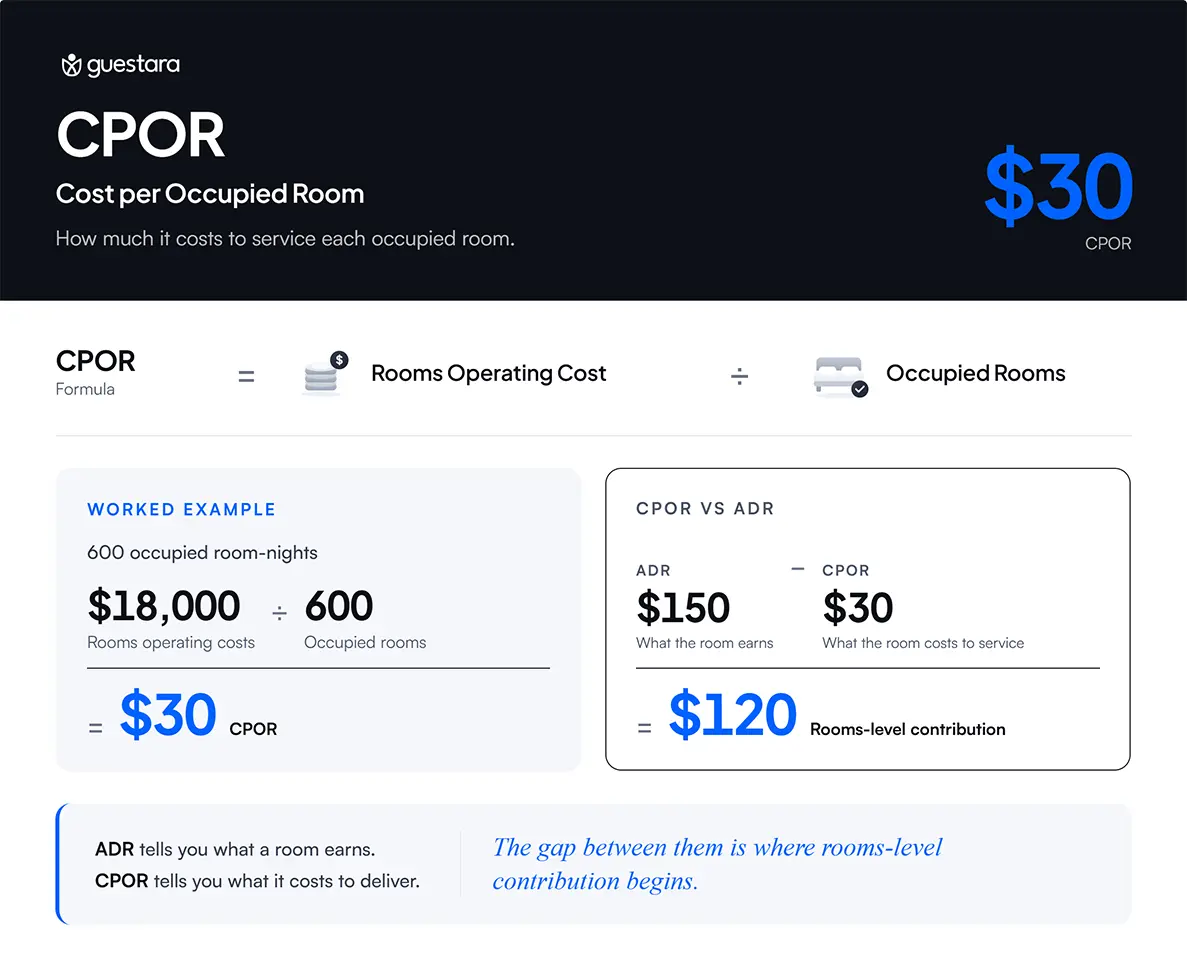
CPOR is the average cost to service one occupied room for a night. Formula: CPOR = Total Rooms Operating Cost / Occupied Rooms. It is the cost-side companion to ADR: the gap between what you charge (ADR) and what a room costs to deliver (CPOR) is where rooms profit lives.
Cost per Occupied Room (CPOR) measures how much it costs a hotel to service each room it actually sells. Most operators calculate it on rooms-department operating costs, the direct expenses of turning a sold room into a stay: housekeeping labor, laundry, guest amenities, cleaning supplies, and room-level utilities.
Some operators also track a broader cost per occupied room that loads in administrative and back-office overhead, to see the full cost each occupied room carries. Either way, CPOR is the natural counterweight to ADR: one tells you what a room earns, the other what it costs.
CPOR = Total Rooms Operating Cost / Number of Occupied Rooms
A hotel records $18,000 in rooms-department costs over a period with 600 occupied room-nights.
CPOR = $18,000 / 600 = $30 per occupied room
Set that against rate. If ADR over the same period is $150:
ADR - CPOR = $150 - $30 = $120 rooms-level contribution per occupied room
That $120 is roughly what each occupied room contributes before undistributed and fixed costs, which is exactly the kind of contribution that rolls up into GOP and GOPPAR.
CPOR turns cost from an abstract line on the P&L into a per-room number you can act on. It does three things well:
A rising CPOR is not automatically bad if it comes with a richer guest experience that supports a higher ADR. The warning sign is CPOR climbing while ADR stays flat, because that quietly compresses the margin on every room you sell.
That back-office overhead is easy to overlook, but it lands on every occupied room. Guestara's hotel payments automates collection and reconciliation, trimming the manual finance work and revenue leakage that inflate the administrative cost sitting behind CPOR.
What it actually costs to service one room for a night.
CPOR is the average cost to service one occupied room for a night. Formula: CPOR = Total Rooms Operating Cost / Occupied Rooms. It is the cost-side companion to ADR: the gap between what you charge (ADR) and what a room costs to deliver (CPOR) is where rooms profit lives.
Cost per Occupied Room (CPOR) measures how much it costs a hotel to service each room it actually sells. Most operators calculate it on rooms-department operating costs, the direct expenses of turning a sold room into a stay: housekeeping labor, laundry, guest amenities, cleaning supplies, and room-level utilities.
Some operators also track a broader cost per occupied room that loads in administrative and back-office overhead, to see the full cost each occupied room carries. Either way, CPOR is the natural counterweight to ADR: one tells you what a room earns, the other what it costs.
CPOR = Total Rooms Operating Cost / Number of Occupied Rooms
A hotel records $18,000 in rooms-department costs over a period with 600 occupied room-nights.
CPOR = $18,000 / 600 = $30 per occupied room
Set that against rate. If ADR over the same period is $150:
ADR - CPOR = $150 - $30 = $120 rooms-level contribution per occupied room
That $120 is roughly what each occupied room contributes before undistributed and fixed costs, which is exactly the kind of contribution that rolls up into GOP and GOPPAR.
CPOR turns cost from an abstract line on the P&L into a per-room number you can act on. It does three things well:
A rising CPOR is not automatically bad if it comes with a richer guest experience that supports a higher ADR. The warning sign is CPOR climbing while ADR stays flat, because that quietly compresses the margin on every room you sell.
That back-office overhead is easy to overlook, but it lands on every occupied room. Guestara's hotel payments automates collection and reconciliation, trimming the manual finance work and revenue leakage that inflate the administrative cost sitting behind CPOR.
Typically rooms-department operating costs: housekeeping labor, laundry, amenities, supplies, and room utilities. A broader definition also allocates administrative and overhead cost per occupied room.
ADR is revenue per room sold; CPOR is cost per room occupied. The difference between them is the rooms-level contribution each occupied room makes, which is why they are read together.
It varies by segment. Luxury and full-service hotels carry higher CPOR than budget properties because they deliver more per room. Benchmark against comparable hotels and judge CPOR against your ADR, not in isolation.
Be careful. A rate above a room's marginal cost can still contribute on a high-need night, but consistently selling below CPOR erodes profit. Use CPOR to understand your floor before discounting.


