Lead-time restrictions are rate and availability rules based on how far ahead of arrival a guest books. Hotels use them to reward early commitment with advance-purchase rates and to protect rate close to arrival, shaping demand across the booking curve. They work best when driven by booking pace, not applied as blanket rules.
Lead time is the gap between when a reservation is made and the date of the stay, also called the booking window. Lead-time restrictions are the rate and inventory controls a hotel applies based on that gap, deciding which rates are available depending on how early or how late a guest books.
The logic behind them is simple: a guest booking three months out behaves very differently from one booking the night before, and their price sensitivity differs too. Lead-time restrictions let a hotel treat those two bookings differently on purpose.
Lead-time restrictions generally work in one of two directions:
Lead-time restrictions are configured as rate-plan rules in the booking engine, PMS, or channel manager. An advance-purchase rate simply will not display once the booking window drops below its threshold, and a last-minute rate will not open until the window narrows to a set number of days.
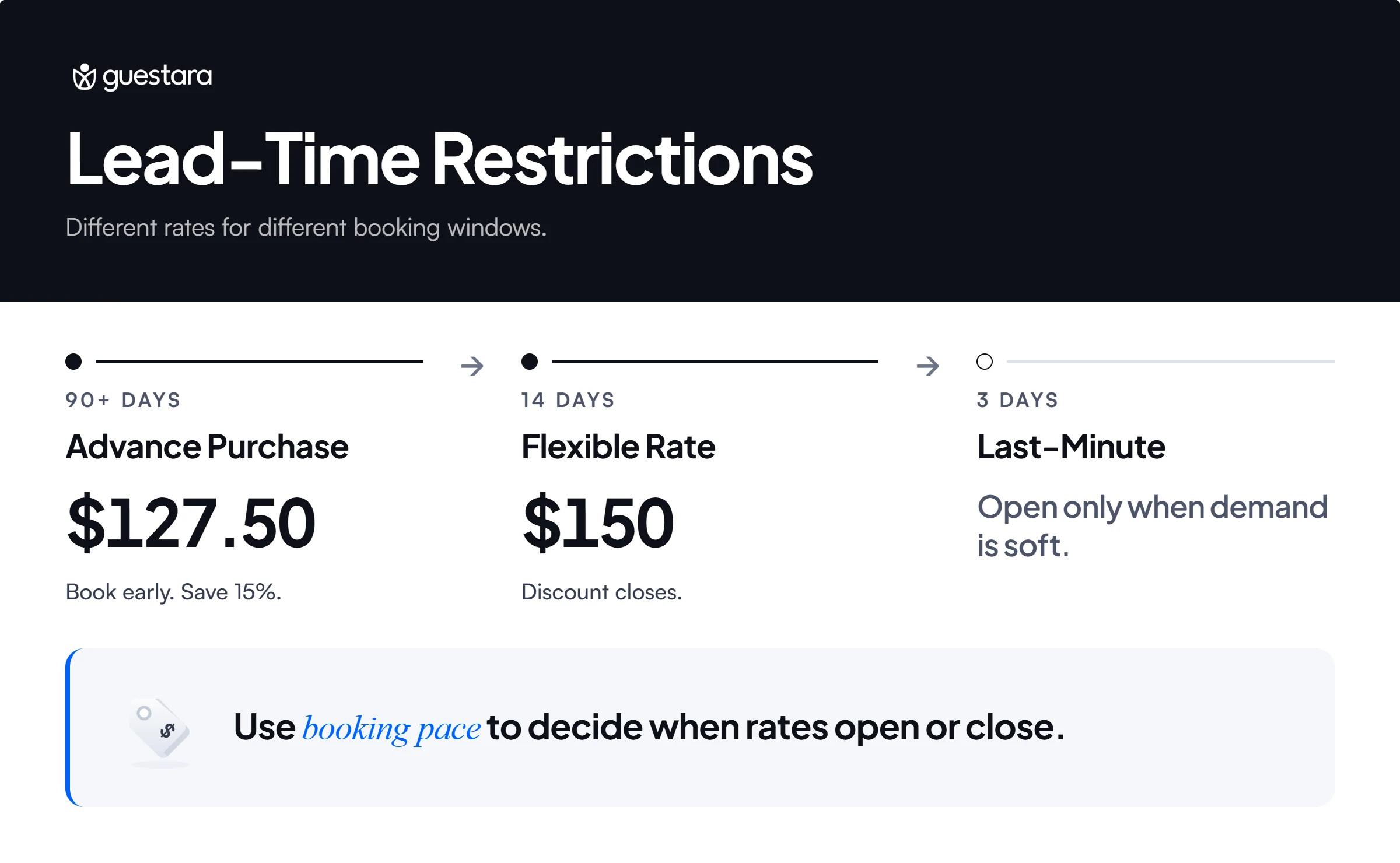
For example, a hotel might publish an advance-purchase rate at $127.50 that disappears 14 days out, then hold its flexible rate at $150 for later bookers, and open a last-minute rate only on soft dates where rooms remain unsold inside 3 days.
Lead-time restrictions are only as good as the demand read behind them. Booking pace, the rate at which reservations come in for a date compared with normal, is the signal that should drive them. When pace runs ahead of forecast, a hotel can close advance discounts earlier and protect rate. When pace lags, it can keep advance rates open longer or open last-minute deals to catch up.
Applied off pace and forecast, restrictions are a precision tool. Applied as fixed, blanket rules, they either give away rate you would have earned or turn away bookings you could have won.
Because these decisions hinge on reading demand well, the intelligence layer matters. Guestara's hospitality AI surfaces demand and booking-pace signals that help inform when to tighten or loosen lead-time controls, so restrictions track real demand rather than a static calendar.
Shape demand by how early, or how late, guests book.
Lead-time restrictions are rate and availability rules based on how far ahead of arrival a guest books. Hotels use them to reward early commitment with advance-purchase rates and to protect rate close to arrival, shaping demand across the booking curve. They work best when driven by booking pace, not applied as blanket rules.
Lead time is the gap between when a reservation is made and the date of the stay, also called the booking window. Lead-time restrictions are the rate and inventory controls a hotel applies based on that gap, deciding which rates are available depending on how early or how late a guest books.
The logic behind them is simple: a guest booking three months out behaves very differently from one booking the night before, and their price sensitivity differs too. Lead-time restrictions let a hotel treat those two bookings differently on purpose.
Lead-time restrictions generally work in one of two directions:
Lead-time restrictions are configured as rate-plan rules in the booking engine, PMS, or channel manager. An advance-purchase rate simply will not display once the booking window drops below its threshold, and a last-minute rate will not open until the window narrows to a set number of days.
For example, a hotel might publish an advance-purchase rate at $127.50 that disappears 14 days out, then hold its flexible rate at $150 for later bookers, and open a last-minute rate only on soft dates where rooms remain unsold inside 3 days.
Lead-time restrictions are only as good as the demand read behind them. Booking pace, the rate at which reservations come in for a date compared with normal, is the signal that should drive them. When pace runs ahead of forecast, a hotel can close advance discounts earlier and protect rate. When pace lags, it can keep advance rates open longer or open last-minute deals to catch up.
Applied off pace and forecast, restrictions are a precision tool. Applied as fixed, blanket rules, they either give away rate you would have earned or turn away bookings you could have won.
Because these decisions hinge on reading demand well, the intelligence layer matters. Guestara's hospitality AI surfaces demand and booking-pace signals that help inform when to tighten or loosen lead-time controls, so restrictions track real demand rather than a static calendar.
A rate or availability rule based on how far in advance a guest books. Advance-purchase rates require booking a set number of days ahead; last-minute controls govern what is available close to arrival.
To capture early, price-sensitive demand and firm up the forecast, often with prepaid or non-refundable terms that bring cash in sooner and reduce cancellation risk.
A lead-time restriction acts on the booking window (how far ahead the guest books). A length-of-stay rule acts on the number of nights. Both shape demand and are often used together.
On dates where booking pace is lagging and rooms are likely to go unsold. On strong dates, restrict late discounts instead, since that demand will arrive without a price cut.


