.webp)
ALOS is the average number of nights guests stay per booking. Formula: ALOS = Total Room Nights / Total Bookings. A higher ALOS usually means lower cost per night and smoother operations, because long stays spread acquisition and turnover costs across more nights.
Average Length of Stay (ALOS) measures how many nights, on average, a guest stays each time they book. It is a simple demand-shape metric: two hotels can sell the same number of room-nights, but the one filling them with fewer, longer stays runs a very different operation than the one turning over a new guest every night.
ALOS is usually expressed in room-nights per reservation, where each booking counts once no matter how many nights it covers.
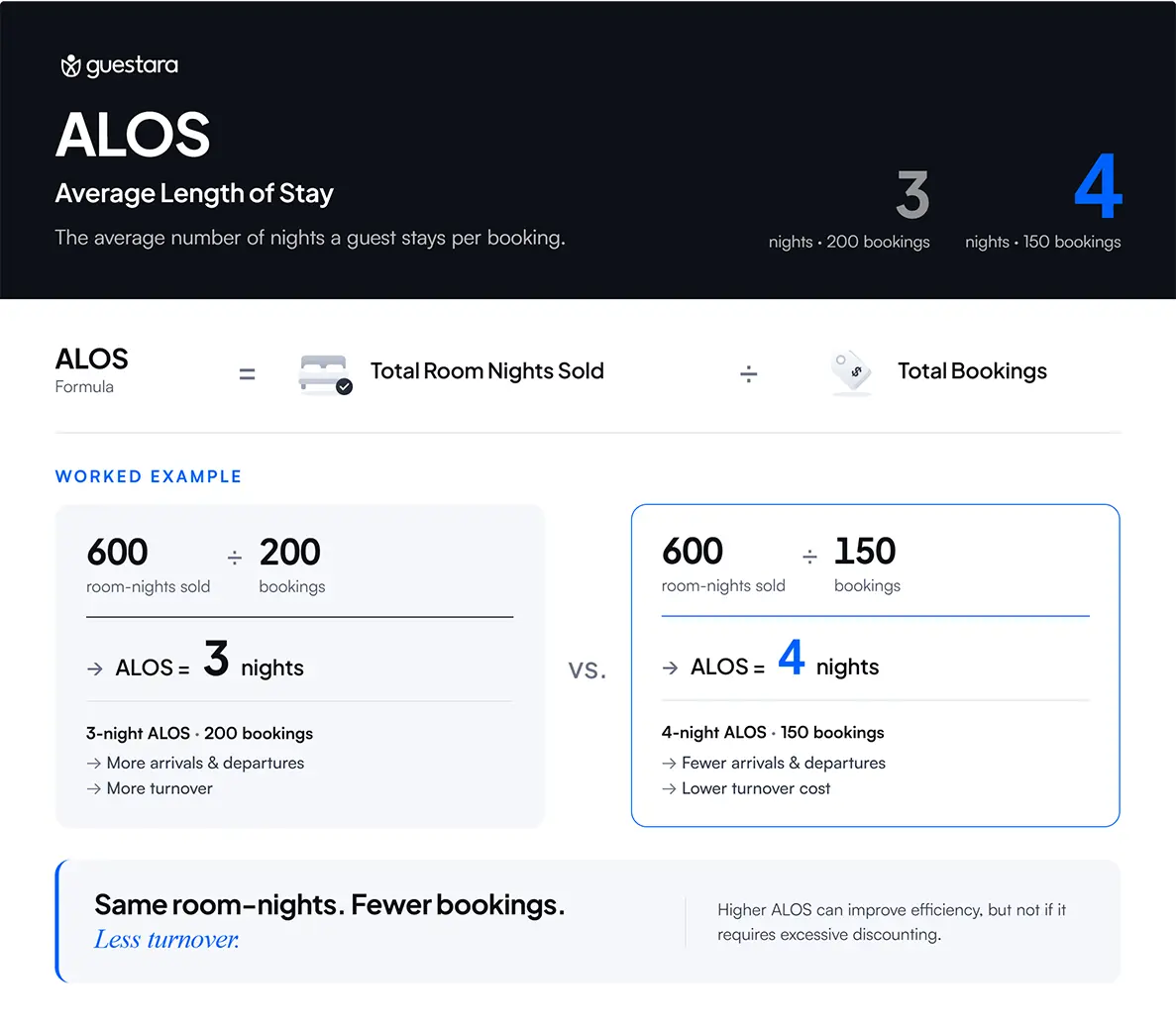
ALOS = Total Room Nights Sold / Total Number of Bookings
In a given month a hotel sells 600 room-nights across 200 bookings.
ALOS = 600 / 200 = 3 nights
If a stronger long-stay mix produces the same 600 room-nights from just 150 bookings:
ALOS = 600 / 150 = 4 nights
Same room-nights, but the second hotel handled a third fewer arrivals and departures to get them.
ALOS is really a cost and efficiency lever disguised as a demand metric. Longer stays reduce the number of things that cost money and create friction:
Because of all this, a higher ALOS often improves margin even when ADR and occupancy hold steady, simply by making each occupied night cheaper to deliver.
ALOS is not a metric to maximize blindly. The most common way to push it, length-of-stay discounts, can dilute ADR if the discount is deeper than the efficiency it buys. The goal is a healthier stay pattern, not longer stays at any price, so ALOS is best read alongside ADR and occupancy rather than chased on its own.
Much of this comes down to reaching the guest with the right nudge at the right moment. Guestara's guest engagement platform automates pre-arrival and in-stay messaging across the guest journey, which is where extend-your-stay offers and add-a-night prompts actually land, and where repeat, longer-staying relationships are built.
How many nights guests stay, and why longer stays quietly cut your costs.
ALOS is the average number of nights guests stay per booking. Formula: ALOS = Total Room Nights / Total Bookings. A higher ALOS usually means lower cost per night and smoother operations, because long stays spread acquisition and turnover costs across more nights.
Average Length of Stay (ALOS) measures how many nights, on average, a guest stays each time they book. It is a simple demand-shape metric: two hotels can sell the same number of room-nights, but the one filling them with fewer, longer stays runs a very different operation than the one turning over a new guest every night.
ALOS is usually expressed in room-nights per reservation, where each booking counts once no matter how many nights it covers.
ALOS = Total Room Nights Sold / Total Number of Bookings
In a given month a hotel sells 600 room-nights across 200 bookings.
ALOS = 600 / 200 = 3 nights
If a stronger long-stay mix produces the same 600 room-nights from just 150 bookings:
ALOS = 600 / 150 = 4 nights
Same room-nights, but the second hotel handled a third fewer arrivals and departures to get them.
ALOS is really a cost and efficiency lever disguised as a demand metric. Longer stays reduce the number of things that cost money and create friction:
Because of all this, a higher ALOS often improves margin even when ADR and occupancy hold steady, simply by making each occupied night cheaper to deliver.
ALOS is not a metric to maximize blindly. The most common way to push it, length-of-stay discounts, can dilute ADR if the discount is deeper than the efficiency it buys. The goal is a healthier stay pattern, not longer stays at any price, so ALOS is best read alongside ADR and occupancy rather than chased on its own.
Much of this comes down to reaching the guest with the right nudge at the right moment. Guestara's guest engagement platform automates pre-arrival and in-stay messaging across the guest journey, which is where extend-your-stay offers and add-a-night prompts actually land, and where repeat, longer-staying relationships are built.
Divide total room-nights sold by the number of bookings in the period. Each reservation counts once, regardless of how many nights it spans.
It depends entirely on property type and market. Resorts and extended-stay hotels naturally run higher ALOS than urban transient hotels. Benchmark against comparable properties and your own trailing periods rather than an absolute figure.
It lowers cost per night. Fewer checkouts mean less housekeeping turnover, and acquisition cost is spread across more nights, so each occupied night is cheaper to deliver.
It can, if you drive length purely through discounting. Use length-of-stay pricing deliberately and watch ADR and occupancy alongside ALOS so the stay pattern improves without giving away rate.


