
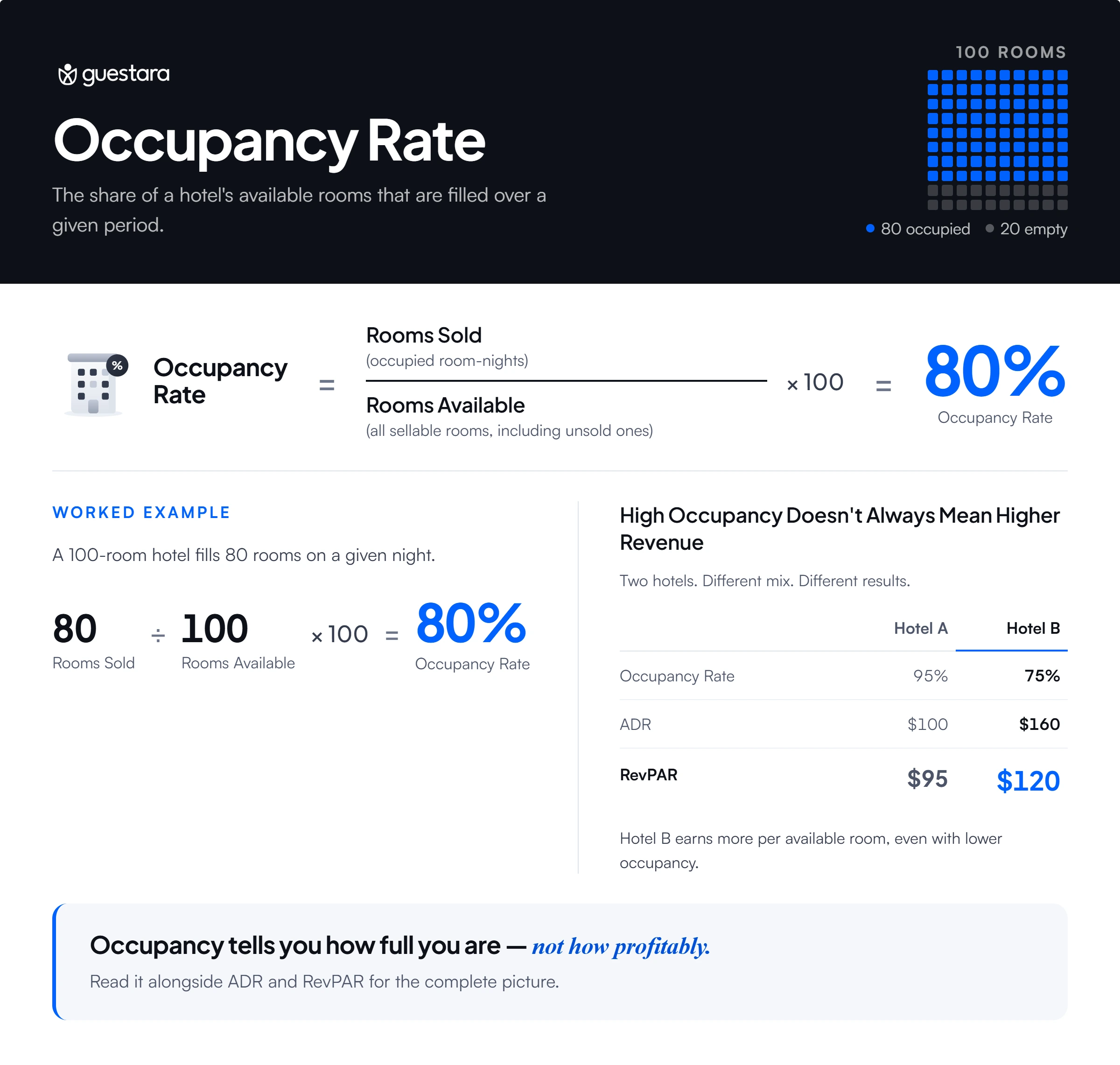
Occupancy Rate is the share of a hotel's available rooms that are filled over a given period. Formula: Occupancy Rate = (Rooms Sold / Rooms Available) x 100. It measures how full you are, but not how profitably, so read it alongside ADR and RevPAR.
Occupancy Rate is the percentage of a property's sellable rooms that are actually occupied across a night, week, month, or year. It is a pure volume metric: it tells you how well you are filling inventory, with no reference to the rate you charged. That makes it one half of the demand picture, paired with ADR on the price side.
Occupancy is usually calculated on occupied rooms against available rooms. Available rooms exclude out-of-order rooms, and properties should stay consistent about whether complimentary and house-use rooms are counted as occupied.
Occupancy Rate = (Rooms Sold / Rooms Available) x 100
A 100-room hotel fills 80 rooms on a given night.
Occupancy Rate = (80 / 100) x 100 = 80%
Over a 30-night month, that property has 3,000 available room-nights. If 2,400 are sold:
Occupancy Rate = (2,400 / 3,000) x 100 = 80%
Occupancy is the clearest read on demand. It shows whether your distribution, pricing, and marketing are actually putting heads in beds, and it feeds directly into RevPAR:
RevPAR = ADR x Occupancy Rate
But occupancy on its own is easy to game and easy to misread. Any hotel can hit high occupancy by cutting rates hard enough, so a full house is not automatically a good outcome. A property at 95% occupancy with a deeply discounted ADR can earn less per available room than one at 75% holding rate. This is exactly why occupancy is never judged alone: it is read together with ADR and RevPAR.
There is no universal target, and chasing 100% is often a warning sign rather than a goal, because it usually means rooms were underpriced. A healthy occupancy rate is relative to your market, segment, season, and comp set. The real question is not "how full are we?" but "are we full at the right rate?", which is what RevPAR answers.
Repeat stays and reputation are two of the most durable occupancy levers, and both come down to guest experience. Guestara's guest engagement platform automates messaging, review generation, and journey touchpoints across the stay, and hotels using it see up to 300% more positive reviews, which strengthens visibility and repeat demand that show up as occupancy.
Hotel occupancy rate is the share of available rooms sold. Learn the occupancy formula with a worked example.
Occupancy Rate is the share of a hotel's available rooms that are filled over a given period. Formula: Occupancy Rate = (Rooms Sold / Rooms Available) x 100. It measures how full you are, but not how profitably, so read it alongside ADR and RevPAR.
Occupancy Rate is the percentage of a property's sellable rooms that are actually occupied across a night, week, month, or year. It is a pure volume metric: it tells you how well you are filling inventory, with no reference to the rate you charged. That makes it one half of the demand picture, paired with ADR on the price side.
Occupancy is usually calculated on occupied rooms against available rooms. Available rooms exclude out-of-order rooms, and properties should stay consistent about whether complimentary and house-use rooms are counted as occupied.
Occupancy Rate = (Rooms Sold / Rooms Available) x 100
A 100-room hotel fills 80 rooms on a given night.
Occupancy Rate = (80 / 100) x 100 = 80%
Over a 30-night month, that property has 3,000 available room-nights. If 2,400 are sold:
Occupancy Rate = (2,400 / 3,000) x 100 = 80%
Occupancy is the clearest read on demand. It shows whether your distribution, pricing, and marketing are actually putting heads in beds, and it feeds directly into RevPAR:
RevPAR = ADR x Occupancy Rate
But occupancy on its own is easy to game and easy to misread. Any hotel can hit high occupancy by cutting rates hard enough, so a full house is not automatically a good outcome. A property at 95% occupancy with a deeply discounted ADR can earn less per available room than one at 75% holding rate. This is exactly why occupancy is never judged alone: it is read together with ADR and RevPAR.
There is no universal target, and chasing 100% is often a warning sign rather than a goal, because it usually means rooms were underpriced. A healthy occupancy rate is relative to your market, segment, season, and comp set. The real question is not "how full are we?" but "are we full at the right rate?", which is what RevPAR answers.
Repeat stays and reputation are two of the most durable occupancy levers, and both come down to guest experience. Guestara's guest engagement platform automates messaging, review generation, and journey touchpoints across the stay, and hotels using it see up to 300% more positive reviews, which strengthens visibility and repeat demand that show up as occupancy.
Occupancy measures volume only (how many rooms are filled). RevPAR combines that volume with rate, so it reflects both how full you are and how well you priced.
Not necessarily. Full occupancy at a discounted rate can underperform lower occupancy at a stronger rate. Always check ADR and RevPAR before calling high occupancy a win.
It depends on your convention. Some properties count all occupied rooms, others only paid ones. Pick one basis and apply it consistently so comparisons hold.
ADR is the average rate on rooms you sold; occupancy is the share of available rooms you filled. One is about price, the other about volume, and RevPAR ties them together.


