In This Article:
Subscribe to our newsletter
Read about our privacy policy.
Thank you! Your submission has been received!
Oops! Something went wrong while submitting the form.
Hotel Operations

What Is a Resort Fee? Definition, Costs, and Rules

A resort fee is a mandatory daily charge hotels add to the room rate. Learn what it covers, how much it costs, whether you can avoid it, and the new FTC rules.


Published on:
3/10/2026
Summarise with:
What resort fees cover, how much they really cost, and the new rules forcing hotels to show the full price upfront, Complete guide by Guestara
TL;DR — Key Takeaways
  • A resort fee is a mandatory daily charge, separate from the room rate, that hotels add to cover on-site amenities.
  • Resort fees typically run $20 to $50 per night, and at some luxury or destination properties they run higher.
  • The fee is usually not optional, even if you never use the amenities it claims to cover.
  • Since May 2025, the US FTC requires hotels to show the total price, including mandatory fees, upfront, though it does not ban or cap the fee.
  • Resort fees are mostly a US practice and are rare in India, the GCC, and much of Asia.

A resort fee is a mandatory daily charge that a hotel adds on top of the advertised room rate, meant to cover amenities like wifi, the pool, or the gym.

You have probably seen it happen. A room looks like $149 a night, then a $45 resort fee appears at checkout and the real price is closer to $200. This guide explains what a resort fee is, what it covers, how much to expect, whether you can avoid it, and the new rules that now govern how it must be shown.

What Is a Resort Fee?

A resort fee is a mandatory daily charge, separate from the room rate, that a hotel adds to cover access to on-site amenities. It is sometimes called a destination fee or a facility fee, and it applies whether or not you use those amenities.

The fee is charged per room, per night, and it is not a tax. It is revenue the hotel keeps, unlike a government lodging tax. Because it sits outside the advertised rate, it has long been a way for hotels to show a lower headline price than a guest actually pays.

Key takeaways

  • A resort fee is a mandatory per-night charge, separate from the room rate, for on-site amenities.
  • It is also called a destination or facility fee, and it is revenue the hotel keeps, not a government tax.
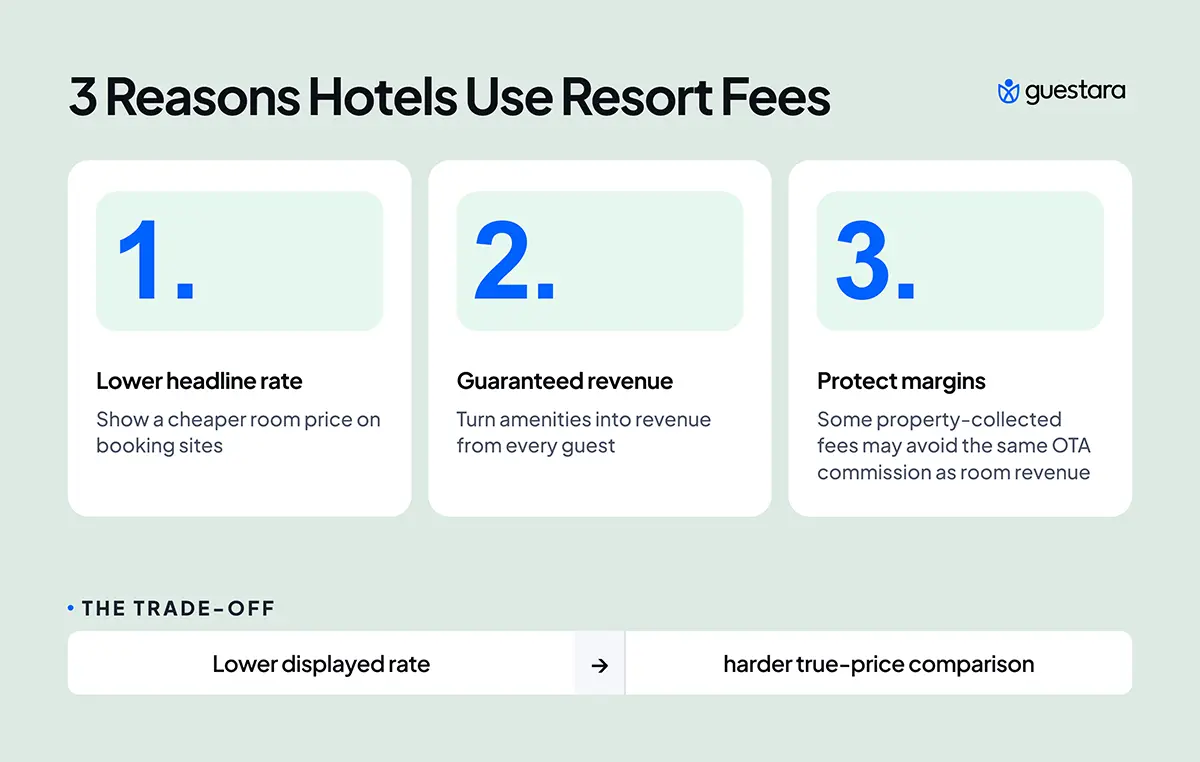
Guestara infographic explaining three reasons hotels use resort fees: displaying a lower headline room rate, generating guaranteed revenue from amenities, and protecting margins, with the trade-off of making true-price comparisons harder.

What Does a Resort Fee Cover?

A resort fee bundles a set of on-site amenities into one daily charge. What it covers varies by property, but it commonly includes:

  • Wifi and internet access
  • Pool, beach, and fitness center access
  • Local and toll-free phone calls
  • Bottled water or a coffee station
  • Newspapers and printing
  • Business center or coworking access
  • Shuttle service or parking, at some properties

The catch is that the fee applies even if you use none of these. A business traveler who only needs wifi still pays for the pool and the shuttle.

Key takeaways

  • A resort fee bundles amenities like wifi, pool, gym, and phone calls into one daily charge.
  • The fee applies whether or not you use any of the amenities it covers.

Typical Resort Fee Costs

Resort fees usually range from $20 to $50 per night, though the exact amount depends on the property and location. Luxury and destination resorts sit at the top of that range or above, while a mid-tier city hotel with a destination fee sits lower.

A simple example shows the impact:

  • Room advertised at $199 per night
  • Mandatory resort fee of $39 per night
  • Real nightly cost: $238 before tax
  • Over a four-night stay, the fee alone adds $156

Because it is charged per night, the fee grows with the length of the stay, not with the room rate.

Key takeaways

  • Resort fees typically run $20 to $50 per night, higher at luxury and destination properties.
  • The fee is charged per night, so a $39 fee adds $156 to a four-night stay before tax.

Why Do Hotels Charge Resort Fees?

Hotels charge resort fees for reasons that have more to do with pricing strategy than with amenities. The main drivers are:

  • A lower headline rate. Splitting the price lets a hotel advertise $149 instead of $199 and rank better on price-sorted booking sites.
  • Revenue that skips some OTA commissions. Fees collected directly at the property are not always subject to the same online travel agency commission as the room rate.
  • Guaranteed amenity revenue. The fee turns optional services into income the hotel collects from every guest.

For the hotel, the fee protects margin and search ranking. For the guest, it makes true price comparison harder, which is exactly why regulators stepped in.

Key takeaways

  • Hotels use resort fees to advertise a lower headline rate and rank better on price-sorted sites.
  • The fee also converts optional amenities into guaranteed revenue and can avoid some OTA commissions.

Are Resort Fees Mandatory or Avoidable?

Resort fees are almost always mandatory, and in most cases you cannot opt out even if you skip every amenity. They typically run $20 to $50 per night with no way to refuse them. Still, a few situations let you avoid or reduce one:

  • Award stays. Some loyalty programs waive resort fees on points bookings.
  • Elite status. Certain hotel loyalty tiers exempt members from the fee.
  • Closed or missing amenities. A property will sometimes remove the fee if a key amenity was unavailable, though this is not guaranteed.
  • Booking a property without one. Many hotels, especially outside the US, charge no resort fee at all.

Do not count on avoiding it. Treat the fee as part of the real price when you compare hotels.

Key takeaways

  • Resort fees are almost always mandatory and usually cannot be opted out of.
  • Award stays, elite status, or a closed amenity are the main ways a fee is sometimes waived.

Resort Fee Rules and the FTC Transparency Requirement

In the US, resort fees are now regulated for transparency but not for price. Since May 12, 2025, the FTC's Rule on Unfair or Deceptive Fees requires hotels, vacation rentals, and ticket sellers to show the total price, including all mandatory fees, upfront rather than revealing them at checkout, according to the FTC.

What the rule does and does not do:

  • It requires all-in pricing. The advertised price must include the resort fee, so a $199 room with a $39 fee must be shown at $238.
  • It does not ban or cap resort fees. Hotels can still charge them and set the amount.
  • It carries real penalties. Violations can draw civil penalties of up to $51,744 each.

The FTC estimates the rule will save travelers up to 53 million hours a year otherwise spent decoding true prices. Several US states and a proposed federal Hotel Fees Transparency Act push in the same direction. Outside the US, resort fees remain uncommon, so for most hotels this is largely a US compliance issue.

Key takeaways

  • Since May 2025, US hotels must display the all-in price including any resort fee upfront (FTC, 2025).
  • The rule regulates disclosure, not price, so resort fees remain legal but must appear in the headline total.

Should Your Hotel Charge a Resort Fee?

If you run a hotel, a resort fee is getting harder to justify. It can protect your headline rate, but it now has to appear in the total price anyway, and it carries a real risk to guest trust. Before adding one, weigh:

  • Transparency rules. In the US you must show the all-in price, so a hidden fee no longer buys a lower displayed rate.
  • Guest trust. Surprise fees are among the most common complaints in reviews, and a damaged score costs more than the fee earns.
  • Your market. In India, the GCC, and most of Asia, resort fees are rare, so charging one makes you an outlier.

A cleaner path to the same revenue is transparent, optional upselling. Instead of a mandatory fee every guest resents, let guests choose paid extras they actually want. Guestara's Upsell turns amenities into optional add-ons guests buy willingly, Smart Checkout shows a clear folio at departure, and Payments keeps billing clean. For a deeper approach, see the guide to hotel upselling.

Key takeaways

  • Under US transparency rules, a resort fee no longer buys a lower displayed rate, and it risks guest trust.
  • Transparent optional upsells earn similar revenue without the surprise-fee backlash, and resort fees are rare outside the US anyway.

[[cta:cta-4 | eyebrow=HOTEL UPSELLS | heading=Earn extra revenue from add-ons guests *actually want*. | btn=Explore Hotel Upsells | link=https://www.guestara.com/hotel-upsell-software ]]

Pratik Bhondve
Marketing Manager
One Platform

Run your entire guest journey from one platform

Automate check-in, messaging, upsells and reviews, all in one place.

Get a demo
Looking for Guest Management guide in 2026?
Book a personalised demo now.
Book a demo
Subscribe to our newsletter
Read about our privacy policy.
Thank you! Your submission has been received!
Oops! Something went wrong while submitting the form.
Hotel Operations

What Is a Resort Fee? Definition, Costs, and Rules

A resort fee is a mandatory daily charge hotels add to the room rate. Learn what it covers, how much it costs, whether you can avoid it, and the new FTC rules.

10/3/2026
What resort fees cover, how much they really cost, and the new rules forcing hotels to show the full price upfront, Complete guide by Guestara
Summarise with:
TL;DR — Key Takeaways
  • A resort fee is a mandatory daily charge, separate from the room rate, that hotels add to cover on-site amenities.
  • Resort fees typically run $20 to $50 per night, and at some luxury or destination properties they run higher.
  • The fee is usually not optional, even if you never use the amenities it claims to cover.
  • Since May 2025, the US FTC requires hotels to show the total price, including mandatory fees, upfront, though it does not ban or cap the fee.
  • Resort fees are mostly a US practice and are rare in India, the GCC, and much of Asia.

A resort fee is a mandatory daily charge that a hotel adds on top of the advertised room rate, meant to cover amenities like wifi, the pool, or the gym.

You have probably seen it happen. A room looks like $149 a night, then a $45 resort fee appears at checkout and the real price is closer to $200. This guide explains what a resort fee is, what it covers, how much to expect, whether you can avoid it, and the new rules that now govern how it must be shown.

What Is a Resort Fee?

A resort fee is a mandatory daily charge, separate from the room rate, that a hotel adds to cover access to on-site amenities. It is sometimes called a destination fee or a facility fee, and it applies whether or not you use those amenities.

The fee is charged per room, per night, and it is not a tax. It is revenue the hotel keeps, unlike a government lodging tax. Because it sits outside the advertised rate, it has long been a way for hotels to show a lower headline price than a guest actually pays.
Key takeaways

  • A resort fee is a mandatory per-night charge, separate from the room rate, for on-site amenities.
  • It is also called a destination or facility fee, and it is revenue the hotel keeps, not a government tax.
Guestara infographic explaining three reasons hotels use resort fees: displaying a lower headline room rate, generating guaranteed revenue from amenities, and protecting margins, with the trade-off of making true-price comparisons harder.

What Does a Resort Fee Cover?

A resort fee bundles a set of on-site amenities into one daily charge. What it covers varies by property, but it commonly includes:

  • Wifi and internet access
  • Pool, beach, and fitness center access
  • Local and toll-free phone calls
  • Bottled water or a coffee station
  • Newspapers and printing
  • Business center or coworking access
  • Shuttle service or parking, at some properties

The catch is that the fee applies even if you use none of these. A business traveler who only needs wifi still pays for the pool and the shuttle.

Key takeaways

  • A resort fee bundles amenities like wifi, pool, gym, and phone calls into one daily charge.
  • The fee applies whether or not you use any of the amenities it covers.

Typical Resort Fee Costs

Resort fees usually range from $20 to $50 per night, though the exact amount depends on the property and location. Luxury and destination resorts sit at the top of that range or above, while a mid-tier city hotel with a destination fee sits lower.

A simple example shows the impact:

  • Room advertised at $199 per night
  • Mandatory resort fee of $39 per night
  • Real nightly cost: $238 before tax
  • Over a four-night stay, the fee alone adds $156

Because it is charged per night, the fee grows with the length of the stay, not with the room rate.

Key takeaways

  • Resort fees typically run $20 to $50 per night, higher at luxury and destination properties.
  • The fee is charged per night, so a $39 fee adds $156 to a four-night stay before tax.

Why Do Hotels Charge Resort Fees?

Hotels charge resort fees for reasons that have more to do with pricing strategy than with amenities. The main drivers are:

  • A lower headline rate. Splitting the price lets a hotel advertise $149 instead of $199 and rank better on price-sorted booking sites.
  • Revenue that skips some OTA commissions. Fees collected directly at the property are not always subject to the same online travel agency commission as the room rate.
  • Guaranteed amenity revenue. The fee turns optional services into income the hotel collects from every guest.

For the hotel, the fee protects margin and search ranking. For the guest, it makes true price comparison harder, which is exactly why regulators stepped in.

Key takeaways

  • Hotels use resort fees to advertise a lower headline rate and rank better on price-sorted sites.
  • The fee also converts optional amenities into guaranteed revenue and can avoid some OTA commissions.

Are Resort Fees Mandatory or Avoidable?

Resort fees are almost always mandatory, and in most cases you cannot opt out even if you skip every amenity. They typically run $20 to $50 per night with no way to refuse them. Still, a few situations let you avoid or reduce one:

  • Award stays. Some loyalty programs waive resort fees on points bookings.
  • Elite status. Certain hotel loyalty tiers exempt members from the fee.
  • Closed or missing amenities. A property will sometimes remove the fee if a key amenity was unavailable, though this is not guaranteed.
  • Booking a property without one. Many hotels, especially outside the US, charge no resort fee at all.

Do not count on avoiding it. Treat the fee as part of the real price when you compare hotels.

Key takeaways

  • Resort fees are almost always mandatory and usually cannot be opted out of.
  • Award stays, elite status, or a closed amenity are the main ways a fee is sometimes waived.

Resort Fee Rules and the FTC Transparency Requirement

In the US, resort fees are now regulated for transparency but not for price. Since May 12, 2025, the FTC's Rule on Unfair or Deceptive Fees requires hotels, vacation rentals, and ticket sellers to show the total price, including all mandatory fees, upfront rather than revealing them at checkout, according to the FTC.

What the rule does and does not do:

  • It requires all-in pricing. The advertised price must include the resort fee, so a $199 room with a $39 fee must be shown at $238.
  • It does not ban or cap resort fees. Hotels can still charge them and set the amount.
  • It carries real penalties. Violations can draw civil penalties of up to $51,744 each.

The FTC estimates the rule will save travelers up to 53 million hours a year otherwise spent decoding true prices. Several US states and a proposed federal Hotel Fees Transparency Act push in the same direction. Outside the US, resort fees remain uncommon, so for most hotels this is largely a US compliance issue.

Key takeaways

  • Since May 2025, US hotels must display the all-in price including any resort fee upfront (FTC, 2025).
  • The rule regulates disclosure, not price, so resort fees remain legal but must appear in the headline total.

Should Your Hotel Charge a Resort Fee?

If you run a hotel, a resort fee is getting harder to justify. It can protect your headline rate, but it now has to appear in the total price anyway, and it carries a real risk to guest trust. Before adding one, weigh:

  • Transparency rules. In the US you must show the all-in price, so a hidden fee no longer buys a lower displayed rate.
  • Guest trust. Surprise fees are among the most common complaints in reviews, and a damaged score costs more than the fee earns.
  • Your market. In India, the GCC, and most of Asia, resort fees are rare, so charging one makes you an outlier.

A cleaner path to the same revenue is transparent, optional upselling. Instead of a mandatory fee every guest resents, let guests choose paid extras they actually want. Guestara's Upsell turns amenities into optional add-ons guests buy willingly, Smart Checkout shows a clear folio at departure, and Payments keeps billing clean. For a deeper approach, see the guide to hotel upselling.

Key takeaways

  • Under US transparency rules, a resort fee no longer buys a lower displayed rate, and it risks guest trust.
  • Transparent optional upsells earn similar revenue without the surprise-fee backlash, and resort fees are rare outside the US anyway.

[[cta:cta-4 | eyebrow=HOTEL UPSELLS | heading=Earn extra revenue from add-ons guests *actually want*. | btn=Explore Hotel Upsells | link=https://www.guestara.com/hotel-upsell-software ]]

Pratik Bhondve
Marketing Manager
Subscribe to our newsletter
Read about our privacy policy.
Thank you! Your submission has been received!
Oops! Something went wrong while submitting the form.

Frequently Asked Questions

What is a resort fee at a hotel?

A resort fee is a mandatory daily charge a hotel adds on top of the room rate to cover on-site amenities like wifi, the pool, and the gym. It is charged per room, per night, and it applies whether or not you use those amenities. It is revenue the hotel keeps, not a government tax.

Are resort fees mandatory?

In almost all cases, yes. Most hotels that charge a resort fee do not let guests opt out, even if they never use the amenities it covers. Some loyalty programs waive the fee on award stays or for elite members, and a property may occasionally remove it if a key amenity was closed.

How much is a typical resort fee?

Resort fees usually range from $20 to $50 per night, with luxury and destination properties at the top of that range or higher. Because the fee is charged per night, it grows with the length of your stay. A $39 fee on a four-night stay adds $156 before tax.

Are resort fees legal?

Yes. Resort fees are legal in the US, but since May 2025 the FTC requires hotels to display the total price, including any mandatory resort fee, upfront rather than at checkout. The rule regulates how the fee is shown, not whether it can be charged or how much it can be.

Do hotels outside the US charge resort fees?

Rarely. Resort fees are largely a US practice, and hotels in India, the GCC, and most of Asia typically do not charge them. Travelers in those markets are far more likely to see the room rate plus government taxes, with amenities included rather than billed as a separate daily fee.

Your hospitality tech stack’s best friend

We work closely with the industry leaders to offer seamless solutions

Guestara is already easy to use. But we’re still here for you

We’re here to help your whole team stay ahead of the curve as you grow.

heart handshake icon
Onboarding Services

Get up and running quickly with a personalized onboarding plan

customer support icon
24/7 Support

Connect with real people who really get it, 24/7

book icon
Guides and Templates

Checkout our vast library of free resources, templates and more

See Guestara in action now.

There's only so much we can say — so let us show you! Schedule a demo today and reach your business goals.