Hotel payment processing best practices that cut chargebacks, prevent no-show losses, secure guest cards, and keep your property PCI DSS compliant.





Hotel payment processing is the full set of steps a hotel uses to take a guest's money safely, from the deposit at booking to the final charge at checkout. Get it right and the money arrives on time, guests trust you with their card, and disputes stay rare. Get it wrong and you leak revenue you have already earned.
Picture a normal Friday. One guest books on an OTA and pays nothing upfront. Another sends a deposit by bank transfer that your team reconciles by hand three days later. A third hands a card across the desk while two more guests wait behind them.
By Sunday, one guest has filed a chargeback, one never showed up, and nobody is sure which deposit matched which booking.
Every one of those is a payment problem, not a front desk problem. This guide covers how hotels should process payments across the whole stay, and the practices that keep revenue where it belongs.
Hotel payment processing is the end-to-end flow that moves money from a guest's card into your hotel's account, at each stage of the stay. It is wider than a single swipe at the desk. A complete hotel payment processing system handles the booking deposit, the pre-arrival balance, in-stay charges like room service, and the final settlement at checkout.
Under the surface, every hotel payment moves through the same chain. The guest's card details enter through a payment gateway. The gateway asks the guest's bank to authorize the amount. The bank approves or declines. Later, the hotel captures the authorized amount, and the money settles into the hotel's account through an acquiring bank.
Two things make hotel payments different from a shop. First, there is often a long gap between the authorization at booking and the capture at checkout. Second, the same guest is charged more than once across a single stay, so the system has to keep the card on file safely between charges.
This is why a hotel payment processing system that syncs with your property management system matters. When payments and the PMS talk to each other, every deposit, upsell, and folio charge lands against the right booking with no manual matching. You can see how this works inside Guestara's hotel payments platform, which connects the full payment flow to the booking record.
Key takeaways
.webp)
Hotels face more payment risk than most businesses because the majority of hotel bookings are card-not-present, transaction values are high, and weeks can pass between the booking and the stay. A shop takes a card in person for a small amount and hands over the goods on the spot. A hotel takes a card remotely for hundreds of dollars and delivers the service later, which is exactly the setup fraudsters and disputes exploit.
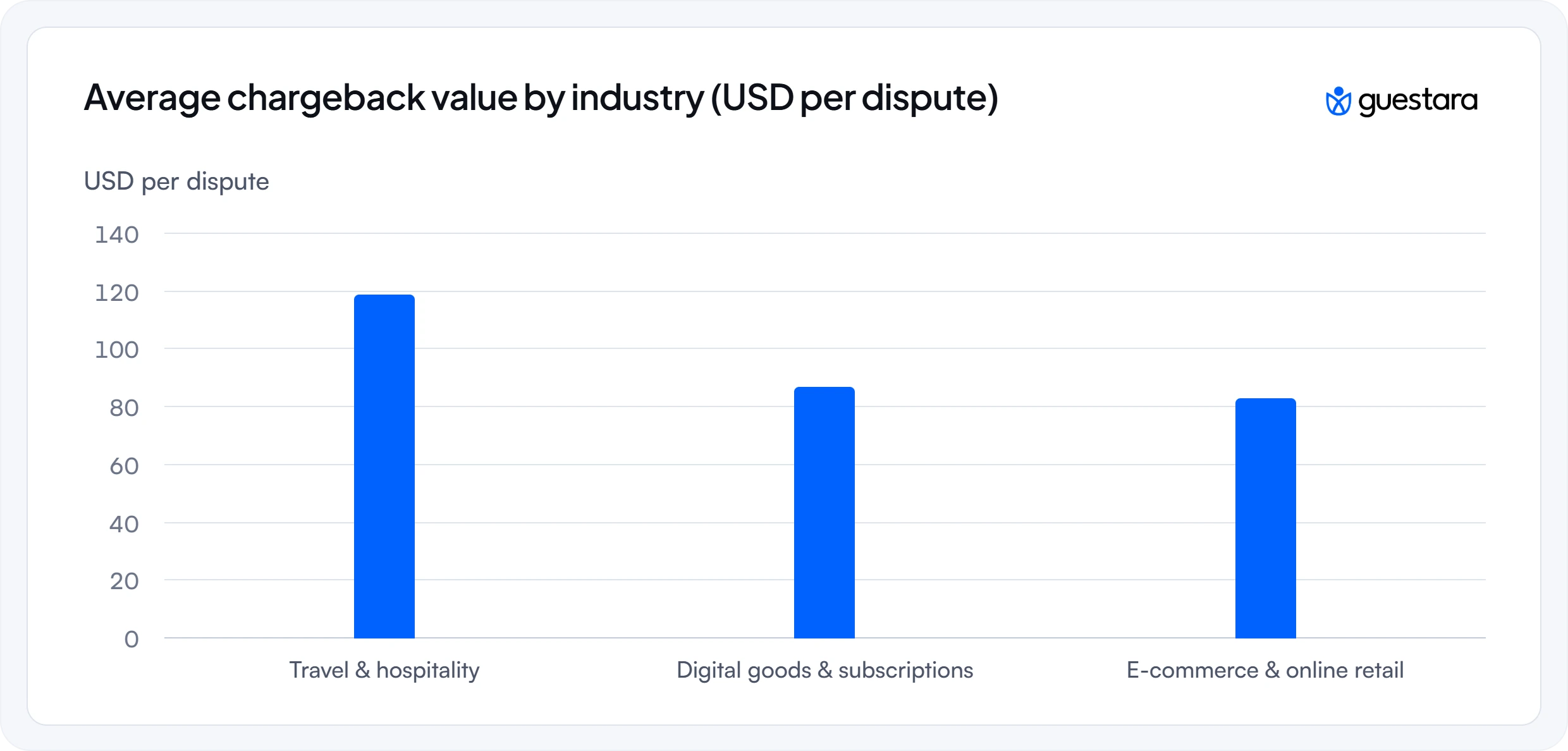
The numbers back this up. Travel and hospitality have the highest average chargeback value of any industry at around 120 dollars per dispute, well ahead of general online retail (Chargeflow, 2025 chargeback statistics). And the true cost runs several times higher than the disputed amount once processing fees, the lost room night, and staff time spent fighting the dispute are added.
Most of these disputes are not the work of criminals. Card networks estimate that a large majority of chargebacks are first-party or "friendly" fraud, where a real guest who stayed at the property later disputes a charge they do not recognize on their statement. That means your own past guests, not strangers, drive most of the losses.
The lesson is not to fear payments. It is to build a hotel payment processing system that removes the weak points: manual card handling, unclear billing descriptors, and charges with no supporting evidence.
Key takeaways
Hotels should collect a deposit or place a pre-authorization hold at the moment of booking, not at arrival, and should keep the card securely on file for the rest of the stay. Waiting until check-in to secure any money is the single most common way hotels expose themselves to no-shows and unpaid stays.
A deposit and a pre-authorization hold are not the same thing, and using the wrong one frustrates guests or leaves you exposed. The table below shows the difference.
Three practices keep this stage clean. Collect the deposit at booking so a no-show still leaves you covered, since hotel no-show rates commonly run between 5 and 15 percent of bookings (industry range, 2025). Use a hold rather than a full charge for incidentals so you are not refunding guests constantly. And store the card as a secure token so you can charge the balance later without asking for the card again.
Guestara's Payments module collects deposits and places holds automatically as part of the booking journey, with the card tokenized for later charges. You can set the rules once for how you collect and protect security deposits and how you handle card authorization and pre-authorization, and every booking follows them.
Key takeaways
The safest way to store guest cards is to never store the raw card number at all, and instead keep a secure token through a PCI DSS compliant processor. Card details written on a form, saved in an email inbox, or typed into a spreadsheet are the highest-risk practice in any hotel, and they put the entire property in scope for a data breach.
Tokenization replaces the real card number with a meaningless reference that is useless to a thief. Your team can charge the card on file for the balance, a late checkout, or an incidental, but the actual number is never visible to staff and never stored on your systems. This is what "card on file" should mean in a modern hotel payment processing system.
Compliance is not optional here. PCI DSS 4.0.1 has been the only active version of the standard since the end of 2024, and the 51 formerly future-dated requirements became mandatory on 31 March 2025 with no grace period. The rules apply to any hotel that accepts, processes, stores, or transmits card data, from a boutique inn to a large group. You can read the current PCI DSS 4.0.1 requirements for hospitality for the full detail.
The financial stakes are real at any size. Independent hotels typically spend 1,500 to 3,000 dollars a year to stay compliant, while fines for non-compliance run from 5,000 to 100,000 dollars a month. Using a processor that tokenizes cards shrinks how much of your property sits in PCI scope in the first place. Guestara's Payments module stores cards as tokens and keeps card handling PCI DSS compliant, so your staff never touch a raw card number.
Key takeaways
Hotels reduce chargebacks by verifying every card-not-present charge upfront and keeping clear evidence for every transaction. Since most hotel disputes come from real guests who do not recognize a charge, prevention is split between stopping genuine fraud and stopping honest confusion.
For genuine fraud, verification does the work. Three tools catch most bad transactions before the money moves:
For friendly fraud, clarity does the work. A card network estimate cited across the industry puts up to 75 percent of all chargebacks in the "dispute abuse" category rather than criminal fraud (Visa, cited 2025), and much of that comes down to guests not recognizing a charge. You beat it with a clear billing descriptor that shows your hotel name, a signed digital folio, and a record of what the guest agreed to. For the deeper data behind this, the hospitality chargeback statistics show how the pattern has shifted toward first-party disputes.
Guestara's Payments module builds these safeguards in, with 3D Secure, address verification, CVC, and ID verification on card-not-present charges, plus a clear record tied to each booking. That record is what wins a dispute when a guest challenges a charge they authorized.
Key takeaways
.webp)
Hotels should accept the payment methods their guests actually use, which now goes well beyond cards and varies sharply by region. Offering only one method at only one moment, the card at the desk, quietly costs you bookings and adds friction for guests who expected to pay from their phone.
The right mix depends on where your guests come from. The table below shows the practical picture across the markets most independent hotels serve.
Two channel shifts matter for every hotel. Contactless payments are now the default expectation, not a nice extra, so the option to tap or pay on a phone should exist at every touchpoint. And in-stay charges should be payable in the moment, so a guest ordering room service or a late checkout can pay on their phone rather than settling everything at the desk.
Guestara's Payments module takes in-app payment at the point of order, so when a guest orders through the branded upsell menu, the payment and the request move together. That turns every in-stay moment into a clean, paid transaction instead of a charge your team has to chase at checkout.
Key takeaways
The last mile of hotel payment processing, checkout and no-shows, is where hotels lose the most money, and it is the easiest to fix. A guest who walks out with an unpaid incidental, or a booking that never arrives and is never charged, is revenue you already earned and then let go.
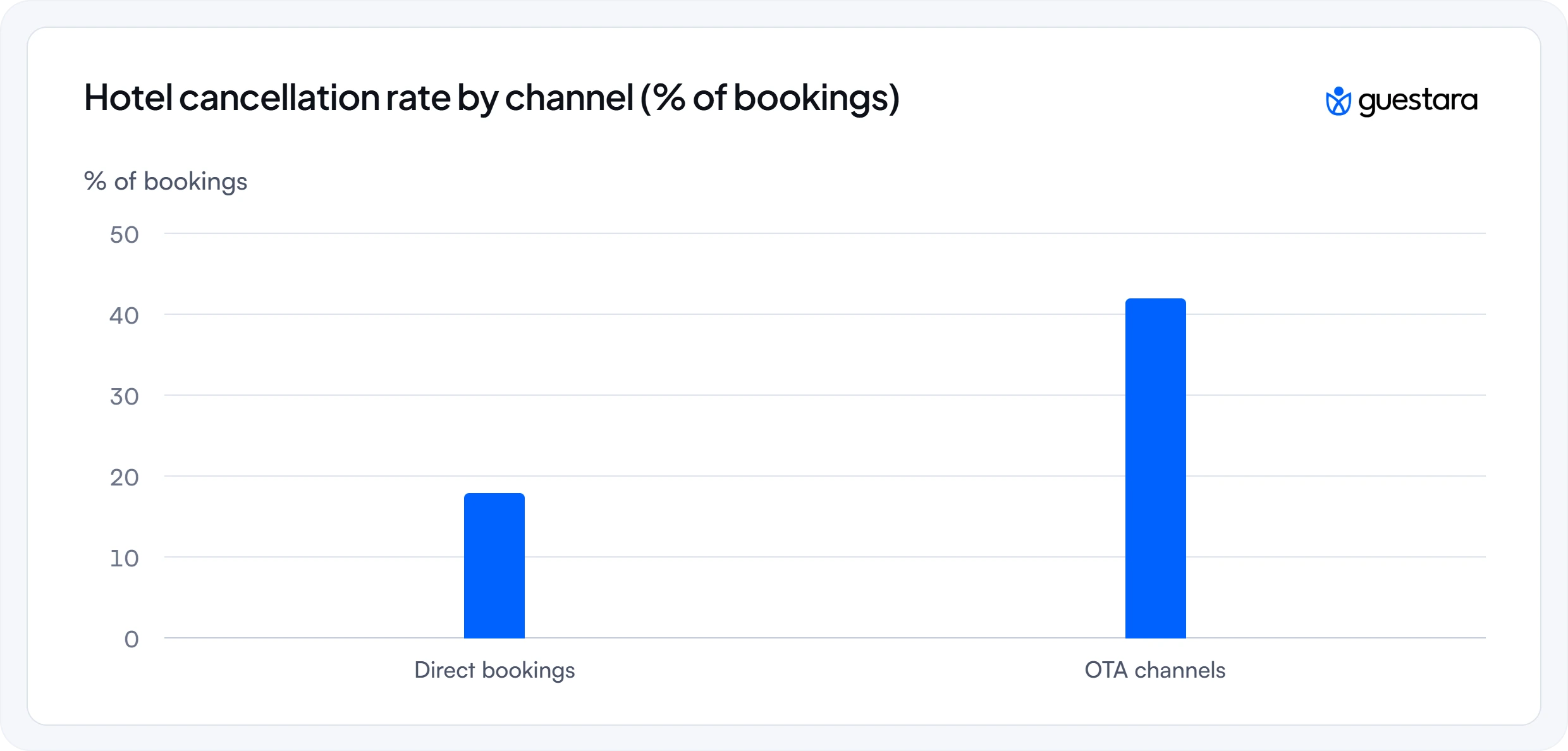
No-shows and cancellations are not rare. Hotel cancellation rates range from about 18 percent on direct bookings to over 40 percent on some OTA channels, according to the 2024 Hotel Distribution Report. Without a deposit or a card on file, most of that is uncollectable. With one, a no-show charge fires automatically against the agreed rate.
At checkout, three practices protect the money. Settle every pending charge before the guest leaves, using the card already on file. Sync the settlement back to the PMS so the folio closes cleanly with no manual matching. And offer the guest a last chance to add a late checkout or extend the stay, which turns the final moment into extra revenue rather than a queue.
Guestara's Smart Checkout lets the guest settle pending payments and sign the folio from their phone, with no download, while Guestara's Payments module handles the no-show charge and the PMS sync. The room is released for housekeeping the moment payment clears, so faster turnaround comes for free.
Key takeaways
[[cta:cta-5 | eyebrow=HOTEL PAYMENTS | heading=Collect every payment automatically and stop revenue leaks.| btn=Explore Hotel Payments | link=https://www.guestara.com/hotel-payments ]]
Automated hotel payment processing removes the manual steps where revenue leaks, and it does it at every stage of the stay. Manual processing is not just slower. It is where deposits go uncollected, cards get mishandled, no-shows go uncharged, and disputes get lost for want of evidence.
The contrast is clearest side by side.
The pattern is consistent. Every manual step is a place where money can go missing or a card can be exposed. Automation does not just save time. It closes the gaps that cost you revenue and put guest data at risk.
This is the case for building payments into one connected system rather than stitching them across a card machine, a spreadsheet, and an inbox. Guestara's hotel payments platform runs the whole flow, deposits, card-on-file, in-stay charges, no-show recovery, and checkout, against the booking record, so the manual gaps simply are not there to leak through.
Key takeaways
[[cta:cta-4 | eyebrow=PAYMENT AUTOMATION | heading=See how Guestara handles hotel payments end to end.| btn=Explore Guestara Payments | link=https://www.guestara.com/hotel-payments ]]


Hotel payment processing best practices that cut chargebacks, prevent no-show losses, secure guest cards, and keep your property PCI DSS compliant.
Hotel payment processing is the full set of steps a hotel uses to take a guest's money safely, from the deposit at booking to the final charge at checkout. Get it right and the money arrives on time, guests trust you with their card, and disputes stay rare. Get it wrong and you leak revenue you have already earned.
Picture a normal Friday. One guest books on an OTA and pays nothing upfront. Another sends a deposit by bank transfer that your team reconciles by hand three days later. A third hands a card across the desk while two more guests wait behind them.
By Sunday, one guest has filed a chargeback, one never showed up, and nobody is sure which deposit matched which booking.
Every one of those is a payment problem, not a front desk problem. This guide covers how hotels should process payments across the whole stay, and the practices that keep revenue where it belongs.
Hotel payment processing is the end-to-end flow that moves money from a guest's card into your hotel's account, at each stage of the stay. It is wider than a single swipe at the desk. A complete hotel payment processing system handles the booking deposit, the pre-arrival balance, in-stay charges like room service, and the final settlement at checkout.
Under the surface, every hotel payment moves through the same chain. The guest's card details enter through a payment gateway. The gateway asks the guest's bank to authorize the amount. The bank approves or declines. Later, the hotel captures the authorized amount, and the money settles into the hotel's account through an acquiring bank.
Two things make hotel payments different from a shop. First, there is often a long gap between the authorization at booking and the capture at checkout. Second, the same guest is charged more than once across a single stay, so the system has to keep the card on file safely between charges.
This is why a hotel payment processing system that syncs with your property management system matters. When payments and the PMS talk to each other, every deposit, upsell, and folio charge lands against the right booking with no manual matching. You can see how this works inside Guestara's hotel payments platform, which connects the full payment flow to the booking record.
Key takeaways
Hotels face more payment risk than most businesses because the majority of hotel bookings are card-not-present, transaction values are high, and weeks can pass between the booking and the stay. A shop takes a card in person for a small amount and hands over the goods on the spot. A hotel takes a card remotely for hundreds of dollars and delivers the service later, which is exactly the setup fraudsters and disputes exploit.
The numbers back this up. Travel and hospitality have the highest average chargeback value of any industry at around 120 dollars per dispute, well ahead of general online retail (Chargeflow, 2025 chargeback statistics). And the true cost runs several times higher than the disputed amount once processing fees, the lost room night, and staff time spent fighting the dispute are added.
Most of these disputes are not the work of criminals. Card networks estimate that a large majority of chargebacks are first-party or "friendly" fraud, where a real guest who stayed at the property later disputes a charge they do not recognize on their statement. That means your own past guests, not strangers, drive most of the losses.
The lesson is not to fear payments. It is to build a hotel payment processing system that removes the weak points: manual card handling, unclear billing descriptors, and charges with no supporting evidence.
Key takeaways
Hotels should collect a deposit or place a pre-authorization hold at the moment of booking, not at arrival, and should keep the card securely on file for the rest of the stay. Waiting until check-in to secure any money is the single most common way hotels expose themselves to no-shows and unpaid stays.
A deposit and a pre-authorization hold are not the same thing, and using the wrong one frustrates guests or leaves you exposed. The table below shows the difference.
Three practices keep this stage clean. Collect the deposit at booking so a no-show still leaves you covered, since hotel no-show rates commonly run between 5 and 15 percent of bookings (industry range, 2025). Use a hold rather than a full charge for incidentals so you are not refunding guests constantly. And store the card as a secure token so you can charge the balance later without asking for the card again.
Guestara's Payments module collects deposits and places holds automatically as part of the booking journey, with the card tokenized for later charges. You can set the rules once for how you collect and protect security deposits and how you handle card authorization and pre-authorization, and every booking follows them.
Key takeaways
The safest way to store guest cards is to never store the raw card number at all, and instead keep a secure token through a PCI DSS compliant processor. Card details written on a form, saved in an email inbox, or typed into a spreadsheet are the highest-risk practice in any hotel, and they put the entire property in scope for a data breach.
Tokenization replaces the real card number with a meaningless reference that is useless to a thief. Your team can charge the card on file for the balance, a late checkout, or an incidental, but the actual number is never visible to staff and never stored on your systems. This is what "card on file" should mean in a modern hotel payment processing system.
Compliance is not optional here. PCI DSS 4.0.1 has been the only active version of the standard since the end of 2024, and the 51 formerly future-dated requirements became mandatory on 31 March 2025 with no grace period. The rules apply to any hotel that accepts, processes, stores, or transmits card data, from a boutique inn to a large group. You can read the current PCI DSS 4.0.1 requirements for hospitality for the full detail.
The financial stakes are real at any size. Independent hotels typically spend 1,500 to 3,000 dollars a year to stay compliant, while fines for non-compliance run from 5,000 to 100,000 dollars a month. Using a processor that tokenizes cards shrinks how much of your property sits in PCI scope in the first place. Guestara's Payments module stores cards as tokens and keeps card handling PCI DSS compliant, so your staff never touch a raw card number.
Key takeaways
Hotels reduce chargebacks by verifying every card-not-present charge upfront and keeping clear evidence for every transaction. Since most hotel disputes come from real guests who do not recognize a charge, prevention is split between stopping genuine fraud and stopping honest confusion.
For genuine fraud, verification does the work. Three tools catch most bad transactions before the money moves:
For friendly fraud, clarity does the work. A card network estimate cited across the industry puts up to 75 percent of all chargebacks in the "dispute abuse" category rather than criminal fraud (Visa, cited 2025), and much of that comes down to guests not recognizing a charge. You beat it with a clear billing descriptor that shows your hotel name, a signed digital folio, and a record of what the guest agreed to. For the deeper data behind this, the hospitality chargeback statistics show how the pattern has shifted toward first-party disputes.
Guestara's Payments module builds these safeguards in, with 3D Secure, address verification, CVC, and ID verification on card-not-present charges, plus a clear record tied to each booking. That record is what wins a dispute when a guest challenges a charge they authorized.
Key takeaways
Hotels should accept the payment methods their guests actually use, which now goes well beyond cards and varies sharply by region. Offering only one method at only one moment, the card at the desk, quietly costs you bookings and adds friction for guests who expected to pay from their phone.
The right mix depends on where your guests come from. The table below shows the practical picture across the markets most independent hotels serve.
Two channel shifts matter for every hotel. Contactless payments are now the default expectation, not a nice extra, so the option to tap or pay on a phone should exist at every touchpoint. And in-stay charges should be payable in the moment, so a guest ordering room service or a late checkout can pay on their phone rather than settling everything at the desk.
Guestara's Payments module takes in-app payment at the point of order, so when a guest orders through the branded upsell menu, the payment and the request move together. That turns every in-stay moment into a clean, paid transaction instead of a charge your team has to chase at checkout.
Key takeaways
The last mile of hotel payment processing, checkout and no-shows, is where hotels lose the most money, and it is the easiest to fix. A guest who walks out with an unpaid incidental, or a booking that never arrives and is never charged, is revenue you already earned and then let go.
No-shows and cancellations are not rare. Hotel cancellation rates range from about 18 percent on direct bookings to over 40 percent on some OTA channels, according to the 2024 Hotel Distribution Report. Without a deposit or a card on file, most of that is uncollectable. With one, a no-show charge fires automatically against the agreed rate.
At checkout, three practices protect the money. Settle every pending charge before the guest leaves, using the card already on file. Sync the settlement back to the PMS so the folio closes cleanly with no manual matching. And offer the guest a last chance to add a late checkout or extend the stay, which turns the final moment into extra revenue rather than a queue.
Guestara's Smart Checkout lets the guest settle pending payments and sign the folio from their phone, with no download, while Guestara's Payments module handles the no-show charge and the PMS sync. The room is released for housekeeping the moment payment clears, so faster turnaround comes for free.
Key takeaways
[[cta:cta-5 | eyebrow=HOTEL PAYMENTS | heading=Collect every payment automatically and stop revenue leaks.| btn=Explore Hotel Payments | link=https://www.guestara.com/hotel-payments ]]
Automated hotel payment processing removes the manual steps where revenue leaks, and it does it at every stage of the stay. Manual processing is not just slower. It is where deposits go uncollected, cards get mishandled, no-shows go uncharged, and disputes get lost for want of evidence.
The contrast is clearest side by side.
The pattern is consistent. Every manual step is a place where money can go missing or a card can be exposed. Automation does not just save time. It closes the gaps that cost you revenue and put guest data at risk.
This is the case for building payments into one connected system rather than stitching them across a card machine, a spreadsheet, and an inbox. Guestara's hotel payments platform runs the whole flow, deposits, card-on-file, in-stay charges, no-show recovery, and checkout, against the booking record, so the manual gaps simply are not there to leak through.
Key takeaways
[[cta:cta-4 | eyebrow=PAYMENT AUTOMATION | heading=See how Guestara handles hotel payments end to end.| btn=Explore Guestara Payments | link=https://www.guestara.com/hotel-payments ]]
Hotels process credit card payments in stages across the stay, not in a single transaction. The card is authorized at booking through a payment gateway, kept securely on file as a token, and then charged for the balance and any in-stay items before the amount finally settles into the hotel's account. A hotel payment processing system that connects to the property management system matches each of these charges to the right booking automatically.
It is safe when the hotel uses tokenization through a PCI DSS compliant processor, which is now the required standard. In that setup the real card number is replaced by a secure token, so staff can charge the card for later balances without ever seeing or storing the actual number. It is not safe when a hotel writes card details on a form, saves them in an email, or types them into a spreadsheet, which is exactly the practice modern hotel payment processing is built to remove.
A pre-authorization hold reserves an amount on a guest's card without actually charging it, usually to cover incidentals or potential damage. The bank sets the funds aside so they cannot be spent elsewhere, and if the hotel does not capture the amount, the hold drops off and the money returns to the guest. It is different from a deposit, which charges real money that has to be refunded later if unused.
A small hotel reduces chargebacks by verifying every online charge with 3D Secure and address checks, using a clear billing descriptor that shows the hotel name, and keeping a signed digital folio for every stay. Because most hotel chargebacks come from guests who do not recognize a charge rather than from criminals, that clear paper trail resolves most disputes. A payment system that ties this evidence to each booking automatically means the proof is ready the moment a dispute arrives.
Yes. Any hotel that accepts, processes, stores, or transmits card data must comply with PCI DSS, regardless of its size, and PCI DSS 4.0.1 has been mandatory since 31 March 2025. Non-compliance carries fines that can reach 100,000 dollars a month, and using a processor that tokenizes cards is the simplest way to reduce how much of the property falls in scope.
We work closely with the industry leaders to offer seamless solutions




We’re here to help your whole team stay ahead of the curve as you grow.

Get up and running quickly with a personalized onboarding plan

Connect with real people who really get it, 24/7

Checkout our vast library of free resources, templates and more
There's only so much we can say — so let us show you! Schedule a demo today and reach your business goals.



.png)