A hotelier's guide to hotel payment options: the methods guests actually use, by region and stay moment, from cards and UPI to wallets and pay by link.





Hotel payment options are the different ways you let guests pay, from cards and digital wallets to UPI, bank transfer, and pay by link. The right question is not how many you can list. It is which ones your guests actually reach for, and when.
Picture three guests at your property this week. One from Bengaluru opens your payment page to pay by UPI, and the desk takes only cards. One from London wants to tap a phone and cannot. One corporate booker needs a proper invoice and gets a card terminal instead.
Each one hit a wall. Each one is a booking, an upsell, or a repeat stay you nearly lost, for a reason that had nothing to do with your rooms.
This guide covers which hotel payment options to offer, by guest type, region, and stay moment, without drowning your team in reconciliation.
Hotel payment options are the full set of methods a property accepts for room charges, deposits, and extras, across every point of the stay. A method is how the guest pays. A card, a digital wallet, a bank transfer, a pay-by-link click. It is different from the channel or moment, which is where and when they pay, at booking, before arrival, in the room, or at checkout.
The menu of methods has grown far past cash and cards. Today it spans credit and debit cards, contactless taps, digital wallets like Apple Pay and Google Pay, account-to-account rails like UPI in India and SEPA in Europe, buy now pay later, corporate billing, and loyalty points.
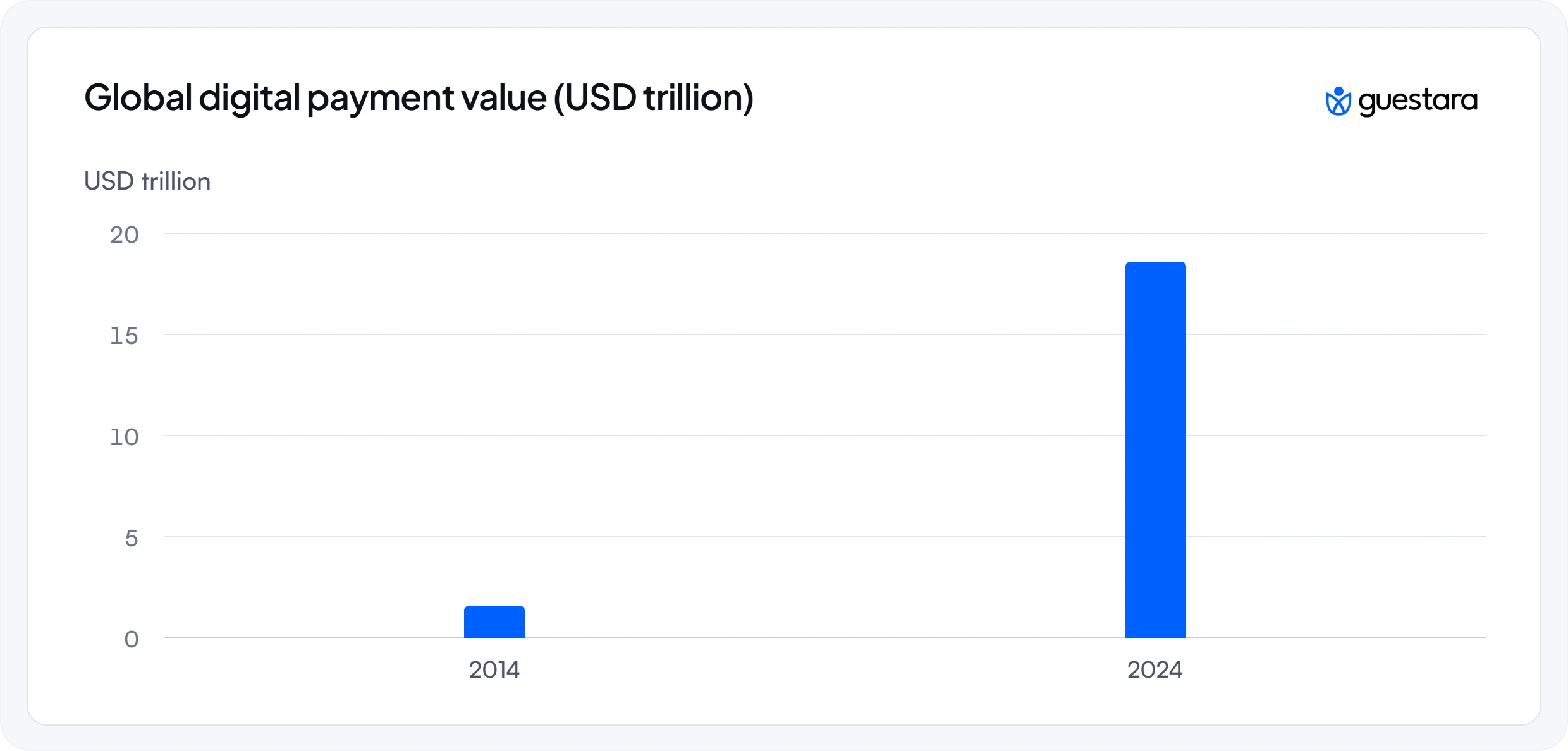
The scale of the shift is hard to overstate. Global spending through digital payment methods grew from 1.7 trillion dollars in 2014 to 18.7 trillion dollars in 2024, a nearly elevenfold rise in a decade (Worldpay Global Payments Report, 2025). Guests now expect to pay a hotel the same way they pay for everything else.
Choosing which options to offer is only half the picture. Processing them safely is the other half, which we cover in our guide to hotel payment processing best practices. This post is about the choosing.
Key takeaways
Hotels should offer more than one payment option because guests abandon bookings when their preferred method is missing, and that preferred method now varies sharply by age and country. Offering a single way to pay quietly loses you the guests whose habit does not match it.
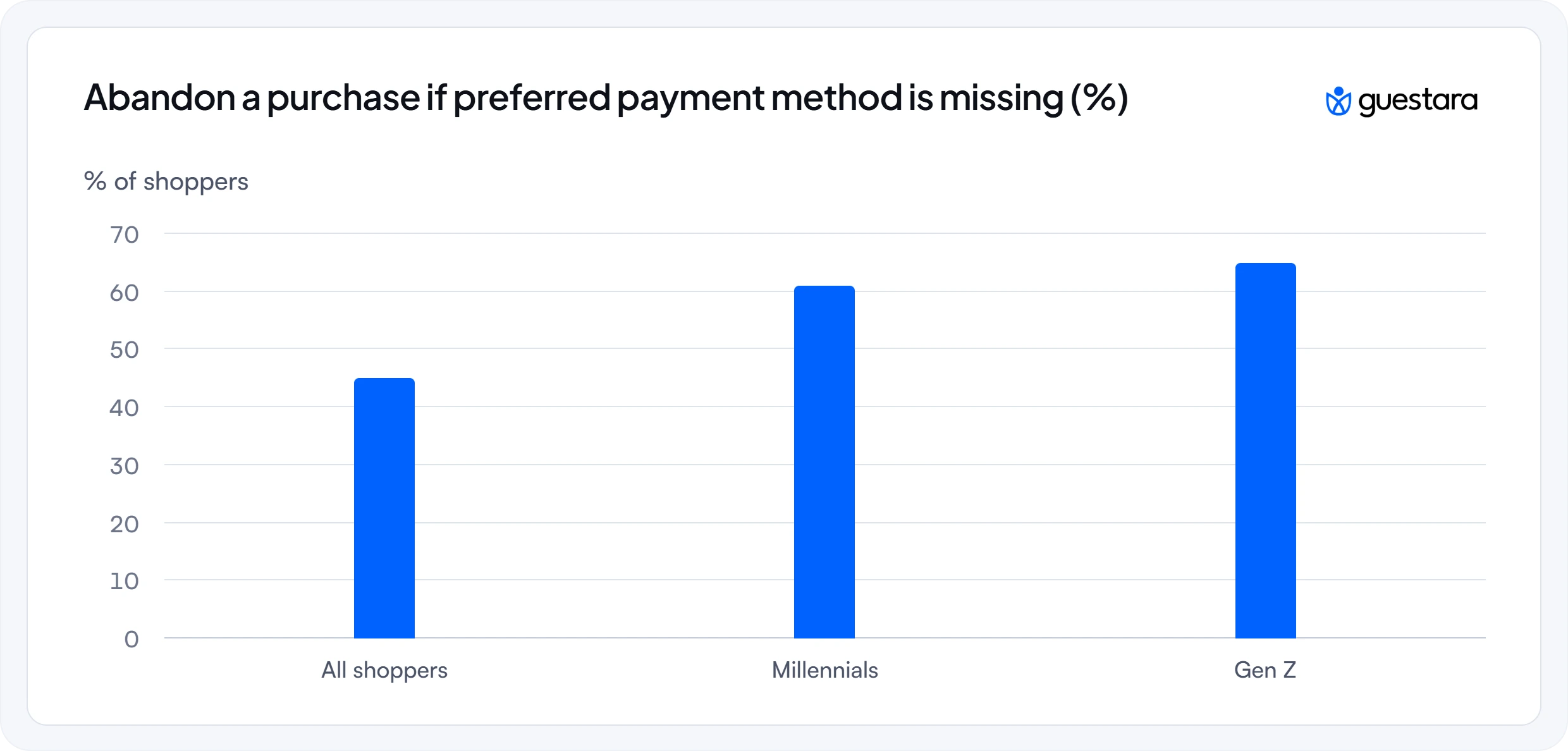
The abandonment pattern is well documented. One 2025 consumer study found that 45 percent of all shoppers had walked away from a purchase in the past year because their preferred payment method was not available, rising to 65 percent of Gen Z and 61 percent of Millennials (Access PaySuite, 2025). A hotel booking is a high-value purchase, so the same friction costs you real revenue.
Two guest groups make this urgent. Younger travelers lean on digital wallets and expect a phone-first checkout. International travelers arrive with the method their home country runs on, which is often not a card.
There is an upside beyond avoided losses. Every extra relevant option is a chance to convert an in-stay upsell that a guest would otherwise skip because paying was a hassle. More ways to pay means more moments where paying is easy.
Key takeaways
Every hotel, whatever its size or country, should accept a core tier of four method families before adding anything specialized. These cover the vast majority of guests and are the baseline a modern property is judged against.
The direction of travel is clear. Digital wallets accounted for 56 percent of global e-commerce value in 2025, overtaking cards as the leading online method, according to the Worldpay Global Payments Report. Cards are not going anywhere, with consumers spending more than 16 trillion dollars through them in 2025, but a card-only hotel now looks dated to a large share of guests.
The pay-by-link option matters most for hotels. Guestara's Payments module sends a secure payment link over WhatsApp, email, or SMS through Guestara's Unified Inbox, so a guest can settle a deposit or a balance in one tap without a card ever being handled by staff. You can see how the full flow works on the Guestara hotel payments platform.
Key takeaways
.webp)
The single biggest factor in choosing payment options is where your guests come from, because the dominant method changes completely across markets. A method that is essential in one country is barely used in another, so a global guest base needs a deliberately mixed set.
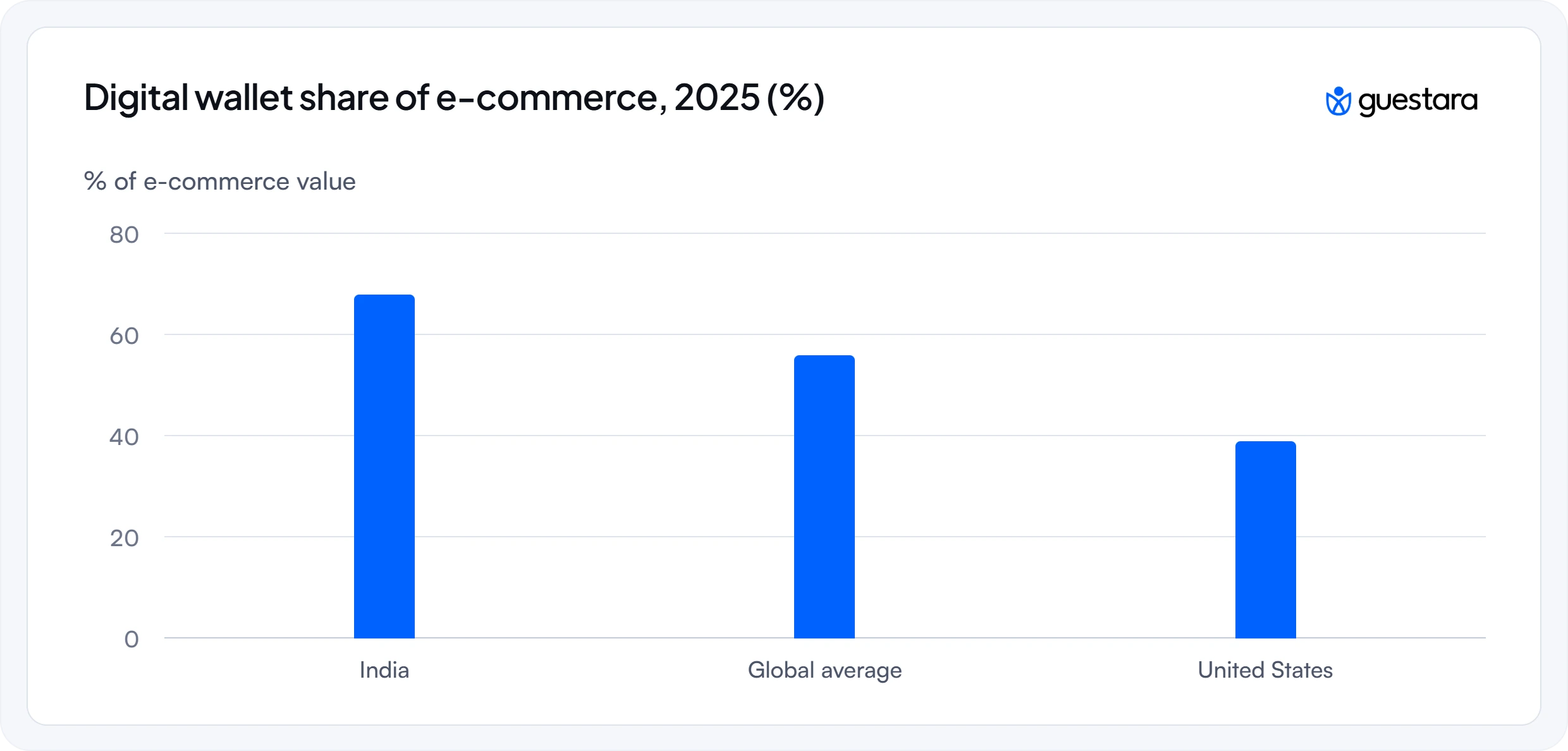
India is the clearest case. UPI carried 85.5 percent of the country's digital payment transaction volume in the second half of 2025, according to the Reserve Bank of India Payment System Report. Digital wallets reached 68 percent of Indian e-commerce value the same year. A hotel serving Indian guests that does not take UPI is turning away the method most of them use by default.
The contrast with the United States is sharp, where cards remain entrenched and digital wallets sit at about 39 percent of e-commerce value. This is exactly why "offer every method" is the wrong instruction. The right instruction is to lead with the method your specific guests use, then cover the rest.
Guestara's Payments module supports cards, digital wallets, UPI, and pay-by-link collection, so a property can switch on the methods its guest mix actually needs rather than bolting on a separate tool for each.
Key takeaways
The best payment option depends on the moment in the stay, so the right approach maps methods to booking, pre-arrival, in-stay, and checkout rather than offering everything everywhere. Each moment has a job, and the method that fits one moment often does not fit another.
At booking, the goal is to secure money without friction, which is where a card on file or a pay-by-link deposit fits. Guestara's Payments module collects the deposit and tokenizes the card, and you can set the rules once for how you collect security deposits and handle card authorization.
In the room, the winning option is in-app payment at the point of order. When a guest orders through Guestara's Upsell menu, payment and request move together, which is what makes mobile food and in-room ordering convert instead of becoming a charge chased later.
At checkout, the guest should settle on their phone. Guestara's Smart Checkout lets them clear pending charges and sign the folio with no download, and you can see it on the smart checkout page. The room releases for housekeeping the moment payment clears.
Key takeaways
[[cta:cta-1 | heading=Give guests every way to *pay and never chase a charge*.| btn=Explore Personalised Upsell | link=https://www.guestara.com/hotel-upsell-software ]]
Every payment option carries a different risk and cost, so a hotel should weigh chargeback exposure, fees, settlement speed, and compliance load before adding one. Offering a method is not free, and the cheapest-looking option for the guest is not always the cheapest for you.
Card-not-present bookings are the highest-risk line, because the card is never physically present and disputes are easy to file. For the full playbook on cutting those disputes, see the chargeback section of our hotel payment processing guide.
Two options need a second look before you commit. Buy now pay later shifts collection risk to a provider but takes a fee and can delay your payout. Cryptocurrency stays niche and adds conversion cost and handling, so it rarely earns its place for a mainstream property.
The safest options for a hotel are the ones that store no card data and settle fast, which is why account-to-account rails and tokenized wallets are attractive. Guestara's Payments module verifies card-not-present charges with 3D Secure and address checks and keeps cards tokenized, so the higher-risk methods carry the protection they need.
Key takeaways
.webp)
A hotel should offer enough options to cover the methods its specific guests actually use, and no more, because every extra method adds reconciliation and compliance overhead. More is not better. Relevant is better.
The trap is chasing a long list for its own sake. A page boasting twenty-plus methods looks thorough, but half of them see almost no use while each one still has to be reconciled, supported, and kept compliant. That is cost with no return.
A simple rule keeps the set tight. Start with the core tier from earlier: cards, contactless and wallets, and pay by link. Add the top one or two methods for the regions your guests come from, such as UPI for Indian guests. Stop there, and revisit only when your guest mix changes.
This discipline matters because the goal was never volume. It was covering the preferred method of each guest so none of them abandon, which the abandonment research shows is what actually drives lost sales. A focused set of six well-run options beats twenty half-supported ones.
Key takeaways
Adding a new payment option is a five-step process, and skipping any step is where hotels end up with a method that costs more than it earns. Work through them in order before you switch anything on.
The reconciliation step is where an integrated platform earns its keep. Guestara's Payments module syncs every method back to the PMS in real time and onboards in about one week, so a new option lands against the right booking automatically instead of in a spreadsheet. Guestara integrates with major PMS systems including Cloudbeds, Hotelogix, Apaleo, and SiteMinder.
Key takeaways
[[cta:cta-7 | eyebrow=PAYMENT OPTIONS | heading=Offer *every payment method* your guests actually use.| btn=Explore Guestara Payments | link=https://www.guestara.com/hotel-payments ]]


A hotelier's guide to hotel payment options: the methods guests actually use, by region and stay moment, from cards and UPI to wallets and pay by link.
Hotel payment options are the different ways you let guests pay, from cards and digital wallets to UPI, bank transfer, and pay by link. The right question is not how many you can list. It is which ones your guests actually reach for, and when.
Picture three guests at your property this week. One from Bengaluru opens your payment page to pay by UPI, and the desk takes only cards. One from London wants to tap a phone and cannot. One corporate booker needs a proper invoice and gets a card terminal instead.
Each one hit a wall. Each one is a booking, an upsell, or a repeat stay you nearly lost, for a reason that had nothing to do with your rooms.
This guide covers which hotel payment options to offer, by guest type, region, and stay moment, without drowning your team in reconciliation.
Hotel payment options are the full set of methods a property accepts for room charges, deposits, and extras, across every point of the stay. A method is how the guest pays. A card, a digital wallet, a bank transfer, a pay-by-link click. It is different from the channel or moment, which is where and when they pay, at booking, before arrival, in the room, or at checkout.
The menu of methods has grown far past cash and cards. Today it spans credit and debit cards, contactless taps, digital wallets like Apple Pay and Google Pay, account-to-account rails like UPI in India and SEPA in Europe, buy now pay later, corporate billing, and loyalty points.
The scale of the shift is hard to overstate. Global spending through digital payment methods grew from 1.7 trillion dollars in 2014 to 18.7 trillion dollars in 2024, a nearly elevenfold rise in a decade (Worldpay Global Payments Report, 2025). Guests now expect to pay a hotel the same way they pay for everything else.
Choosing which options to offer is only half the picture. Processing them safely is the other half, which we cover in our guide to hotel payment processing best practices. This post is about the choosing.
Key takeaways
Hotels should offer more than one payment option because guests abandon bookings when their preferred method is missing, and that preferred method now varies sharply by age and country. Offering a single way to pay quietly loses you the guests whose habit does not match it.
The abandonment pattern is well documented. One 2025 consumer study found that 45 percent of all shoppers had walked away from a purchase in the past year because their preferred payment method was not available, rising to 65 percent of Gen Z and 61 percent of Millennials (Access PaySuite, 2025). A hotel booking is a high-value purchase, so the same friction costs you real revenue.
Two guest groups make this urgent. Younger travelers lean on digital wallets and expect a phone-first checkout. International travelers arrive with the method their home country runs on, which is often not a card.
There is an upside beyond avoided losses. Every extra relevant option is a chance to convert an in-stay upsell that a guest would otherwise skip because paying was a hassle. More ways to pay means more moments where paying is easy.
Key takeaways
Every hotel, whatever its size or country, should accept a core tier of four method families before adding anything specialized. These cover the vast majority of guests and are the baseline a modern property is judged against.
The direction of travel is clear. Digital wallets accounted for 56 percent of global e-commerce value in 2025, overtaking cards as the leading online method, according to the Worldpay Global Payments Report. Cards are not going anywhere, with consumers spending more than 16 trillion dollars through them in 2025, but a card-only hotel now looks dated to a large share of guests.
The pay-by-link option matters most for hotels. Guestara's Payments module sends a secure payment link over WhatsApp, email, or SMS through Guestara's Unified Inbox, so a guest can settle a deposit or a balance in one tap without a card ever being handled by staff. You can see how the full flow works on the Guestara hotel payments platform.
Key takeaways
The single biggest factor in choosing payment options is where your guests come from, because the dominant method changes completely across markets. A method that is essential in one country is barely used in another, so a global guest base needs a deliberately mixed set.
India is the clearest case. UPI carried 85.5 percent of the country's digital payment transaction volume in the second half of 2025, according to the Reserve Bank of India Payment System Report. Digital wallets reached 68 percent of Indian e-commerce value the same year. A hotel serving Indian guests that does not take UPI is turning away the method most of them use by default.
The contrast with the United States is sharp, where cards remain entrenched and digital wallets sit at about 39 percent of e-commerce value. This is exactly why "offer every method" is the wrong instruction. The right instruction is to lead with the method your specific guests use, then cover the rest.
Guestara's Payments module supports cards, digital wallets, UPI, and pay-by-link collection, so a property can switch on the methods its guest mix actually needs rather than bolting on a separate tool for each.
Key takeaways
The best payment option depends on the moment in the stay, so the right approach maps methods to booking, pre-arrival, in-stay, and checkout rather than offering everything everywhere. Each moment has a job, and the method that fits one moment often does not fit another.
At booking, the goal is to secure money without friction, which is where a card on file or a pay-by-link deposit fits. Guestara's Payments module collects the deposit and tokenizes the card, and you can set the rules once for how you collect security deposits and handle card authorization.
In the room, the winning option is in-app payment at the point of order. When a guest orders through Guestara's Upsell menu, payment and request move together, which is what makes mobile food and in-room ordering convert instead of becoming a charge chased later.
At checkout, the guest should settle on their phone. Guestara's Smart Checkout lets them clear pending charges and sign the folio with no download, and you can see it on the smart checkout page. The room releases for housekeeping the moment payment clears.
Key takeaways
[[cta:cta-1 | heading=Give guests every way to *pay and never chase a charge*.| btn=Explore Personalised Upsell | link=https://www.guestara.com/hotel-upsell-software ]]
Every payment option carries a different risk and cost, so a hotel should weigh chargeback exposure, fees, settlement speed, and compliance load before adding one. Offering a method is not free, and the cheapest-looking option for the guest is not always the cheapest for you.
Card-not-present bookings are the highest-risk line, because the card is never physically present and disputes are easy to file. For the full playbook on cutting those disputes, see the chargeback section of our hotel payment processing guide.
Two options need a second look before you commit. Buy now pay later shifts collection risk to a provider but takes a fee and can delay your payout. Cryptocurrency stays niche and adds conversion cost and handling, so it rarely earns its place for a mainstream property.
The safest options for a hotel are the ones that store no card data and settle fast, which is why account-to-account rails and tokenized wallets are attractive. Guestara's Payments module verifies card-not-present charges with 3D Secure and address checks and keeps cards tokenized, so the higher-risk methods carry the protection they need.
Key takeaways
A hotel should offer enough options to cover the methods its specific guests actually use, and no more, because every extra method adds reconciliation and compliance overhead. More is not better. Relevant is better.
The trap is chasing a long list for its own sake. A page boasting twenty-plus methods looks thorough, but half of them see almost no use while each one still has to be reconciled, supported, and kept compliant. That is cost with no return.
A simple rule keeps the set tight. Start with the core tier from earlier: cards, contactless and wallets, and pay by link. Add the top one or two methods for the regions your guests come from, such as UPI for Indian guests. Stop there, and revisit only when your guest mix changes.
This discipline matters because the goal was never volume. It was covering the preferred method of each guest so none of them abandon, which the abandonment research shows is what actually drives lost sales. A focused set of six well-run options beats twenty half-supported ones.
Key takeaways
Adding a new payment option is a five-step process, and skipping any step is where hotels end up with a method that costs more than it earns. Work through them in order before you switch anything on.
The reconciliation step is where an integrated platform earns its keep. Guestara's Payments module syncs every method back to the PMS in real time and onboards in about one week, so a new option lands against the right booking automatically instead of in a spreadsheet. Guestara integrates with major PMS systems including Cloudbeds, Hotelogix, Apaleo, and SiteMinder.
Key takeaways
[[cta:cta-7 | eyebrow=PAYMENT OPTIONS | heading=Offer *every payment method* your guests actually use.| btn=Explore Guestara Payments | link=https://www.guestara.com/hotel-payments ]]
A hotel payment method is any way a property lets a guest pay for a room, deposit, or extra charge. It ranges from the familiar, like credit and debit cards, to the regional, like UPI in India or SEPA in Europe, to newer options like digital wallets and buy now pay later. The method is how the guest pays, which is separate from when in the stay they pay.
A small hotel should start with the core tier: credit and debit cards, contactless and digital wallets, and a pay-by-link option for remote bookings. It should then add the one or two methods most used by its typical guests, such as UPI for a property serving Indian travelers. This covers almost everyone without the overhead of supporting methods that see little use.
Many modern hotels accept both, and in some markets they are essential rather than optional. UPI carried 85.5 percent of India's digital payment volume in the second half of 2025, so a hotel serving Indian guests that skips it is turning away most guests' default method. Digital wallets like Apple Pay and Google Pay are now the leading online payment method globally, so accepting them is close to a baseline expectation.
A hotel should offer enough options to cover the methods its guests actually use, and no more. Every extra method has to be reconciled, supported, and kept compliant, so a long list of rarely used options is cost without return. The practical set is the core tier of cards, wallets, and pay by link, plus the top one or two methods for the regions the hotel's guests come from.
Offering the right payment options increases bookings by removing a common reason guests abandon a purchase, which one 2025 study put at 45 percent of all shoppers and 65 percent of Gen Z. The key word is right, not more, because relevance drives the gain, not volume. Adding a method your guests do not use adds cost without lifting conversion, while adding the method they prefer directly reduces lost bookings.
We work closely with the industry leaders to offer seamless solutions




We’re here to help your whole team stay ahead of the curve as you grow.

Get up and running quickly with a personalized onboarding plan

Connect with real people who really get it, 24/7

Checkout our vast library of free resources, templates and more
There's only so much we can say — so let us show you! Schedule a demo today and reach your business goals.


.png)