Hotel market segmentation explained: the three demand types, how segment differs from source and rate code, and how to build a segment mix that holds up.




Ask two people at the same hotel which segment a booking belongs to and you will often get two answers. The reservations agent says it came from Booking.com. The sales manager says it is corporate. The owner looks at the month-end report, sees a segment called Other holding 30% of room nights, and stops trusting the report entirely.
That is a segmentation problem, and it costs money quietly. Every pricing decision, every forecast and every campaign is built on top of those buckets. If the buckets are wrong, so is everything stacked on them. Here is how segmentation actually works and how to set it up so the report holds.
Hotel market segmentation is the practice of grouping bookings by the type of demand that produced them, such as individual travellers, blocked groups or contracted crews. Each segment behaves differently on price, lead time and length of stay. Segmenting lets a property forecast, price and market to each group separately rather than treating all demand as one.
Hotel market segmentation sorts every booking into a defined category based on how and why the business arrived, then reports occupancy, average rate and revenue separately for each one. The purpose is not classification for its own sake. It is to see which demand is worth more, which is worth less, and which is displacing the other.
A single blended occupancy number hides all of that. At 80% occupancy the property looks healthy whether the rooms were sold at rack rate to last-minute arrivals or handed to a tour operator at a deep discount. Segmented, those are two entirely different months, and they call for opposite decisions next year.
Segmentation sits underneath four daily jobs:
Market segmentation matters because the same room night is worth different amounts depending on who bought it, and only a segmented view shows the difference. Without it, a property manages to an average that describes none of its actual business.
The clearest example is displacement. A fifty-room block at a discounted group rate looks like a good week on the occupancy report. If those dates were going to fill with individual bookings at a higher rate anyway, the block cost the property money while appearing to make it. That calculation is impossible without knowing what each segment yields.
Lead time is the second reason. Contracted and group business commits months out. Individual bookings arrive in the final two weeks and respond sharply to price. A property that knows its mix can read its booking pace in early October and act in time, instead of discovering the shortfall in November.
Seasonality is the third. Most properties have segments that carry the low season and segments that should be restricted in the high season. Treating all demand as one means accepting low-yield business on the dates you least need it.
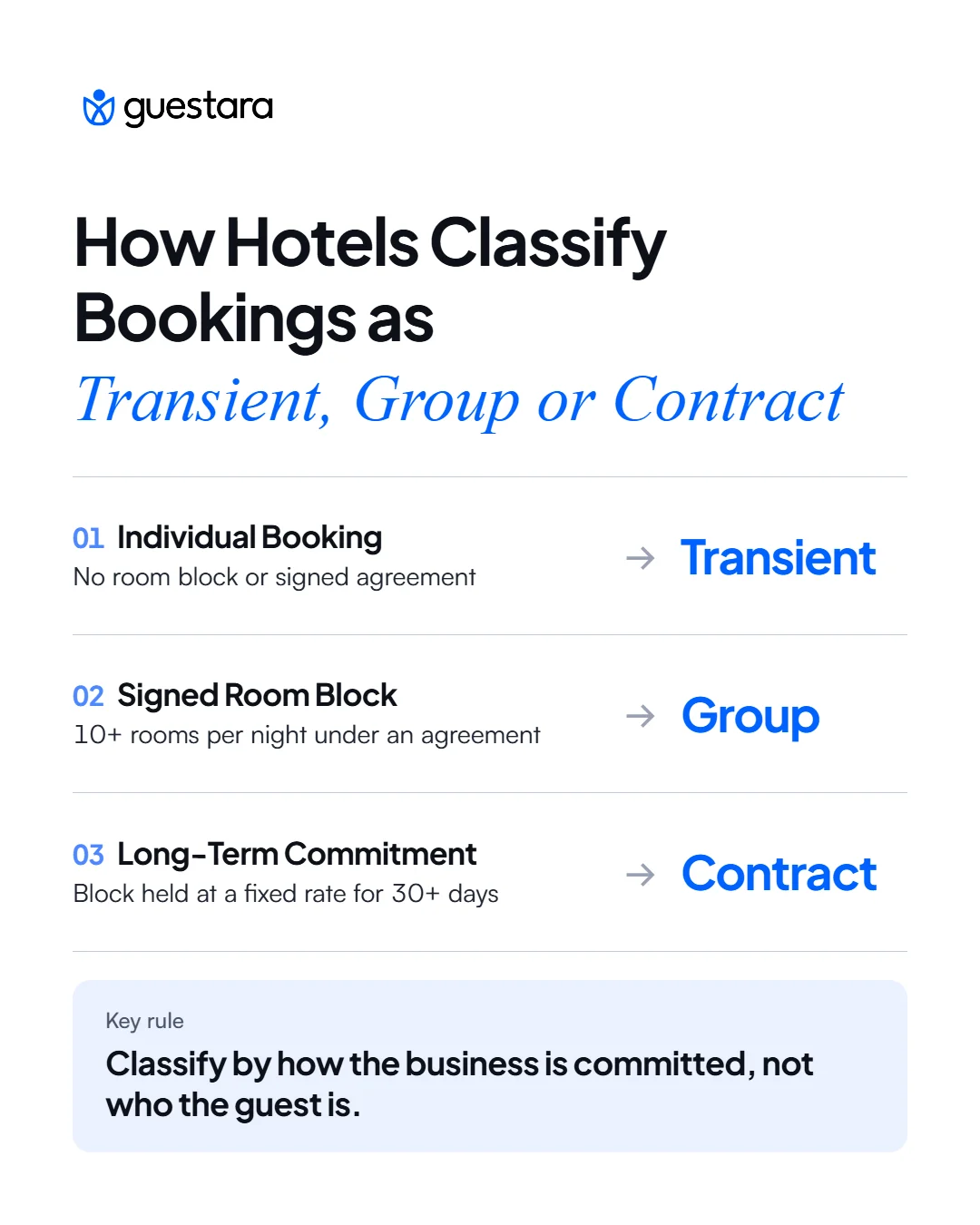
Hotel benchmarking is built on three demand types: transient, group and contract. Every finer segment a property runs sits underneath one of these three. The definitions come from the industry reporting standards used for benchmarking and in the Uniform System of Accounts for the Lodging Industry, where rooms sold is the sum of transient, group and contract rooms.
The three split along how the business was committed, not who the traveller is.
Notice what sits inside transient. Corporate negotiated rates are transient business, because the traveller books individually even though the rate was agreed in advance. Many properties file corporate under group by instinct, and the report is wrong from that point forward.
A group is typically defined as 10 or more rooms per night sold under a signed agreement. Both halves of that matter. Ten friends booking ten rooms separately on an OTA is transient business ten times over, not a group, because no agreement was signed and no block was held.
The signed agreement is what creates the obligations that make group business different: a cut-off date, an attrition clause covering rooms blocked but not filled, and a rate held regardless of what the market does in between.
Contract business is a consistent block of rooms committed at a stipulated rate for an extended period, conventionally more than 30 days, with payment guaranteed whether or not the rooms are used. Airline crew contracts are the standard example.
Most independent hotels have no contract business and can leave the segment empty. Airport properties, hotels near long-running project sites and city hotels with corporate long-stay arrangements usually do, and filing it as transient distorts both segments at once. Contract rates are low but guaranteed, so they drag the transient average rate down while hiding genuinely committed revenue.
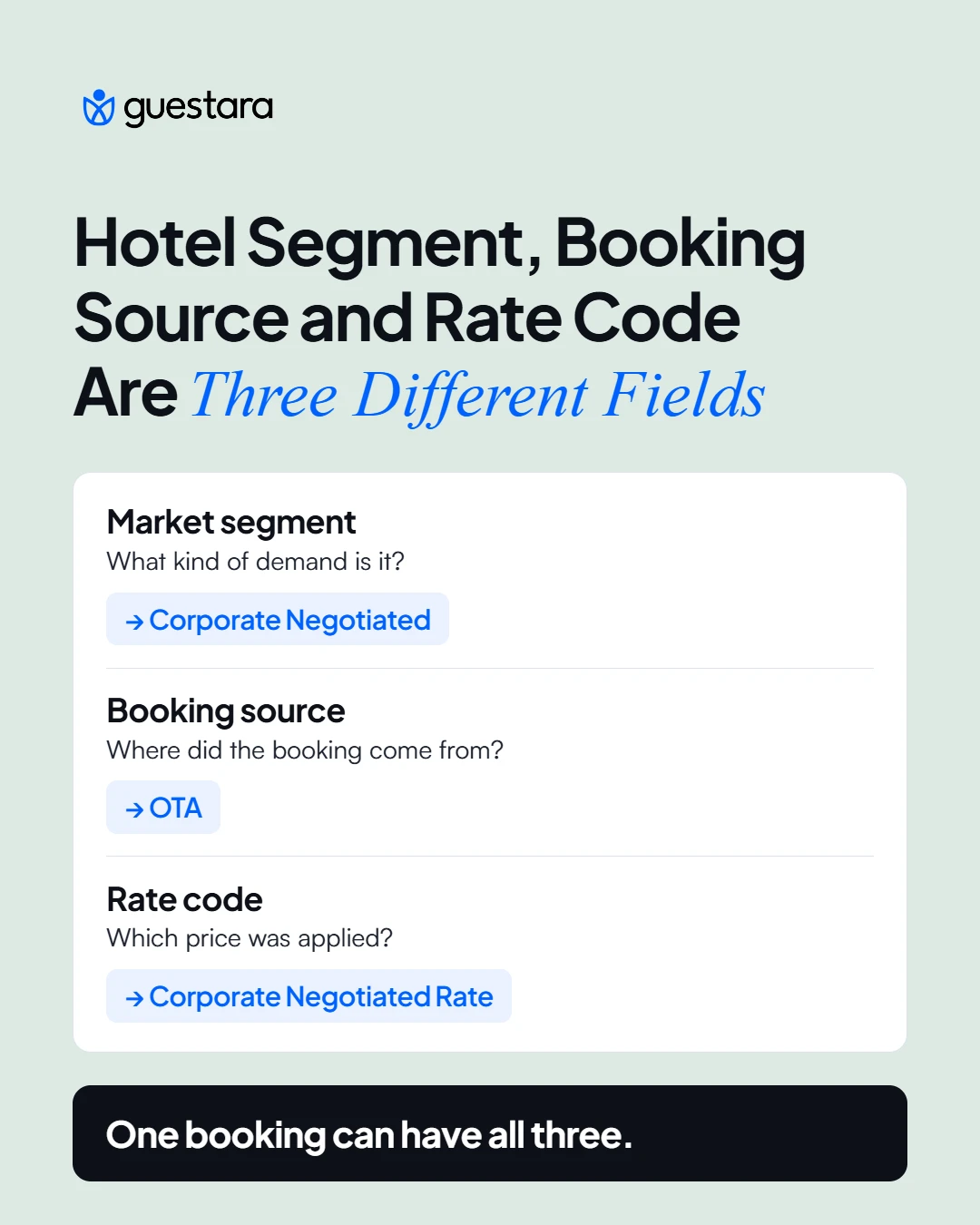
Market segment, booking source and rate code are three separate fields that answer three separate questions, and confusing them is the most common reason a hotel's segment report cannot be trusted. A booking has all three at once.
A corporate traveller books a negotiated rate through an online travel agency. The segment is corporate negotiated. The source is the OTA. The rate code is the negotiated corporate code. Record any one of those in place of the others and the report starts describing something nobody asked about.
The practical test is whether the fields move independently. If every OTA booking in the system automatically carries the segment OTA, the property is recording source twice and has no segmentation at all. Channel tells you what to pay in commission. Segment tells you what the business is worth and whether to take more of it.
Properties that get this wrong usually discover it the same way: a segment named Other or Miscellaneous grows until it holds a fifth of all room nights, because the bookings that did not fit a channel name had nowhere else to go.
Beyond the three demand types, hotels segment guests along five analytical dimensions. These describe the traveller rather than the booking, and they sit on top of the demand types rather than replacing them. They shape marketing and service decisions, not benchmarking reports.
Keep these separate from the demand types in the system. A property that creates a psychographic segment called Wellness Travellers inside its PMS market segment field has just broken its benchmarking, because those guests are already transient business and are now being counted somewhere else. Analytical segments belong in marketing lists and guest profiles, not in the field that feeds the revenue report.
Build a segment mix by starting from the three demand types, splitting each one only where the split would change a decision, and coding every booking consistently from that point on. The common failure is designing an elegant twelve-segment structure that nobody maintains past the first month.
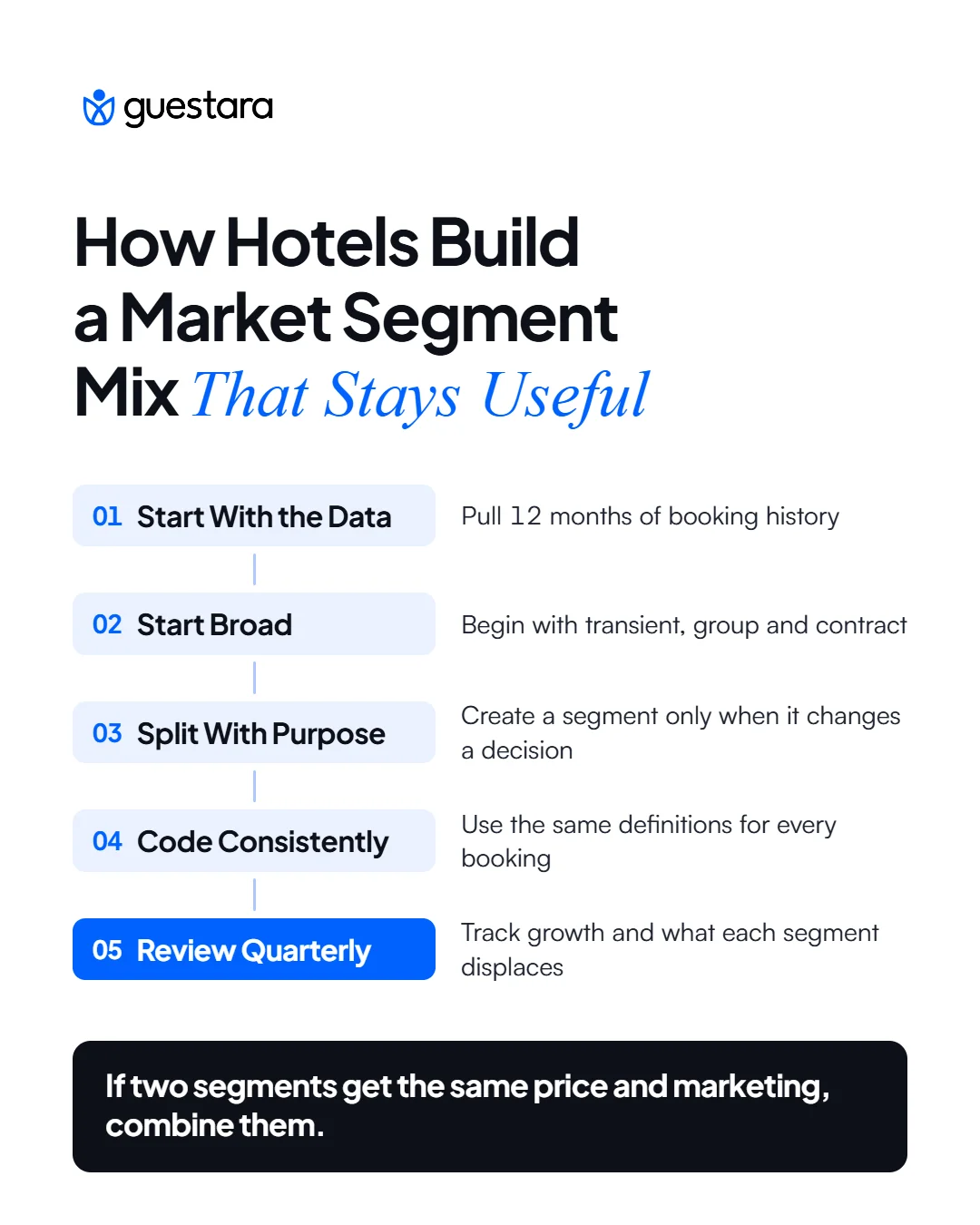
Start with what the property already records on every booking: rate paid, lead time, length of stay, booking channel and purpose of stay where it is captured. These five fields produce a workable segmentation on their own.
Pull twelve months of history before designing anything. Patterns that look obvious from the front desk often disappear in the data, and segments worth separating usually announce themselves as clusters in lead time and rate rather than as categories someone names in a meeting.
Use the smallest number that changes a decision. If two segments get the same price on the same dates and the same marketing, they are one segment wearing two names.
A practical structure for an independent hotel runs five: retail transient, discounted transient including OTA promotional rates, corporate negotiated, group, and contract if any exists. Properties with a strong wholesale relationship add a sixth.
Then hold the line. A segment structure delivers value through consistency over time, and recoding the definitions halfway through a year destroys the year-on-year comparison that made the exercise worth doing.
Review quarterly against two questions: which segment grew, and what did it displace. Growth in a low-yield segment on high-demand dates is a loss disguised as an occupancy gain.
Once the mix is reliable, the offers can follow it. Segment-specific packages work because they match what that group already books for, and a property running targeted offers through Guestara's Upsell can fire a late checkout to a corporate segment and a family activity bundle to a leisure one from the same menu.
A property under 40 rooms with most of its business arriving through online travel agencies still needs segmentation, but not the structure a 300-room city hotel runs. Five segments across 30 rooms produces cells too small to read, where one booking moves the average rate by a visible margin and every trend looks like noise.
The honest version for a small property is three segments, coded perfectly, reviewed monthly.
For OTA-dependent properties specifically, the segment that matters most is the one most often missed. Split retail transient from discounted transient, including promotional and mobile rates, and the real picture appears: how much inventory is selling below the published rate, and whether the discount is buying incremental demand or discounting demand that would have arrived anyway.
Six mistakes account for most unusable segment reports, and all six are recording errors rather than strategy errors. They are worth checking before any conclusion is drawn from the data.
Run a simple audit before trusting any segment report: pull last month's bookings, take a sample of twenty, and code each one by hand. If the manual coding and the system coding disagree on more than two, fix the coding before changing the pricing.
[[cta:cta-5 | eyebrow=Guest Engagement | heading=See how segment-specific messages reach *the right guest* | btn=Explore Guest Engagement | link=https://www.guestara.com/guest-engagement-for-hospitality ]]


Hotel market segmentation explained: the three demand types, how segment differs from source and rate code, and how to build a segment mix that holds up.
Ask two people at the same hotel which segment a booking belongs to and you will often get two answers. The reservations agent says it came from Booking.com. The sales manager says it is corporate. The owner looks at the month-end report, sees a segment called Other holding 30% of room nights, and stops trusting the report entirely.
That is a segmentation problem, and it costs money quietly. Every pricing decision, every forecast and every campaign is built on top of those buckets. If the buckets are wrong, so is everything stacked on them. Here is how segmentation actually works and how to set it up so the report holds.
Hotel market segmentation is the practice of grouping bookings by the type of demand that produced them, such as individual travellers, blocked groups or contracted crews. Each segment behaves differently on price, lead time and length of stay. Segmenting lets a property forecast, price and market to each group separately rather than treating all demand as one.
Hotel market segmentation sorts every booking into a defined category based on how and why the business arrived, then reports occupancy, average rate and revenue separately for each one. The purpose is not classification for its own sake. It is to see which demand is worth more, which is worth less, and which is displacing the other.
A single blended occupancy number hides all of that. At 80% occupancy the property looks healthy whether the rooms were sold at rack rate to last-minute arrivals or handed to a tour operator at a deep discount. Segmented, those are two entirely different months, and they call for opposite decisions next year.
Segmentation sits underneath four daily jobs:
Market segmentation matters because the same room night is worth different amounts depending on who bought it, and only a segmented view shows the difference. Without it, a property manages to an average that describes none of its actual business.
The clearest example is displacement. A fifty-room block at a discounted group rate looks like a good week on the occupancy report. If those dates were going to fill with individual bookings at a higher rate anyway, the block cost the property money while appearing to make it. That calculation is impossible without knowing what each segment yields.
Lead time is the second reason. Contracted and group business commits months out. Individual bookings arrive in the final two weeks and respond sharply to price. A property that knows its mix can read its booking pace in early October and act in time, instead of discovering the shortfall in November.
Seasonality is the third. Most properties have segments that carry the low season and segments that should be restricted in the high season. Treating all demand as one means accepting low-yield business on the dates you least need it.
Hotel benchmarking is built on three demand types: transient, group and contract. Every finer segment a property runs sits underneath one of these three. The definitions come from the industry reporting standards used for benchmarking and in the Uniform System of Accounts for the Lodging Industry, where rooms sold is the sum of transient, group and contract rooms.
The three split along how the business was committed, not who the traveller is.
Notice what sits inside transient. Corporate negotiated rates are transient business, because the traveller books individually even though the rate was agreed in advance. Many properties file corporate under group by instinct, and the report is wrong from that point forward.
A group is typically defined as 10 or more rooms per night sold under a signed agreement. Both halves of that matter. Ten friends booking ten rooms separately on an OTA is transient business ten times over, not a group, because no agreement was signed and no block was held.
The signed agreement is what creates the obligations that make group business different: a cut-off date, an attrition clause covering rooms blocked but not filled, and a rate held regardless of what the market does in between.
Contract business is a consistent block of rooms committed at a stipulated rate for an extended period, conventionally more than 30 days, with payment guaranteed whether or not the rooms are used. Airline crew contracts are the standard example.
Most independent hotels have no contract business and can leave the segment empty. Airport properties, hotels near long-running project sites and city hotels with corporate long-stay arrangements usually do, and filing it as transient distorts both segments at once. Contract rates are low but guaranteed, so they drag the transient average rate down while hiding genuinely committed revenue.
Market segment, booking source and rate code are three separate fields that answer three separate questions, and confusing them is the most common reason a hotel's segment report cannot be trusted. A booking has all three at once.
A corporate traveller books a negotiated rate through an online travel agency. The segment is corporate negotiated. The source is the OTA. The rate code is the negotiated corporate code. Record any one of those in place of the others and the report starts describing something nobody asked about.
The practical test is whether the fields move independently. If every OTA booking in the system automatically carries the segment OTA, the property is recording source twice and has no segmentation at all. Channel tells you what to pay in commission. Segment tells you what the business is worth and whether to take more of it.
Properties that get this wrong usually discover it the same way: a segment named Other or Miscellaneous grows until it holds a fifth of all room nights, because the bookings that did not fit a channel name had nowhere else to go.
Beyond the three demand types, hotels segment guests along five analytical dimensions. These describe the traveller rather than the booking, and they sit on top of the demand types rather than replacing them. They shape marketing and service decisions, not benchmarking reports.
Keep these separate from the demand types in the system. A property that creates a psychographic segment called Wellness Travellers inside its PMS market segment field has just broken its benchmarking, because those guests are already transient business and are now being counted somewhere else. Analytical segments belong in marketing lists and guest profiles, not in the field that feeds the revenue report.
Build a segment mix by starting from the three demand types, splitting each one only where the split would change a decision, and coding every booking consistently from that point on. The common failure is designing an elegant twelve-segment structure that nobody maintains past the first month.
Start with what the property already records on every booking: rate paid, lead time, length of stay, booking channel and purpose of stay where it is captured. These five fields produce a workable segmentation on their own.
Pull twelve months of history before designing anything. Patterns that look obvious from the front desk often disappear in the data, and segments worth separating usually announce themselves as clusters in lead time and rate rather than as categories someone names in a meeting.
Use the smallest number that changes a decision. If two segments get the same price on the same dates and the same marketing, they are one segment wearing two names.
A practical structure for an independent hotel runs five: retail transient, discounted transient including OTA promotional rates, corporate negotiated, group, and contract if any exists. Properties with a strong wholesale relationship add a sixth.
Then hold the line. A segment structure delivers value through consistency over time, and recoding the definitions halfway through a year destroys the year-on-year comparison that made the exercise worth doing.
Review quarterly against two questions: which segment grew, and what did it displace. Growth in a low-yield segment on high-demand dates is a loss disguised as an occupancy gain.
Once the mix is reliable, the offers can follow it. Segment-specific packages work because they match what that group already books for, and a property running targeted offers through Guestara's Upsell can fire a late checkout to a corporate segment and a family activity bundle to a leisure one from the same menu.
A property under 40 rooms with most of its business arriving through online travel agencies still needs segmentation, but not the structure a 300-room city hotel runs. Five segments across 30 rooms produces cells too small to read, where one booking moves the average rate by a visible margin and every trend looks like noise.
The honest version for a small property is three segments, coded perfectly, reviewed monthly.
For OTA-dependent properties specifically, the segment that matters most is the one most often missed. Split retail transient from discounted transient, including promotional and mobile rates, and the real picture appears: how much inventory is selling below the published rate, and whether the discount is buying incremental demand or discounting demand that would have arrived anyway.
Six mistakes account for most unusable segment reports, and all six are recording errors rather than strategy errors. They are worth checking before any conclusion is drawn from the data.
Run a simple audit before trusting any segment report: pull last month's bookings, take a sample of twenty, and code each one by hand. If the manual coding and the system coding disagree on more than two, fix the coding before changing the pricing.
[[cta:cta-5 | eyebrow=Guest Engagement | heading=See how segment-specific messages reach *the right guest* | btn=Explore Guest Engagement | link=https://www.guestara.com/guest-engagement-for-hospitality ]]
Hotel benchmarking uses three demand types: transient, group and contract. Transient covers individually booked rooms including retail, discounted and corporate negotiated rates. Group covers rooms blocked under a signed agreement, conventionally 10 or more per night. Contract covers committed blocks held at a stipulated rate for more than 30 days, such as airline crew rooms.
Market segment records what kind of demand a booking represents, while booking source records which channel delivered it. A corporate traveller booking a negotiated rate through an online travel agency is corporate negotiated by segment and OTA by source. Recording the channel in the segment field is the most common segmentation error, because it leaves the property reporting the same information twice.
Use the smallest number that changes a decision, which for most independent hotels is three to five. If two segments receive the same price on the same dates and the same marketing, they are functionally one segment. Over-segmentation at a small property creates cells so small that single bookings distort the averages.
A group booking is typically 10 or more rooms per night sold under a signed agreement, which usually carries a cut-off date, an attrition clause and a fixed rate. The signed agreement is the defining feature. Ten rooms booked individually by ten people on the same dates are ten transient bookings rather than a group.
Segmentation shows which demand responds to price and which is fixed by agreement, so rates can be moved where movement works. Contract and negotiated rates are committed in advance and stay flat, while retail and discounted transient rates can be adjusted against demand. It also reveals displacement, meaning whether discounted business on a given date is replacing higher-yielding bookings.
We work closely with the industry leaders to offer seamless solutions




We’re here to help your whole team stay ahead of the curve as you grow.

Get up and running quickly with a personalized onboarding plan

Connect with real people who really get it, 24/7

Checkout our vast library of free resources, templates and more
There's only so much we can say — so let us show you! Schedule a demo today and reach your business goals.