Hotel attrition is the shortfall when a group misses its room-block commitment. Learn how attrition clauses work, how fees are calculated, and how to reduce risk.





Hotel attrition is the shortfall between the room nights a group commits to in its contract and the number its guests actually book.
Picture a wedding block booked months out. You hold 100 rooms off the market, turn away other business, and then only 70 rooms fill. Those empty rooms are lost revenue you cannot get back. The attrition clause is what decides who absorbs that loss. This guide explains what attrition means, how the clauses work, how to calculate the fee, how to write a clause that is fair to both sides, and how to handle a shortfall when it happens.
Hotel attrition is the difference between the number of room nights a group reserves in a booking contract and the number its attendees actually book. When the group falls short of the committed minimum, the hotel charges an attrition fee to recover part of the lost revenue.
The word appears mostly in contracts. On the floor you will hear it called block performance or pickup, which both describe the same thing: how many of the rooms set aside for a group actually got filled.
The mechanics are simple. A group commits to a minimum number of room nights. You take those rooms off the market and stop selling them to anyone else. A cut-off date arrives, unused rooms release back to inventory, and on arrival day you count the pickup. If the group filled fewer rooms than it promised, the attrition clause decides what the group owes.
It matters because a held room is a sold opportunity you gave up. Once a block is reserved, that inventory is committed, so a shortfall is revenue you cannot recover after arrival day.
One clarification. This is group room-block attrition, the contract clause. It is not staff attrition, which is employee turnover. Both use the word, and this guide is about the room block.
Hotel attrition hits revenue in two ways: the empty rooms themselves, and the ancillary spend those guests would have brought. A shortfall on a room block also disrupts the forecasting, staffing, and pricing decisions that were built around the group.
The best group business does more than fill rooms. A wedding block fills the banquet hall and the spa. A conference fills meeting space, catering, and the bar. When the block underperforms, you lose that connected revenue too, and the gap is hard to backfill on short notice.
There is a displacement cost as well. To hold a large block, you often turn away transient guests and smaller bookings for the same dates. If the group then falls short, you have lost both the block revenue and the business you declined to protect it. Strong ancillary spend can offset part of a room shortfall, which is why the healthiest group deals are measured on total account value, not room nights alone.
This is why attrition belongs in your revenue strategy from the first quote, not the cut-off date. A single underperforming block can pull down occupancy, waste prepared staffing hours, and force discounting to move the leftover inventory.
There are three main types of attrition clause: revenue-based, cumulative, and per-night. They differ in how they measure whether the group met its commitment, and each shifts risk differently between hotel and planner.
A revenue-based clause gives planners the most flexibility, since they can move between room types as long as the total spend lands. It also takes closer tracking to enforce, and it is more complex to calculate.
Cumulative is usually the most forgiving for the group, because strong nights can offset weak ones across the event. The trade-off is that it does not guarantee steady occupancy on any single night, which makes operational planning harder.
Per-night is the strictest and protects your nightly occupancy most tightly. It carries the highest shortfall risk for the group, especially on low-demand nights, so planners resist it on events with uneven attendance.
Whichever you use, state the allowable threshold clearly. Sample hotel contracts commonly set the required pickup at 80% to 85% of the block and frame any shortfall charge as liquidated damages rather than a penalty, which is the language that makes the term enforceable.
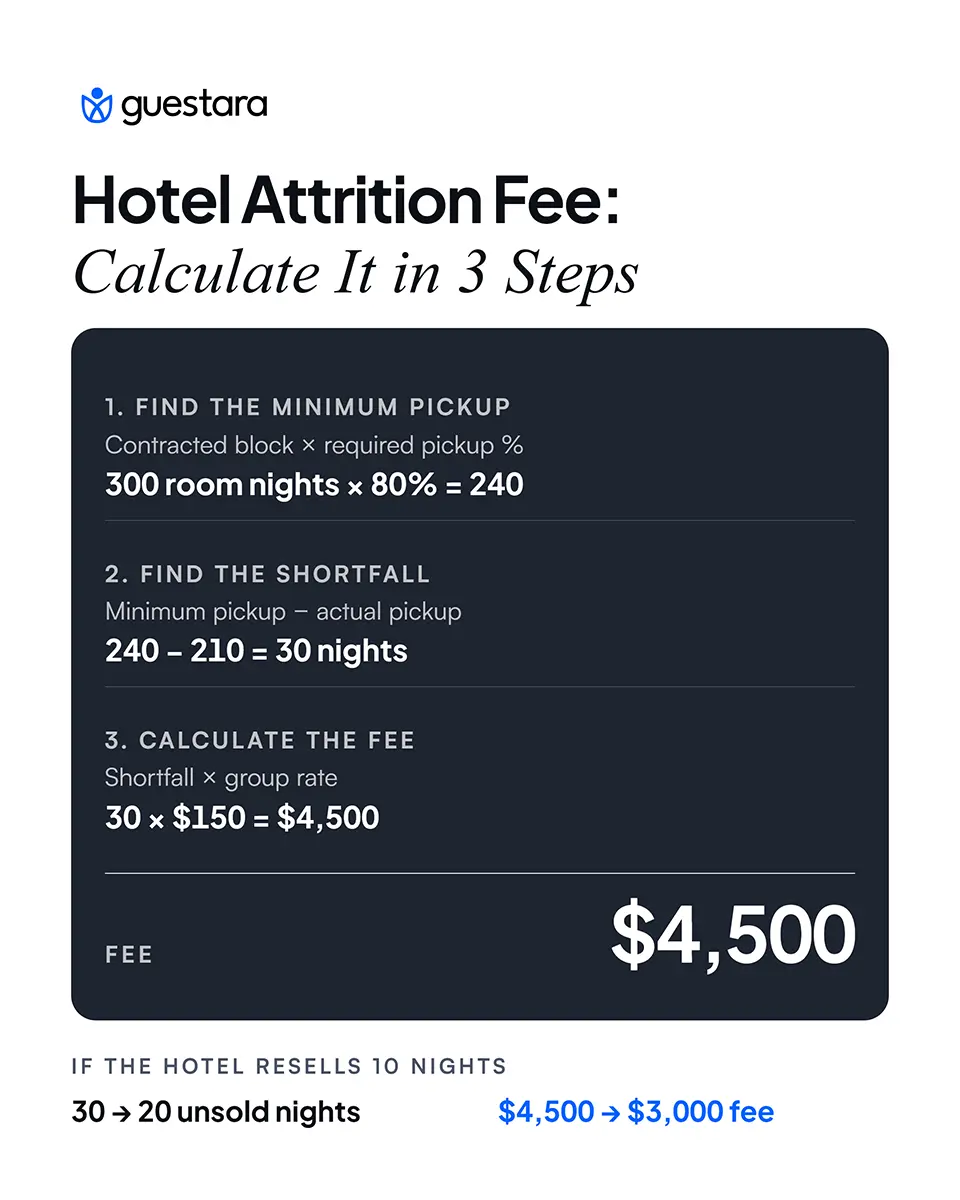
Calculate a hotel attrition fee in three steps: find the minimum room nights the clause requires, subtract the actual pickup to get the shortfall, then multiply the shortfall by the group rate. A resale credit reduces the fee if the hotel rebooks the released rooms.
Here is a worked example on a cumulative 80% clause.
If a resale clause applies and the hotel rebooks 10 of those nights, the fee falls to 20 nights, or $3,000. The formula is the same in any currency. Only the rate changes.
The measurement method changes the math. Under a per-night clause, you test each night against its own minimum and add up the nightly shortfalls, which can produce a larger fee than a cumulative test on the same block. For context, attrition penalties commonly run between 50% and 80% of the room rate for each unsold room below the threshold, so the exact rate and method matter to both sides.
A fair attrition clause sets a realistic threshold, spells out clear cut-off dates, includes a resale credit, and ties any food and beverage minimum to the same allowance. Fairness is not softness. A clear, balanced clause protects your revenue and makes planners want to book with you again.
Start by setting the right rate. The 80% baseline, where a group may release up to 20% of the block, is a common starting point, not a default to apply blindly. Adjust it against four factors.
A group with a strong track record or a shoulder-season date may earn a more generous threshold. A first-time client on a high-demand weekend warrants stricter terms.
Then include the terms that make the clause clear and enforceable.
Two terms carry extra weight. A security deposit taken at signing gives the group a financial stake in its own commitment. And for vacation rental and short-term operators, a signed rental agreement plays the same role a group contract does for a hotel, setting commitment, deposit, and release terms in one place.
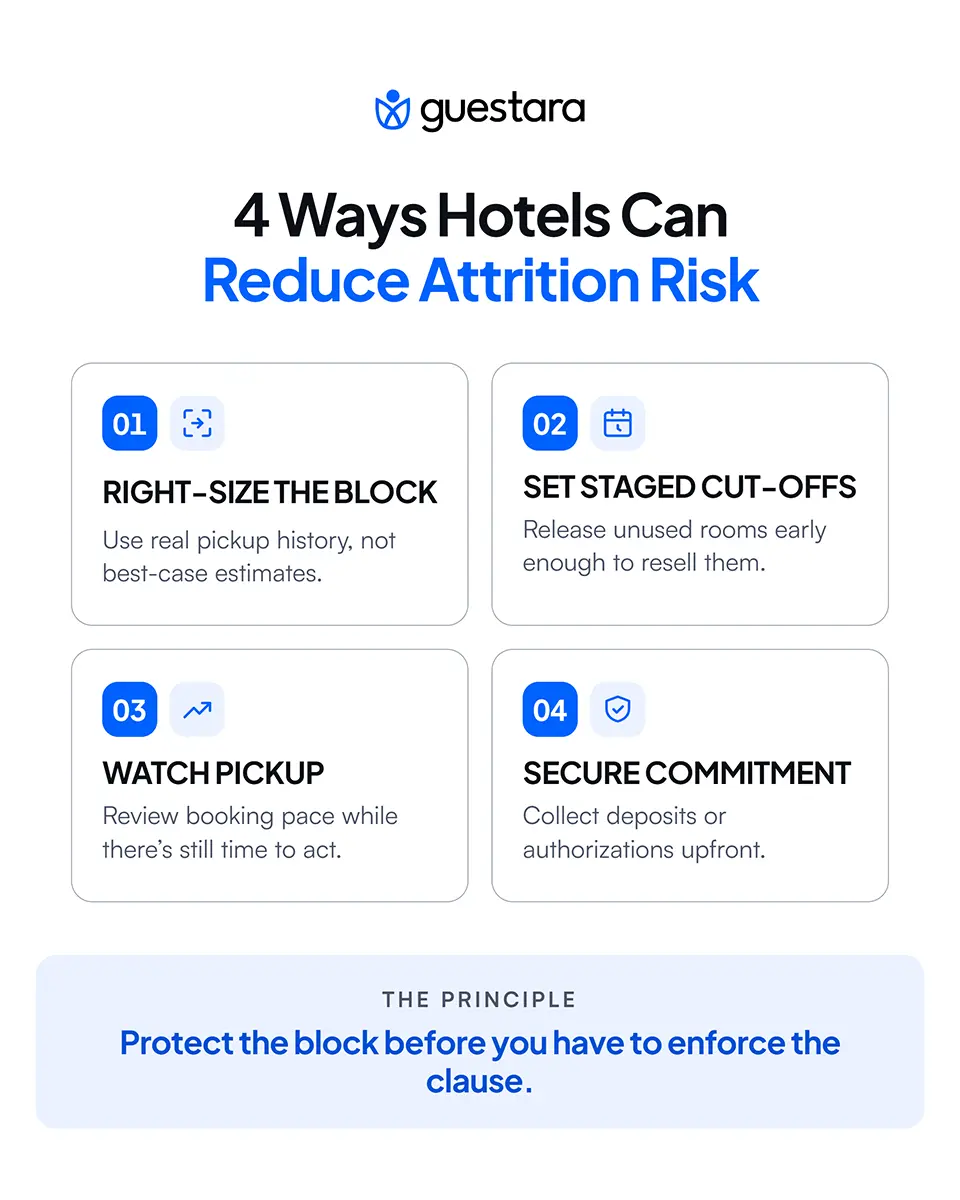
You reduce attrition risk by right-sizing the block before signing, setting clear cut-off dates, and staying in contact with the planner as pickup comes in. Securing deposits early adds a financial commitment that keeps groups engaged with their block.
That last point is where payment tooling helps. Guestara's Payments collects pre-arrival deposits that sync with your PMS, and card-on-file authorizations lock in the financial commitment behind a block without manual chasing. When the money side is handled early, planners take pickup more seriously and shortfalls shrink.
[[cta:cta-7 | eyebrow=SECURE PAYMENTS | heading=Collect group *deposits* before the block underperforms. | btn= Explore Hotel Payments | link=https://www.guestara.com/hotel-payments ]]
Even with careful planning, some groups will miss their commitment. When that happens, handle it with clarity and keep the relationship intact, because most group business is repeat business.
Work through it in order.
The goal is to protect your revenue and preserve a planner who books again. A hotel that handles a shortfall professionally often keeps the account, while one that leads with a hard invoice usually loses it.
Attrition clauses matter most where room blocks are large, multi-night, and booked far ahead, which describes India's wedding and MICE business exactly. A big Indian wedding can hold dozens of rooms across several nights, often at a destination property, so a shortfall carries real money.
The stakes are rising. India's destination-wedding market was estimated at around USD 16 billion in 2024 and is growing fast, helped by the government's Wed in India campaign. More multi-day destination weddings means more large blocks, longer lead times, and more attrition exposure for the properties that host them.
For independent hotels in these markets, two habits protect you. Write cut-off dates that match local booking behavior, where guests often confirm late. And tie any food and beverage minimum to the same attrition allowance, so a released block scales the catering commitment down with it rather than leaving you exposed on both.
[[cta:cta-4 | eyebrow=HOTEL PAYMENTS | heading=Lock in group commitment with *deposits* collected automatically. | btn=Explore Hotel Payments | link=https://www.guestara.com/hotel-payments ]]


Hotel attrition is the shortfall when a group misses its room-block commitment. Learn how attrition clauses work, how fees are calculated, and how to reduce risk.
Hotel attrition is the shortfall between the room nights a group commits to in its contract and the number its guests actually book.
Picture a wedding block booked months out. You hold 100 rooms off the market, turn away other business, and then only 70 rooms fill. Those empty rooms are lost revenue you cannot get back. The attrition clause is what decides who absorbs that loss. This guide explains what attrition means, how the clauses work, how to calculate the fee, how to write a clause that is fair to both sides, and how to handle a shortfall when it happens.
Hotel attrition is the difference between the number of room nights a group reserves in a booking contract and the number its attendees actually book. When the group falls short of the committed minimum, the hotel charges an attrition fee to recover part of the lost revenue.
The word appears mostly in contracts. On the floor you will hear it called block performance or pickup, which both describe the same thing: how many of the rooms set aside for a group actually got filled.
The mechanics are simple. A group commits to a minimum number of room nights. You take those rooms off the market and stop selling them to anyone else. A cut-off date arrives, unused rooms release back to inventory, and on arrival day you count the pickup. If the group filled fewer rooms than it promised, the attrition clause decides what the group owes.
It matters because a held room is a sold opportunity you gave up. Once a block is reserved, that inventory is committed, so a shortfall is revenue you cannot recover after arrival day.
One clarification. This is group room-block attrition, the contract clause. It is not staff attrition, which is employee turnover. Both use the word, and this guide is about the room block.
Hotel attrition hits revenue in two ways: the empty rooms themselves, and the ancillary spend those guests would have brought. A shortfall on a room block also disrupts the forecasting, staffing, and pricing decisions that were built around the group.
The best group business does more than fill rooms. A wedding block fills the banquet hall and the spa. A conference fills meeting space, catering, and the bar. When the block underperforms, you lose that connected revenue too, and the gap is hard to backfill on short notice.
There is a displacement cost as well. To hold a large block, you often turn away transient guests and smaller bookings for the same dates. If the group then falls short, you have lost both the block revenue and the business you declined to protect it. Strong ancillary spend can offset part of a room shortfall, which is why the healthiest group deals are measured on total account value, not room nights alone.
This is why attrition belongs in your revenue strategy from the first quote, not the cut-off date. A single underperforming block can pull down occupancy, waste prepared staffing hours, and force discounting to move the leftover inventory.
There are three main types of attrition clause: revenue-based, cumulative, and per-night. They differ in how they measure whether the group met its commitment, and each shifts risk differently between hotel and planner.
A revenue-based clause gives planners the most flexibility, since they can move between room types as long as the total spend lands. It also takes closer tracking to enforce, and it is more complex to calculate.
Cumulative is usually the most forgiving for the group, because strong nights can offset weak ones across the event. The trade-off is that it does not guarantee steady occupancy on any single night, which makes operational planning harder.
Per-night is the strictest and protects your nightly occupancy most tightly. It carries the highest shortfall risk for the group, especially on low-demand nights, so planners resist it on events with uneven attendance.
Whichever you use, state the allowable threshold clearly. Sample hotel contracts commonly set the required pickup at 80% to 85% of the block and frame any shortfall charge as liquidated damages rather than a penalty, which is the language that makes the term enforceable.
Calculate a hotel attrition fee in three steps: find the minimum room nights the clause requires, subtract the actual pickup to get the shortfall, then multiply the shortfall by the group rate. A resale credit reduces the fee if the hotel rebooks the released rooms.
Here is a worked example on a cumulative 80% clause.
If a resale clause applies and the hotel rebooks 10 of those nights, the fee falls to 20 nights, or $3,000. The formula is the same in any currency. Only the rate changes.
The measurement method changes the math. Under a per-night clause, you test each night against its own minimum and add up the nightly shortfalls, which can produce a larger fee than a cumulative test on the same block. For context, attrition penalties commonly run between 50% and 80% of the room rate for each unsold room below the threshold, so the exact rate and method matter to both sides.
A fair attrition clause sets a realistic threshold, spells out clear cut-off dates, includes a resale credit, and ties any food and beverage minimum to the same allowance. Fairness is not softness. A clear, balanced clause protects your revenue and makes planners want to book with you again.
Start by setting the right rate. The 80% baseline, where a group may release up to 20% of the block, is a common starting point, not a default to apply blindly. Adjust it against four factors.
A group with a strong track record or a shoulder-season date may earn a more generous threshold. A first-time client on a high-demand weekend warrants stricter terms.
Then include the terms that make the clause clear and enforceable.
Two terms carry extra weight. A security deposit taken at signing gives the group a financial stake in its own commitment. And for vacation rental and short-term operators, a signed rental agreement plays the same role a group contract does for a hotel, setting commitment, deposit, and release terms in one place.
You reduce attrition risk by right-sizing the block before signing, setting clear cut-off dates, and staying in contact with the planner as pickup comes in. Securing deposits early adds a financial commitment that keeps groups engaged with their block.
That last point is where payment tooling helps. Guestara's Payments collects pre-arrival deposits that sync with your PMS, and card-on-file authorizations lock in the financial commitment behind a block without manual chasing. When the money side is handled early, planners take pickup more seriously and shortfalls shrink.
[[cta:cta-7 | eyebrow=SECURE PAYMENTS | heading=Collect group *deposits* before the block underperforms. | btn= Explore Hotel Payments | link=https://www.guestara.com/hotel-payments ]]
Even with careful planning, some groups will miss their commitment. When that happens, handle it with clarity and keep the relationship intact, because most group business is repeat business.
Work through it in order.
The goal is to protect your revenue and preserve a planner who books again. A hotel that handles a shortfall professionally often keeps the account, while one that leads with a hard invoice usually loses it.
Attrition clauses matter most where room blocks are large, multi-night, and booked far ahead, which describes India's wedding and MICE business exactly. A big Indian wedding can hold dozens of rooms across several nights, often at a destination property, so a shortfall carries real money.
The stakes are rising. India's destination-wedding market was estimated at around USD 16 billion in 2024 and is growing fast, helped by the government's Wed in India campaign. More multi-day destination weddings means more large blocks, longer lead times, and more attrition exposure for the properties that host them.
For independent hotels in these markets, two habits protect you. Write cut-off dates that match local booking behavior, where guests often confirm late. And tie any food and beverage minimum to the same attrition allowance, so a released block scales the catering commitment down with it rather than leaving you exposed on both.
[[cta:cta-4 | eyebrow=HOTEL PAYMENTS | heading=Lock in group commitment with *deposits* collected automatically. | btn=Explore Hotel Payments | link=https://www.guestara.com/hotel-payments ]]
In a hotel contract, attrition is the agreed shortfall a group can have between its committed room block and its actual pickup before fees apply. The clause sets a minimum number of room nights the group must fill. Fall below it, and the group owes the hotel for part of the unused rooms.
Most hotel contracts set the allowable pickup between 80% and 90% of the block, meaning a group can release 10% to 20% of its rooms without penalty. The exact figure is negotiable and depends on the group's history, the season, and demand for the dates. Groups with uncertain attendance often push for a lower threshold.
Take the minimum room nights the clause requires, subtract the actual pickup, and multiply the shortfall by the group rate. For example, a 300-night block at 80% requires 240 nights, so if only 210 are picked up, the 30-night shortfall times the rate is the fee. A resale clause reduces the fee for any rooms the hotel rebooks.
A resale clause, sometimes called a last-room-sold clause, means the hotel only charges attrition on rooms it could not rebook. If the property resells released rooms or sells out entirely, the fee is reduced or waived for those nights. It protects the group from paying for rooms the hotel did not actually lose revenue on.
Attrition applies when a group underuses a room block it kept, while cancellation applies when the group calls off the booking entirely. Attrition fees cover only the unsold portion of a block, while cancellation fees cover the whole commitment. Both are defined separately in the contract and calculated differently.
We work closely with the industry leaders to offer seamless solutions




We’re here to help your whole team stay ahead of the curve as you grow.

Get up and running quickly with a personalized onboarding plan

Connect with real people who really get it, 24/7

Checkout our vast library of free resources, templates and more
There's only so much we can say — so let us show you! Schedule a demo today and reach your business goals.



.png)