The most common hotel problems and real fixes: what to say to the guest, when to compensate and how much, what each failure costs and how to catch it early.




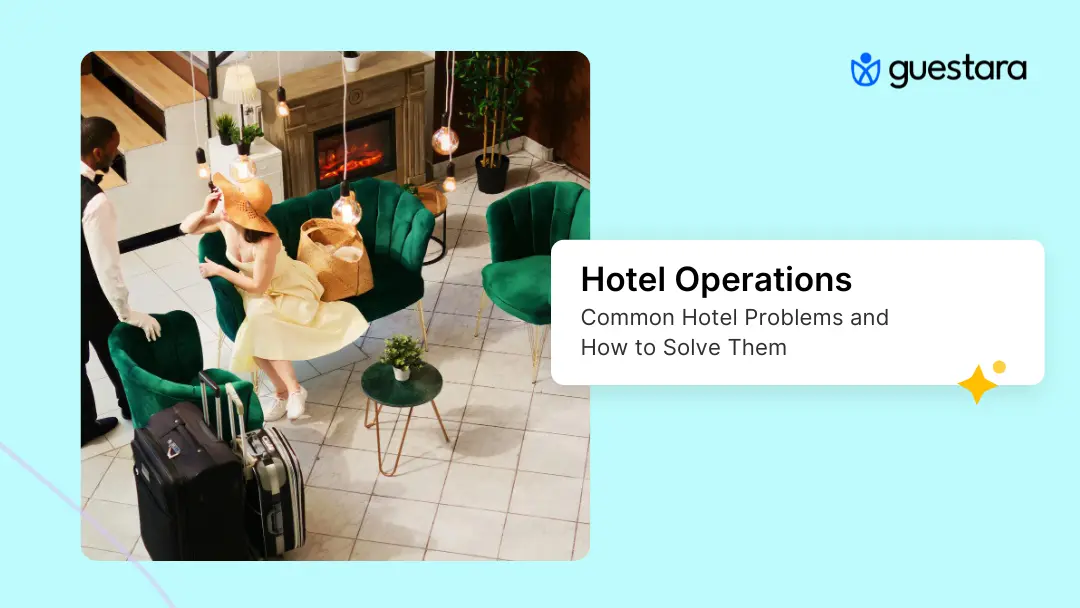
A guest reaches the desk at 3pm. Their room is not ready. The agent apologises, offers the lobby, and promises twenty minutes. Housekeeping says the room was finished at 2:40 but nobody updated the status. The guest waits forty minutes for a room that was clean the whole time.
Nobody in that story made a mistake. The room was cleaned, the apology was sincere, the guest was handled politely. The problem was that two departments were working from different information, and that is what most hotel problems turn out to be. Here are the failures that recur at every property, what to do about each one, and what to say while you do it.
A hotel problem is an operational failure that reaches the guest or costs the property revenue, such as a room not ready at check-in, an overbooking, a billing dispute or a maintenance fault. Most are caused by departments working from different information rather than by individual error.
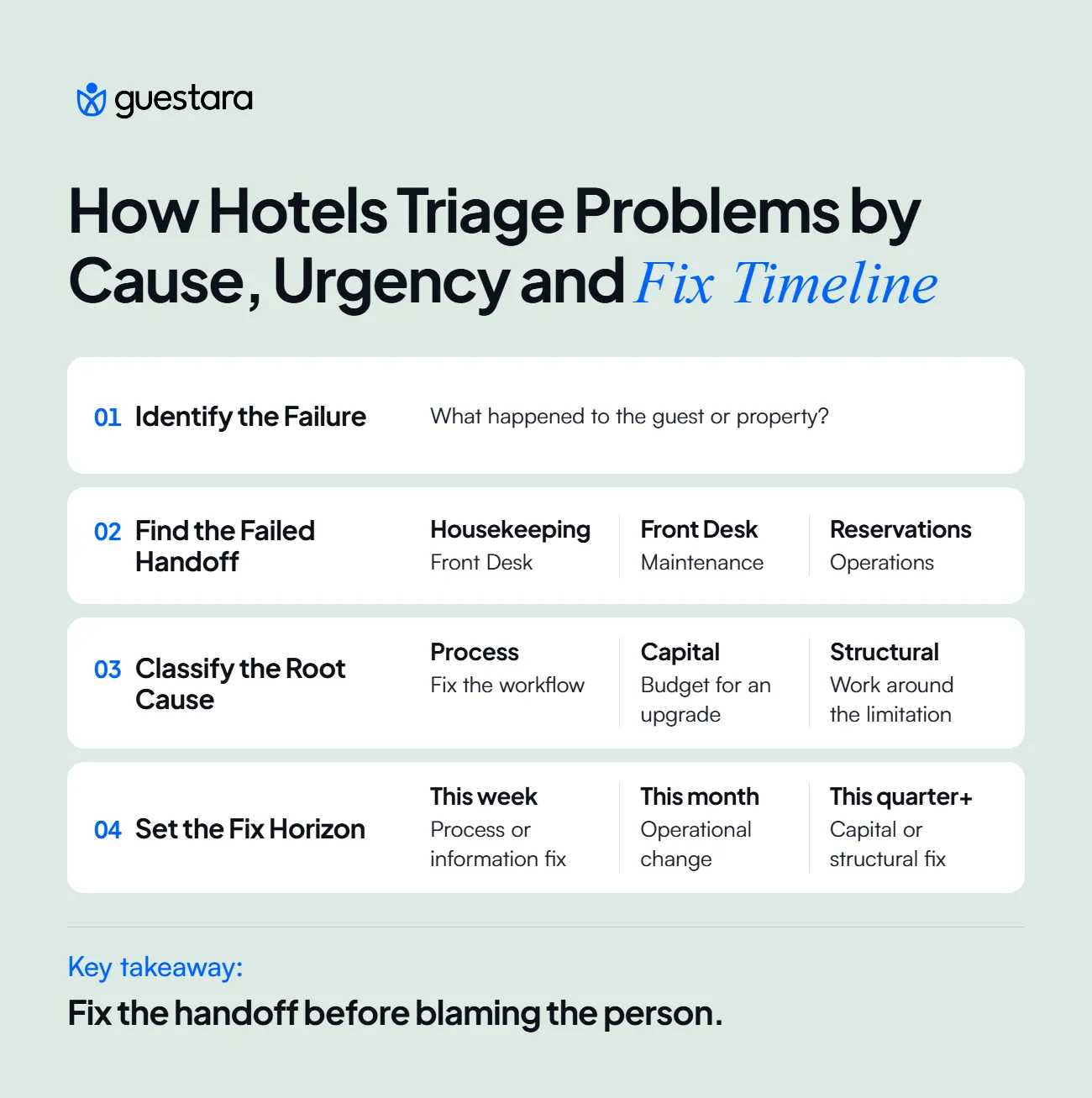
The most common hotel problems cluster around the handoffs between departments, not inside any one of them. Housekeeping to front desk, front desk to maintenance, and reservations to both are where failures appear, because each handoff depends on information arriving in time.
Sorting them by root cause and fix horizon is more useful than listing them, because it tells you which ones you can act on this week.
Note how many of these land in the first column within a week. The expensive-looking problems are often not the urgent ones, and the cheap fixes sit in the handoffs.
Front desk problems concentrate into the two hours around the arrival peak, which means they are a capacity problem disguised as a service problem. The desk is not slow all day. It is overwhelmed between 2pm and 5pm and quiet either side.
Check-in creates a queue because arrivals cluster and the desk is staffed evenly. Four agents spread across twelve hours produce the same total hours as a staggered shape and leave you short at exactly the moment everybody arrives.
Three fixes work in order of cost. Stagger shift start times against the arrival pattern rather than the opening hours. Move form filling and document capture to before arrival, so the desk interaction is a greeting and a key rather than a data-entry session. Then set room allocation the evening before for known arrivals, so the agent is not choosing a room while a guest watches.
Walking a guest means sending someone with a confirmed booking to another property because you have no room. It is the most expensive single failure in hotel operations and the one most likely to end in a public review.
Handle it in a fixed order. Tell the guest before they reach the desk if you know in advance. Book and pay for the alternative yourself rather than asking them to arrange it. Arrange and pay for transport. Then follow up the next day rather than leaving it at the handover. The cost of getting this wrong is quantified later in this guide.
Prevent it by watching the gap between your oversell position and your actual no-show rate. A property that oversells on instinct rather than on its own historical no-show data is choosing to walk guests occasionally without knowing it.
Housekeeping problems reach the guest in two forms: the room is not ready when they arrive, or the room is not right once they are in it. The first is a sequencing failure and the second is an inspection failure.
Room readiness depends on cleaning in arrival order rather than floor order. Cleaning floor by floor is efficient for the attendant and wrong when nine guests are waiting for four specific rooms. Housekeeping needs the day's arrivals with any early check-in requests before the shift starts, not at 2pm when the lobby fills.
The second failure is quieter and more damaging. A room that passes as clean but has a hair in the bathroom, a previous guest's charger in a drawer or a stained pillowcase generates a mid-stay complaint and a review, and it reaches the guest because nobody other than the cleaner looked at it. Inspection is what catches this, and self-inspection catches almost none of it.
Maintenance faults belong in the same section because housekeeping finds them first. An attendant who notices a dripping tap and has no quick way to log it will clean around it for three weeks. Give the person in the room the fastest possible route to report a fault, and the fault gets fixed before a guest pays to discover it.
What you say in the first thirty seconds decides whether the problem becomes a complaint or a recovery. The pattern that works is the same in every scenario: acknowledge the specific failure, apologise once without repeating it, state what happens next with a time, and own the follow-up.
Acronym frameworks for this circulate widely in hospitality training, including HEARD and LEARN, and they all describe roughly that sequence. The wording matters more than the acronym.
Four habits make a problem worse. Explaining the internal cause tells the guest about your rota rather than their room. Apologising repeatedly without acting reads as a delay tactic. Using conditional language such as "I will try" removes the commitment. And saying the policy does not allow it, without offering what the policy does allow, ends the conversation with nothing.
Train the specific wording rather than the principle. A team told to show empathy will each interpret it differently. A team given six openings uses them.
Compensate when the guest lost something they paid for, and size it against what they paid rather than against how annoyed they are. This is the question most operators guess at, and there is research on it.
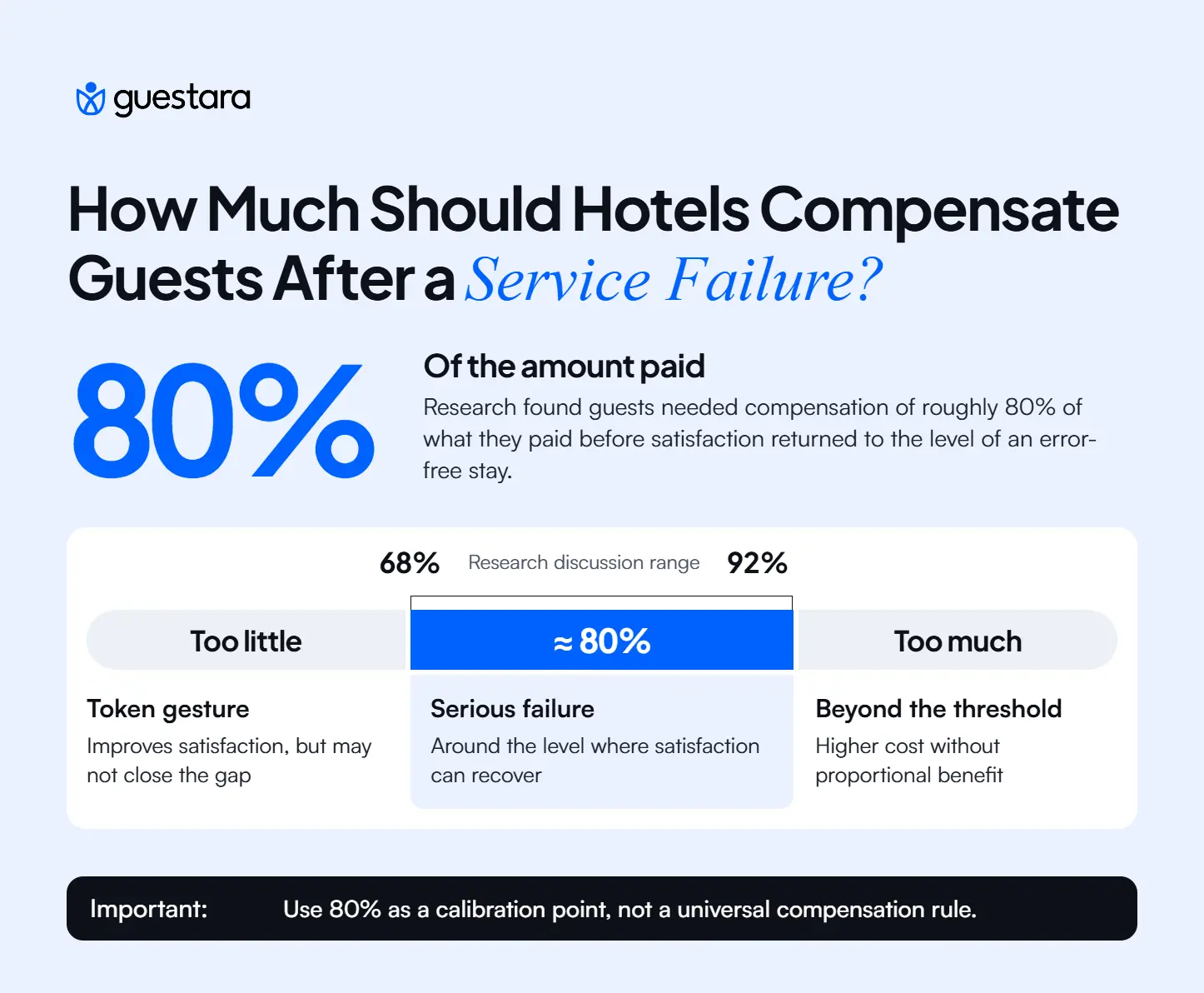
A study of hotel service failures by Edstrom and colleagues in the Journal of Service Theory and Practice tested a double-booking scenario across two experiments. Participants needed roughly 80% of the amount they had paid before their satisfaction returned to the level of guests who had no problem at all. The paper's wider discussion puts the threshold between 68 and 92% of the original price.
Two findings matter more than the number. Compensation below the threshold improved satisfaction but did not close the gap to error-free service, so a token gesture on a serious failure buys partial credit at best. And compensation well above the threshold pushed satisfaction past error-free levels, which the authors treat as unnecessary cost rather than a goal.
Read that as calibration rather than a rule. It was a Swedish sample responding to a hypothetical scenario with one failure type, across 40 and 150 participants. What it establishes is the shape: serious failures need compensation in the region of most of what the guest paid, and small gestures do not scale up to cover large failures.
Set the authorisation levels in writing before you need them. A front desk agent with no authority has to find a manager to approve a complimentary breakfast, and the guest watches that happen.
Give the desk a standing allowance it can use without asking, set a duty manager band above it, and reserve full-stay waivers for the general manager. The specific amounts depend on your rate, so set them as a proportion of your average room rate rather than as fixed figures, and review them when rates change.
The point of written thresholds is speed. A recovery that happens in ninety seconds at the desk costs less and works better than the same remedy approved an hour later.
A single walked guest costs several times the room rate, which is why overselling on instinct is more expensive than it looks. Pricing one failure end to end is the fastest way to justify fixing the cause.
The figures below are illustrative. Run the structure with your own rates, because the method is what transfers.
The review is not in that table because it cannot be costed honestly, and it is often the largest item. A walked guest writes about it, and the review sits on your listing through every future search.
Run the same structure on the problems you see most. A recurring billing dispute costs manager time and a review risk. An hour of queue at the desk costs the upsell nobody had time to offer. None of these numbers is precise, and all of them are larger than the fix.
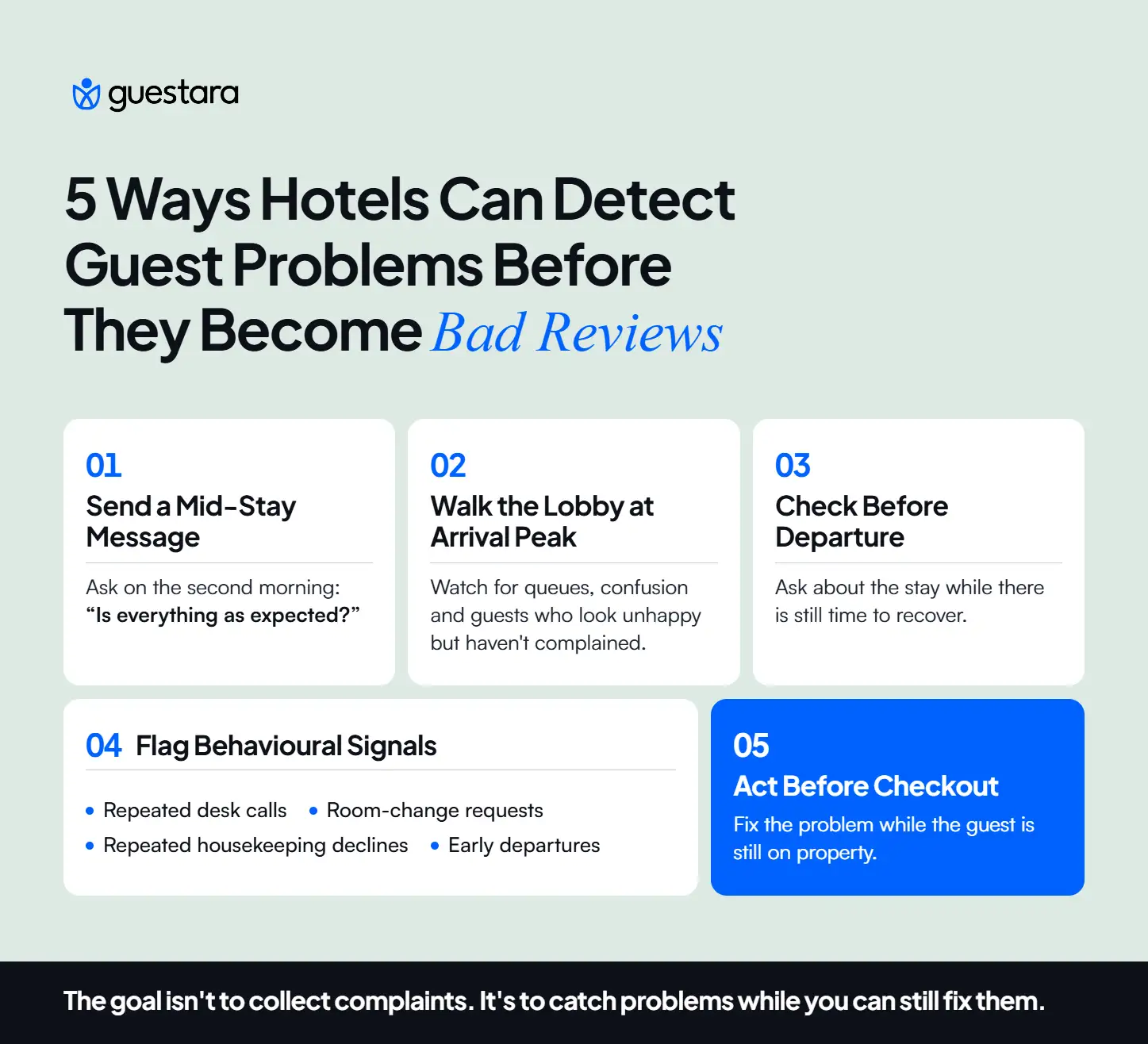
Catch problems early by asking rather than waiting, because most unhappy guests never say anything on property. A complaint at the desk is one of several problems that week, and the others left as a review or as a guest who did not return.
Three checks surface problems while you can still fix them.
The signals are usually there before the complaint. A guest who requests a room change, calls the desk twice, declines housekeeping repeatedly or leaves a day early is telling you something without filing a complaint. Flag those patterns rather than waiting for a sentence that starts with a complaint.
This is also where the review score is actually decided. A property that collects feedback while the guest is still on site can fix the problem and then ask for the public review, rather than finding out what went wrong by reading it. That sequencing is what Guestara's Review Collection handles, by routing negative feedback to an internal alert instead of to a public page.
A small property can fix most service and process problems and almost none of the structural ones, so the useful question is which list a given problem belongs on. Guides that tell a 25-room owner to restructure their departments are describing a different business.
Sort your problems into three groups before deciding what to do about any of them.
Almost every recurring complaint at a small property sits in the first row, and almost every guide aimed at small properties spends its time on the second.
Three things change at a small property. You have no cover depth, so one absence becomes a service failure rather than a reshuffle. You have no separate inspection layer, so cross-checking between two people has to replace a supervisor. And a single bad review moves your score materially, because you have fewer reviews absorbing it.
That last point cuts both ways. A small property that acts on feedback moves its score faster than a large one, because the same number of good reviews counts for more against a smaller base.
Treat a problem as a pattern until the log proves otherwise, because the cost of fixing a one-off twice is far lower than the cost of missing a recurring failure. The difference between the two is only visible if somebody is writing them down.
Keep one log with four fields: what happened, which room or area, when, and what was done. That is enough to separate an incident from a trend, and anything more elaborate stops being filled in.
Review it monthly against three questions. Does the same room number keep appearing, which points at the room rather than the service? Does the same shift or day keep appearing, which points at staffing shape? Does the same failure appear across different rooms and shifts, which points at the process?
The answer changes what you fix. A noise complaint about room 304 every weekend is an allocation or soundproofing issue in one room. Noise complaints across twelve rooms on Saturdays is a policy problem about which parties go where. The complaint reads identically in both cases and the fix is completely different.
Log it at the point it happens, by whoever handles it, in one place. A log that requires someone to remember at the end of a shift records the dramatic incidents and misses the pattern, which is made of small ones.
The practical test is whether the person holding the problem can record it in under thirty seconds without leaving what they are doing. If logging costs more than cleaning around the problem, nobody logs.
[[cta:cta-7 | eyebrow=Guest Reviews | heading=Hear about the problem while the guest is *still in the building* | btn=Explore Review Management | link=https://www.guestara.com/hospitality-review-management ]]


The most common hotel problems and real fixes: what to say to the guest, when to compensate and how much, what each failure costs and how to catch it early.
A guest reaches the desk at 3pm. Their room is not ready. The agent apologises, offers the lobby, and promises twenty minutes. Housekeeping says the room was finished at 2:40 but nobody updated the status. The guest waits forty minutes for a room that was clean the whole time.
Nobody in that story made a mistake. The room was cleaned, the apology was sincere, the guest was handled politely. The problem was that two departments were working from different information, and that is what most hotel problems turn out to be. Here are the failures that recur at every property, what to do about each one, and what to say while you do it.
A hotel problem is an operational failure that reaches the guest or costs the property revenue, such as a room not ready at check-in, an overbooking, a billing dispute or a maintenance fault. Most are caused by departments working from different information rather than by individual error.
The most common hotel problems cluster around the handoffs between departments, not inside any one of them. Housekeeping to front desk, front desk to maintenance, and reservations to both are where failures appear, because each handoff depends on information arriving in time.
Sorting them by root cause and fix horizon is more useful than listing them, because it tells you which ones you can act on this week.
Note how many of these land in the first column within a week. The expensive-looking problems are often not the urgent ones, and the cheap fixes sit in the handoffs.
Front desk problems concentrate into the two hours around the arrival peak, which means they are a capacity problem disguised as a service problem. The desk is not slow all day. It is overwhelmed between 2pm and 5pm and quiet either side.
Check-in creates a queue because arrivals cluster and the desk is staffed evenly. Four agents spread across twelve hours produce the same total hours as a staggered shape and leave you short at exactly the moment everybody arrives.
Three fixes work in order of cost. Stagger shift start times against the arrival pattern rather than the opening hours. Move form filling and document capture to before arrival, so the desk interaction is a greeting and a key rather than a data-entry session. Then set room allocation the evening before for known arrivals, so the agent is not choosing a room while a guest watches.
Walking a guest means sending someone with a confirmed booking to another property because you have no room. It is the most expensive single failure in hotel operations and the one most likely to end in a public review.
Handle it in a fixed order. Tell the guest before they reach the desk if you know in advance. Book and pay for the alternative yourself rather than asking them to arrange it. Arrange and pay for transport. Then follow up the next day rather than leaving it at the handover. The cost of getting this wrong is quantified later in this guide.
Prevent it by watching the gap between your oversell position and your actual no-show rate. A property that oversells on instinct rather than on its own historical no-show data is choosing to walk guests occasionally without knowing it.
Housekeeping problems reach the guest in two forms: the room is not ready when they arrive, or the room is not right once they are in it. The first is a sequencing failure and the second is an inspection failure.
Room readiness depends on cleaning in arrival order rather than floor order. Cleaning floor by floor is efficient for the attendant and wrong when nine guests are waiting for four specific rooms. Housekeeping needs the day's arrivals with any early check-in requests before the shift starts, not at 2pm when the lobby fills.
The second failure is quieter and more damaging. A room that passes as clean but has a hair in the bathroom, a previous guest's charger in a drawer or a stained pillowcase generates a mid-stay complaint and a review, and it reaches the guest because nobody other than the cleaner looked at it. Inspection is what catches this, and self-inspection catches almost none of it.
Maintenance faults belong in the same section because housekeeping finds them first. An attendant who notices a dripping tap and has no quick way to log it will clean around it for three weeks. Give the person in the room the fastest possible route to report a fault, and the fault gets fixed before a guest pays to discover it.
What you say in the first thirty seconds decides whether the problem becomes a complaint or a recovery. The pattern that works is the same in every scenario: acknowledge the specific failure, apologise once without repeating it, state what happens next with a time, and own the follow-up.
Acronym frameworks for this circulate widely in hospitality training, including HEARD and LEARN, and they all describe roughly that sequence. The wording matters more than the acronym.
Four habits make a problem worse. Explaining the internal cause tells the guest about your rota rather than their room. Apologising repeatedly without acting reads as a delay tactic. Using conditional language such as "I will try" removes the commitment. And saying the policy does not allow it, without offering what the policy does allow, ends the conversation with nothing.
Train the specific wording rather than the principle. A team told to show empathy will each interpret it differently. A team given six openings uses them.
Compensate when the guest lost something they paid for, and size it against what they paid rather than against how annoyed they are. This is the question most operators guess at, and there is research on it.
A study of hotel service failures by Edstrom and colleagues in the Journal of Service Theory and Practice tested a double-booking scenario across two experiments. Participants needed roughly 80% of the amount they had paid before their satisfaction returned to the level of guests who had no problem at all. The paper's wider discussion puts the threshold between 68 and 92% of the original price.
Two findings matter more than the number. Compensation below the threshold improved satisfaction but did not close the gap to error-free service, so a token gesture on a serious failure buys partial credit at best. And compensation well above the threshold pushed satisfaction past error-free levels, which the authors treat as unnecessary cost rather than a goal.
Read that as calibration rather than a rule. It was a Swedish sample responding to a hypothetical scenario with one failure type, across 40 and 150 participants. What it establishes is the shape: serious failures need compensation in the region of most of what the guest paid, and small gestures do not scale up to cover large failures.
Set the authorisation levels in writing before you need them. A front desk agent with no authority has to find a manager to approve a complimentary breakfast, and the guest watches that happen.
Give the desk a standing allowance it can use without asking, set a duty manager band above it, and reserve full-stay waivers for the general manager. The specific amounts depend on your rate, so set them as a proportion of your average room rate rather than as fixed figures, and review them when rates change.
The point of written thresholds is speed. A recovery that happens in ninety seconds at the desk costs less and works better than the same remedy approved an hour later.
A single walked guest costs several times the room rate, which is why overselling on instinct is more expensive than it looks. Pricing one failure end to end is the fastest way to justify fixing the cause.
The figures below are illustrative. Run the structure with your own rates, because the method is what transfers.
The review is not in that table because it cannot be costed honestly, and it is often the largest item. A walked guest writes about it, and the review sits on your listing through every future search.
Run the same structure on the problems you see most. A recurring billing dispute costs manager time and a review risk. An hour of queue at the desk costs the upsell nobody had time to offer. None of these numbers is precise, and all of them are larger than the fix.
Catch problems early by asking rather than waiting, because most unhappy guests never say anything on property. A complaint at the desk is one of several problems that week, and the others left as a review or as a guest who did not return.
Three checks surface problems while you can still fix them.
The signals are usually there before the complaint. A guest who requests a room change, calls the desk twice, declines housekeeping repeatedly or leaves a day early is telling you something without filing a complaint. Flag those patterns rather than waiting for a sentence that starts with a complaint.
This is also where the review score is actually decided. A property that collects feedback while the guest is still on site can fix the problem and then ask for the public review, rather than finding out what went wrong by reading it. That sequencing is what Guestara's Review Collection handles, by routing negative feedback to an internal alert instead of to a public page.
A small property can fix most service and process problems and almost none of the structural ones, so the useful question is which list a given problem belongs on. Guides that tell a 25-room owner to restructure their departments are describing a different business.
Sort your problems into three groups before deciding what to do about any of them.
Almost every recurring complaint at a small property sits in the first row, and almost every guide aimed at small properties spends its time on the second.
Three things change at a small property. You have no cover depth, so one absence becomes a service failure rather than a reshuffle. You have no separate inspection layer, so cross-checking between two people has to replace a supervisor. And a single bad review moves your score materially, because you have fewer reviews absorbing it.
That last point cuts both ways. A small property that acts on feedback moves its score faster than a large one, because the same number of good reviews counts for more against a smaller base.
Treat a problem as a pattern until the log proves otherwise, because the cost of fixing a one-off twice is far lower than the cost of missing a recurring failure. The difference between the two is only visible if somebody is writing them down.
Keep one log with four fields: what happened, which room or area, when, and what was done. That is enough to separate an incident from a trend, and anything more elaborate stops being filled in.
Review it monthly against three questions. Does the same room number keep appearing, which points at the room rather than the service? Does the same shift or day keep appearing, which points at staffing shape? Does the same failure appear across different rooms and shifts, which points at the process?
The answer changes what you fix. A noise complaint about room 304 every weekend is an allocation or soundproofing issue in one room. Noise complaints across twelve rooms on Saturdays is a policy problem about which parties go where. The complaint reads identically in both cases and the fix is completely different.
Log it at the point it happens, by whoever handles it, in one place. A log that requires someone to remember at the end of a shift records the dramatic incidents and misses the pattern, which is made of small ones.
The practical test is whether the person holding the problem can record it in under thirty seconds without leaving what they are doing. If logging costs more than cleaning around the problem, nobody logs.
[[cta:cta-7 | eyebrow=Guest Reviews | heading=Hear about the problem while the guest is *still in the building* | btn=Explore Review Management | link=https://www.guestara.com/hospitality-review-management ]]
The recurring complaints are noise, cleanliness detail, slow check-in, room temperature, Wi-Fi reliability, billing disputes and maintenance faults found mid-stay. Most trace back to handoffs rather than to individual performance, such as a room marked ready before inspection or charges posted too late for the guest to recognise them. The same complaint can have different causes, which is why logging where and when it happens matters more than counting how often.
Research on hotel service failures found guests needed roughly 80% of what they had paid before satisfaction returned to the level of error-free service, with a discussion range of 68 to 92% of the original price. Compensation below that improved satisfaction without closing the gap, and compensation well above it produced no additional benefit. Treat it as calibration rather than a rule, since the study used a hypothetical scenario and a single failure type.
Walking a guest means sending someone with a confirmed reservation to a different property because the hotel has no room available, usually following an overbooking or an unexpected extension. The property is expected to book and pay for the alternative accommodation, arrange and pay for transport, and follow up afterwards. It is the most expensive single failure in hotel operations once the alternative room, transport, forgone revenue and manager time are counted.
Acknowledge the specific failure in your first sentence, apologise once rather than repeatedly, state what will happen next with a time attached, and own the follow-up yourself. Avoid explaining the internal cause, which tells the guest about staffing rather than resolving their problem, and avoid conditional language such as trying to help. Resolve it at the lowest level that has authority, since a recovery delivered in ninety seconds works better than the same remedy approved an hour later.
A review usually reflects how a problem was handled rather than the problem itself. Guests accept that faults occur and react to whether anyone took ownership, gave them a timeframe and followed up. Small problems generate bad reviews most often when the guest raised them and nothing visible happened, or when they never raised them at all and had no opportunity to be heard before checkout.
We work closely with the industry leaders to offer seamless solutions




We’re here to help your whole team stay ahead of the curve as you grow.

Get up and running quickly with a personalized onboarding plan

Connect with real people who really get it, 24/7

Checkout our vast library of free resources, templates and more
There's only so much we can say — so let us show you! Schedule a demo today and reach your business goals.