A complete guide to AI guest communication for vacation rentals. How STR operators automate messaging across Airbnb, VRBO, and direct booking channels in 2026.




It is 11:43pm on a Friday.
A guest has just landed at the airport. They sent you a message on Airbnb. Then another one on WhatsApp. Then they called your phone. They cannot find the door code. Their flight was delayed. They have a baby with them.
You are in bed.
By the time you respond, twenty minutes have passed. The guest is angry. The review the next morning will mention "slow communication." Your nightly rate just dropped by 15% in next month's algorithm.
This is the moment most vacation rental operators discover that they cannot run a portfolio of properties on willpower alone. Five listings is a side hustle. Fifteen is a part-time job that owns your evenings. Fifty is a business that requires technology you do not yet have.
This is what AI guest communication for vacation rentals is built for.
AI guest communication for vacation rentals is the use of AI tools that read incoming guest messages across every channel an STR operator uses, understand what the guest is asking, and respond instantly with accurate information pulled from the property's own data.
It is not a chatbot with prewritten answers. It is a system that knows your check-in time, your WiFi password, your house rules, your local restaurant recommendations, and your cancellation policy, and uses that information to handle the conversations you do not have time for.
The difference matters because vacation rentals operate differently from hotels.
A hotel has one front desk, one phone number, one email address. A vacation rental operator might have ten properties, each with a different listing on Airbnb, VRBO, and Booking.com, plus a direct booking website. That is potentially 40 message channels, all expecting fast responses, all running 24/7.
This is the operational math that has driven AI adoption in the STR space faster than in hotels.
The numbers are moving fast.
Hostaway's 2026 Short-Term Rental Report, based on a survey of operators conducted at the end of 2025, found that 61% of STR operators were using AI in some form. By the time Hostaway ran their Summer Snapshot Survey just a few months later, that number had jumped to 84%.
61% to 84% in nine months. That is the steepest adoption curve in the history of vacation rental technology.
A few other numbers worth knowing:
PYMNTS reports that more than 70% of vacation rental managers now use AI tools, citing Hostaway data, and that share has nearly doubled in six months. Vinayak Mahtani, CEO of bnbme Holiday Homes, told Forbes his company's AI assistant handles roughly 70% of guest needs without human involvement.
The Hostaway research found AI adoption climbs even higher among larger portfolios. Operators managing 50+ properties are using AI at a significantly higher rate than smaller hosts. The pattern is clear: as the operational load grows, the math no longer works without AI.
If you are an STR operator and you are not using AI yet, here is the uncomfortable read: 84% of your competitors are. The other 16% are mostly very small operators with one or two properties, where the math still barely works without it.
A hotel deploys AI inside one PMS, one website, and one phone system. A vacation rental operator deploys AI across a stack that did not exist five years ago.
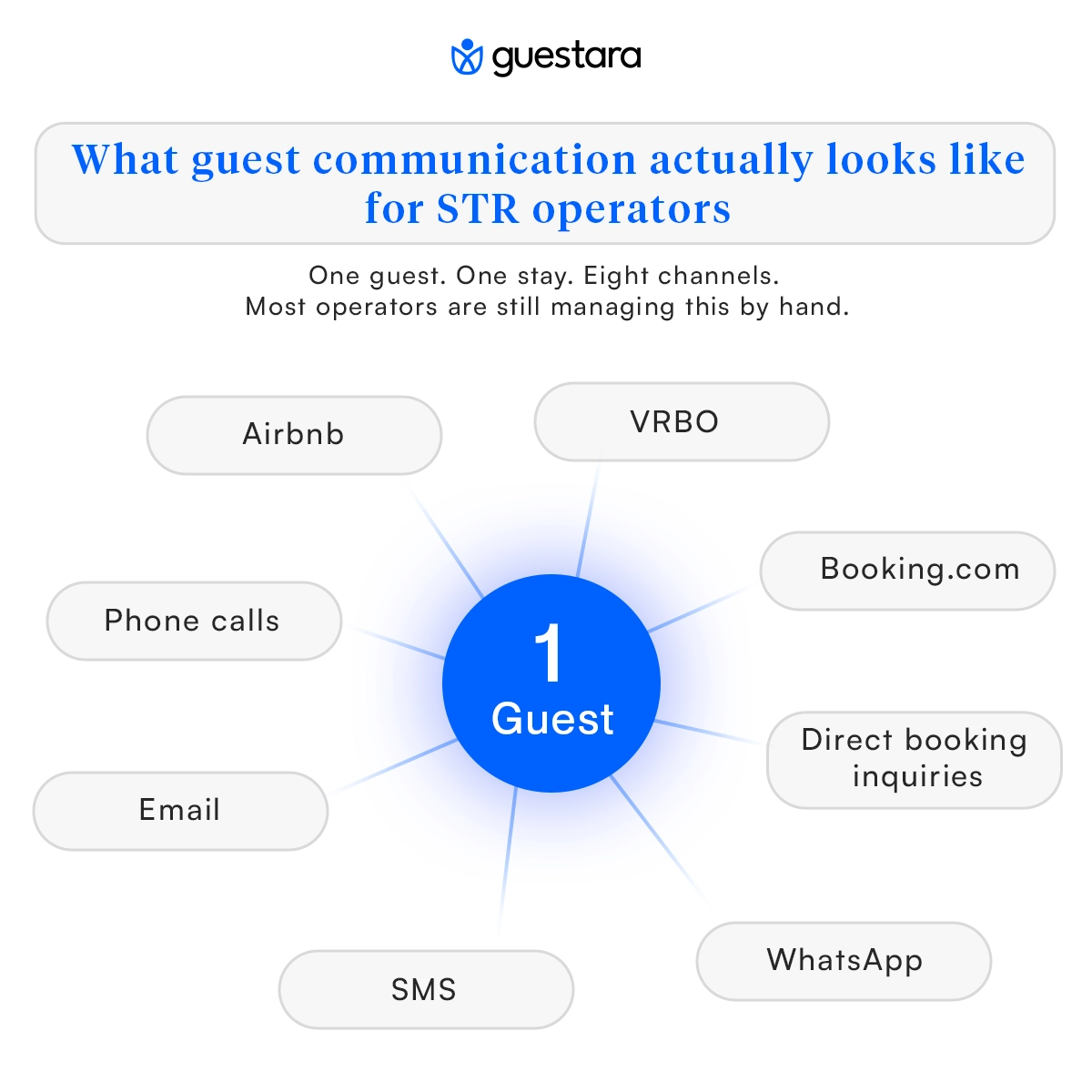
Here is what an actual STR communication channel map looks like:
A guest who books on Airbnb may message you on WhatsApp before arrival, switch to SMS during the stay, and email you a complaint after checkout. Three channels. One conversation. Most operators handle this manually by switching between apps, copying context, and losing track of what was already said.
This is the structural reason AI guest communication tools built for hotels do not always work well for STR operators. Hotels need conversation depth at scale on a small number of channels. STR operators need conversation continuity across many channels with many small properties.
Any AI tool you evaluate for a vacation rental business has to pass three tests:
It has to read every channel you use. If your AI cannot see the message a guest sent on WhatsApp, it cannot respond to it.
It has to hold context across channels. When the same guest moves from Airbnb to WhatsApp, the AI should know it is the same person and what was already discussed.
It has to integrate with your PMS. Without booking data, check-in times, and guest names, the AI is just a chatbot with confidence.
If a vendor cannot demonstrate all three, they are selling you a partial solution.
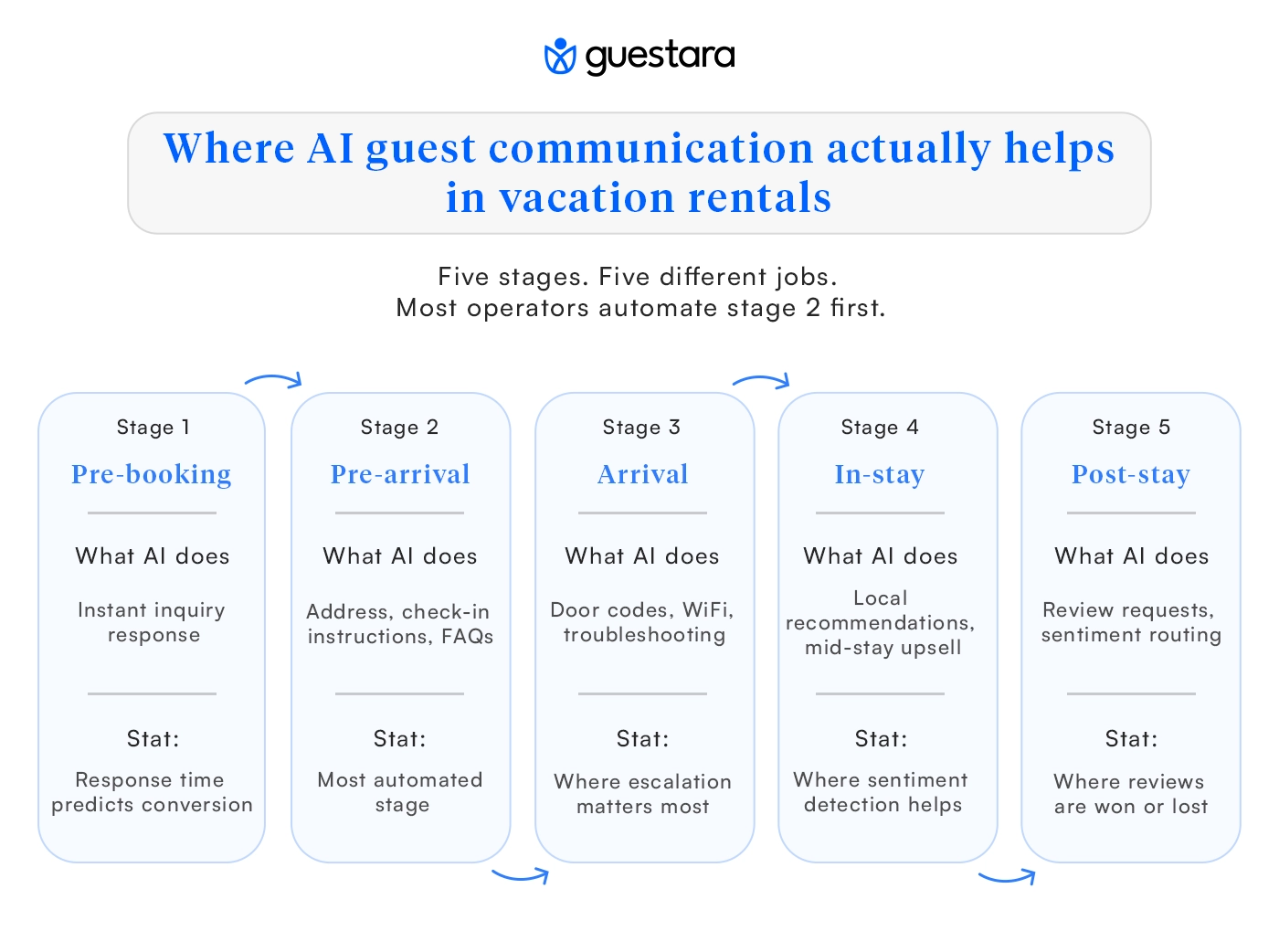
Most articles on this topic stop at "AI saves you time." That is true but useless. Here is where AI actually does the work, broken down by stage of the guest journey.
This is the highest-leverage stage and the most-overlooked.
A potential guest sends a question before booking: "Is the property pet-friendly? How far is the beach? Is there parking?" If you answer in 5 minutes, you might convert. If you answer in 5 hours, the guest has already booked someone else.
AI tools handle these inquiries instantly. They pull from your listing data, answer the question accurately, and either close the booking inside the channel or escalate to you for the questions that need human judgment (custom dates, group rates, unusual requests).
Response time is the single strongest predictor of whether an inquiry converts to a booking. AI compresses your average response time from hours to seconds.
The 24 to 48 hours before check-in is when most operator communication happens.
The guest needs the address. They need check-in instructions. They want to know if early check-in is possible. They want restaurant recommendations. They want to know if the host will be on-site or remote.
This stage is almost entirely automatable. A well-configured AI tool sends the address at the right moment, delivers check-in instructions on the day of arrival, and handles common pre-arrival questions without your involvement. Stage 2 communication is what most operators automate first because the wins are immediate and the risk of getting it wrong is low.
This is where AI either earns its keep or fails badly.
Arrival is when guests are most stressed. They have luggage. They are tired. The flight may have been delayed. The door code might not work the first time. The WiFi password is wrong on the printed sheet.
AI handles the routine arrival questions instantly: door codes, WiFi, parking, garbage day, appliance instructions. But arrival is also when escalation matters most. If the guest texts "I cannot get in," that is not an FAQ. That is a human problem. The AI needs to recognize the difference and either dispatch a co-host or alert you immediately.
The AI tools getting this right have clear escalation rules. The ones getting it wrong respond to "I cannot get in" with a polite link to the check-in instructions.
The middle of the stay is the most relaxed phase from a communication perspective. Guests ask about local restaurants, pool hours, beach access, and the occasional broken appliance.
This is where AI tools start to differ from each other. The basic ones handle restaurant recommendations from your guidebook. The better ones detect sentiment in the guest's messages. If a guest sends "the AC is not really working but it's fine" — the better AI flags this as a potential issue, not a benign comment.
This is also the stage where mid-stay upsells happen. Late checkout offers. Spa bookings. Activity recommendations with a referral fee. The AI tools that integrate with unified messaging and payment systems can take the booking and the payment in the same conversation.
The 24 hours after checkout is the most important moment in your review pipeline.
A well-built AI tool sends a review request through the right channel at the right time. If the guest had a five-star experience, the request goes to Airbnb or your direct review platform. If the AI detected dissatisfaction during the stay, the request stays internal and triggers a recovery message instead.
This is the stage that converts AI guest communication from a cost center to a revenue line. Properties using post-stay AI workflows report meaningfully higher review volumes and meaningfully fewer public negative reviews.
The expectation level for guest communication has changed faster than most operators realize.
Five years ago, responding within 24 hours was acceptable. Three years ago, within 4 hours was the expectation. Today, guests trained on ChatGPT and other instant-response AI tools expect replies within minutes.
Industry research found guests now expect a response to text-based requests in under 12 minutes. Mobile messaging behavior research from Skift and eHotelier confirms guests are not willing to wait. BCV's analysis identifies response time as a primary driver of guest satisfaction and review scores.
This is the structural reason guest communication has become the highest-priority AI use case in vacation rentals. It is the only category where the math has shifted from "nice to have" to "table stakes."
The operators winning in 2026 are not the ones with the best photos or the most listings. They are the ones whose guest communication feels like the property has a 24/7 concierge desk, regardless of whether the operator manages 5 properties or 50.
This is the section most articles on this topic skip. Every AI tool has limits. The operators using AI well are clear about what those limits are.
A guest dealing with a death in the family. A medical emergency. A guest who has already escalated a complaint. These conversations need a human. An AI that handles them efficiently is doing the wrong job.
Group rates, monthly stays, last-minute discounts. These require judgment about your business that an AI does not have. The AI can flag the request and surface relevant context. The decision should be yours.
Your handwritten welcome note. Your personal restaurant recommendations. The text you send to repeat guests with their kids' names in it. AI can replicate generic friendliness, but it cannot replicate you. The good news is that 90% of guest communication does not need that level of personalization. Save your bandwidth for the 10% that does.
A guest reporting a gas smell. A break-in. A flooded bathroom. AI should immediately route these to a human. No exceptions.
A guest who wants to argue about your cancellation policy is not having an information problem. They are having a trust problem. AI can deliver the policy. Resolving the conflict needs a human.
The pattern is consistent: AI handles execution well, humans handle trust and judgment. The Anthropic Economic Index tracks this directly across industries — 57% of AI-assisted tasks involve a human in the loop. For vacation rentals, that ratio is closer to 70/30 in the AI's favor for routine work and 30/70 for anything emotionally complex.
There are roughly twenty AI guest communication tools competing for the STR market right now. The differences between them matter more than the marketing makes obvious.
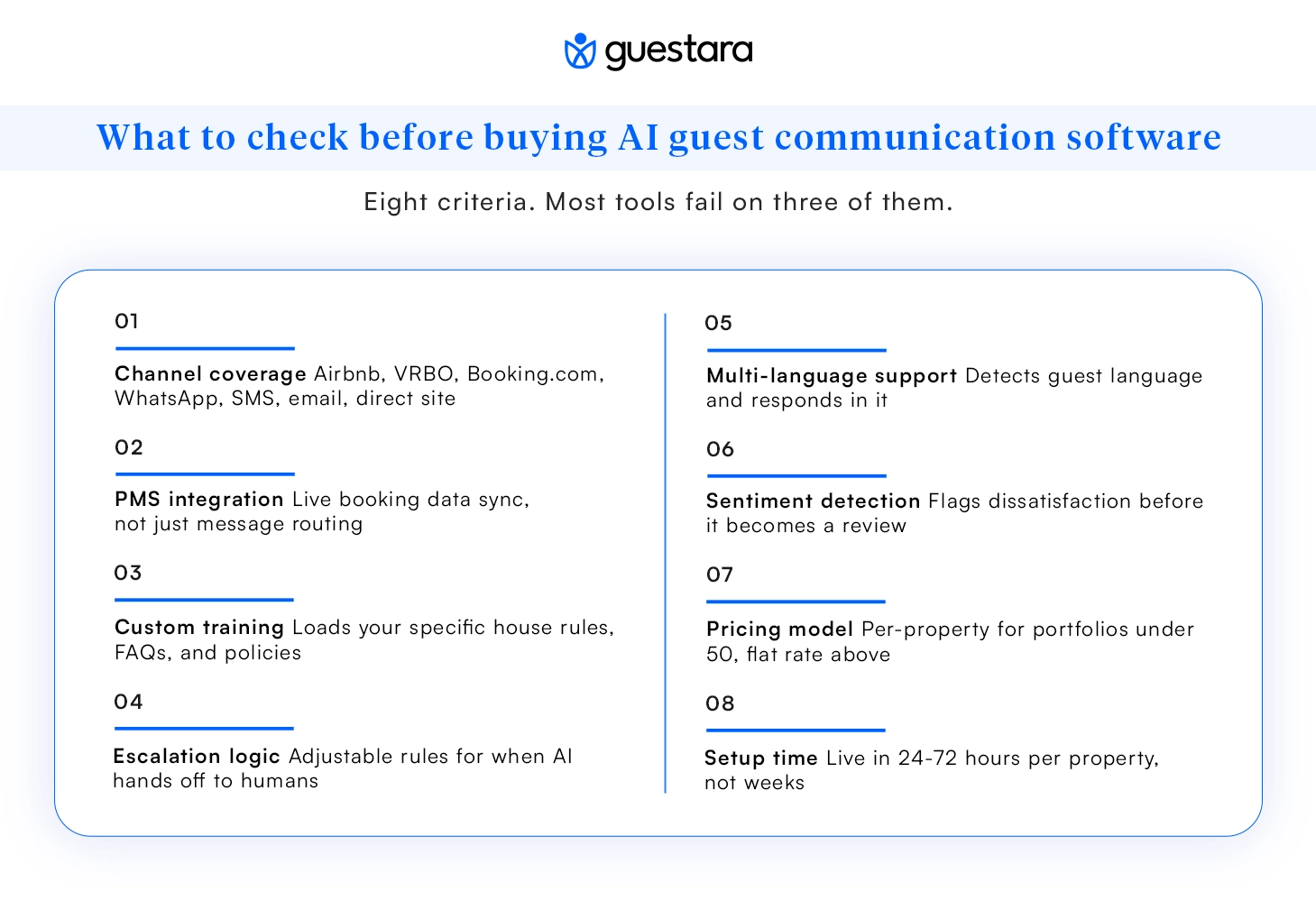
When evaluating any tool, run it against this checklist:
Channel coverage. Does it handle Airbnb, VRBO, Booking.com, WhatsApp, SMS, email, and your direct booking site? If it skips any of these, you are still going to be switching between apps.
PMS integration. Does it pull live booking data from your PMS? Without this, the AI cannot know who is checking in tomorrow or what their stay history is.
Custom training. Can you load your own house rules, guidebook, FAQs, and policies? An AI that cannot be trained on your specific property data will give generic answers that frustrate guests.
Escalation logic. Can you define what gets escalated to a human and what does not? Static rules are fine. Adjustable rules are better.
Multi-language support. If you host international guests, the AI needs to detect the guest's language and respond in it.
Sentiment detection. Does the AI flag dissatisfaction or unusual emotional content? This is a feature most operators ignore until they have their first review crisis.
Pricing model. Per-property, per-message, or flat rate. Per-property is most predictable for portfolios under 50. Flat rate is better above 50.
Setup time. A good tool should be deployable in 24 to 72 hours. If a vendor quotes you weeks of setup, the integration is fragile and the product is not ready.
The best evaluation method is to run a 30-day pilot on one property. If the AI handles 70%+ of guest messages correctly without human intervention, the tool is real. If it sits below 50%, you are buying a chatbot dressed as an AI.
Most AI guest communication tools in the vacation rental market do one part of the job well. Guestara is built around the part most tools skip: making all the channels work as one.
The Unified Inbox aggregates messages from WhatsApp, Airbnb, VRBO, Booking.com, email, Instagram, and Facebook into a single thread per guest. When a guest moves from Airbnb messaging to WhatsApp mid-stay, your team and your AI see one conversation, not two disconnected ones.
The AI Chatbot is trained on your specific property data. WiFi passwords, check-in times, house rules, parking instructions, restaurant recommendations — all loaded once, applied across every channel. When a guest asks the AI a question it cannot confidently answer, escalation rules route it to the right person on your team.
The WhatsApp Marketing module handles the channel that most STR operators have been forced to manage manually. WhatsApp is where international guests live. Guestara's WhatsApp infrastructure is built on Meta's official Business API, which means you get the deliverability without the risk of getting your number banned.
The Engage module ties pre-arrival, in-stay, and post-stay communication together. Trigger-based message journeys read your PMS booking data and fire automated workflows at the right moments — pre-arrival check-in instructions, mid-stay upsell offers, post-stay review requests. Set once, runs for every guest, scales without adding headcount.
What makes the platform work for STR operators specifically is that all of this is built on a single data layer. The AI knows the guest. The inbox knows the channel. The Engage module knows the booking stage. None of it requires you to copy data between apps.
If you are reading this and you are part of the 16% of operators not using AI yet, you have a 90-day catch-up window.
Month 1. Audit your current message volume. Pull 30 days of messages across all channels and categorize them: pre-booking, pre-arrival, arrival, in-stay, post-stay. Identify the top 10 questions you answer repeatedly. These are your highest-leverage automation targets.
Month 2. Pilot one AI tool on one property. Run the 30-day evaluation against the checklist above. Track response time, automation rate, and guest satisfaction. Do not deploy across your portfolio until the pilot is proven.
Month 3. Roll out to your full portfolio with clear escalation rules. Train your team on what the AI handles and what they handle. Audit weekly for the first month, monthly after that.
By the end of the quarter, you should be operating in the same automation tier as the 84% of operators already using AI. The math gets easier from there.
The window to be a fast follower is still open. By the end of 2026, AI guest communication will be table stakes. Operators without it will feel as outdated as operators without channel managers feel today.
If you want to see what AI guest communication actually looks like across a real STR portfolio, book a demo with Guestara. We will walk you through the setup, the channel coverage, and what the first 30 days of deployment look like for an operator starting from zero.


A complete guide to AI guest communication for vacation rentals. How STR operators automate messaging across Airbnb, VRBO, and direct booking channels in 2026.
It is 11:43pm on a Friday.
A guest has just landed at the airport. They sent you a message on Airbnb. Then another one on WhatsApp. Then they called your phone. They cannot find the door code. Their flight was delayed. They have a baby with them.
You are in bed.
By the time you respond, twenty minutes have passed. The guest is angry. The review the next morning will mention "slow communication." Your nightly rate just dropped by 15% in next month's algorithm.
This is the moment most vacation rental operators discover that they cannot run a portfolio of properties on willpower alone. Five listings is a side hustle. Fifteen is a part-time job that owns your evenings. Fifty is a business that requires technology you do not yet have.
This is what AI guest communication for vacation rentals is built for.
AI guest communication for vacation rentals is the use of AI tools that read incoming guest messages across every channel an STR operator uses, understand what the guest is asking, and respond instantly with accurate information pulled from the property's own data.
It is not a chatbot with prewritten answers. It is a system that knows your check-in time, your WiFi password, your house rules, your local restaurant recommendations, and your cancellation policy, and uses that information to handle the conversations you do not have time for.
The difference matters because vacation rentals operate differently from hotels.
A hotel has one front desk, one phone number, one email address. A vacation rental operator might have ten properties, each with a different listing on Airbnb, VRBO, and Booking.com, plus a direct booking website. That is potentially 40 message channels, all expecting fast responses, all running 24/7.
This is the operational math that has driven AI adoption in the STR space faster than in hotels.
The numbers are moving fast.
Hostaway's 2026 Short-Term Rental Report, based on a survey of operators conducted at the end of 2025, found that 61% of STR operators were using AI in some form. By the time Hostaway ran their Summer Snapshot Survey just a few months later, that number had jumped to 84%.
61% to 84% in nine months. That is the steepest adoption curve in the history of vacation rental technology.
A few other numbers worth knowing:
PYMNTS reports that more than 70% of vacation rental managers now use AI tools, citing Hostaway data, and that share has nearly doubled in six months. Vinayak Mahtani, CEO of bnbme Holiday Homes, told Forbes his company's AI assistant handles roughly 70% of guest needs without human involvement.
The Hostaway research found AI adoption climbs even higher among larger portfolios. Operators managing 50+ properties are using AI at a significantly higher rate than smaller hosts. The pattern is clear: as the operational load grows, the math no longer works without AI.
If you are an STR operator and you are not using AI yet, here is the uncomfortable read: 84% of your competitors are. The other 16% are mostly very small operators with one or two properties, where the math still barely works without it.
A hotel deploys AI inside one PMS, one website, and one phone system. A vacation rental operator deploys AI across a stack that did not exist five years ago.
Here is what an actual STR communication channel map looks like:
A guest who books on Airbnb may message you on WhatsApp before arrival, switch to SMS during the stay, and email you a complaint after checkout. Three channels. One conversation. Most operators handle this manually by switching between apps, copying context, and losing track of what was already said.
This is the structural reason AI guest communication tools built for hotels do not always work well for STR operators. Hotels need conversation depth at scale on a small number of channels. STR operators need conversation continuity across many channels with many small properties.
Any AI tool you evaluate for a vacation rental business has to pass three tests:
It has to read every channel you use. If your AI cannot see the message a guest sent on WhatsApp, it cannot respond to it.
It has to hold context across channels. When the same guest moves from Airbnb to WhatsApp, the AI should know it is the same person and what was already discussed.
It has to integrate with your PMS. Without booking data, check-in times, and guest names, the AI is just a chatbot with confidence.
If a vendor cannot demonstrate all three, they are selling you a partial solution.
Most articles on this topic stop at "AI saves you time." That is true but useless. Here is where AI actually does the work, broken down by stage of the guest journey.
This is the highest-leverage stage and the most-overlooked.
A potential guest sends a question before booking: "Is the property pet-friendly? How far is the beach? Is there parking?" If you answer in 5 minutes, you might convert. If you answer in 5 hours, the guest has already booked someone else.
AI tools handle these inquiries instantly. They pull from your listing data, answer the question accurately, and either close the booking inside the channel or escalate to you for the questions that need human judgment (custom dates, group rates, unusual requests).
Response time is the single strongest predictor of whether an inquiry converts to a booking. AI compresses your average response time from hours to seconds.
The 24 to 48 hours before check-in is when most operator communication happens.
The guest needs the address. They need check-in instructions. They want to know if early check-in is possible. They want restaurant recommendations. They want to know if the host will be on-site or remote.
This stage is almost entirely automatable. A well-configured AI tool sends the address at the right moment, delivers check-in instructions on the day of arrival, and handles common pre-arrival questions without your involvement. Stage 2 communication is what most operators automate first because the wins are immediate and the risk of getting it wrong is low.
This is where AI either earns its keep or fails badly.
Arrival is when guests are most stressed. They have luggage. They are tired. The flight may have been delayed. The door code might not work the first time. The WiFi password is wrong on the printed sheet.
AI handles the routine arrival questions instantly: door codes, WiFi, parking, garbage day, appliance instructions. But arrival is also when escalation matters most. If the guest texts "I cannot get in," that is not an FAQ. That is a human problem. The AI needs to recognize the difference and either dispatch a co-host or alert you immediately.
The AI tools getting this right have clear escalation rules. The ones getting it wrong respond to "I cannot get in" with a polite link to the check-in instructions.
The middle of the stay is the most relaxed phase from a communication perspective. Guests ask about local restaurants, pool hours, beach access, and the occasional broken appliance.
This is where AI tools start to differ from each other. The basic ones handle restaurant recommendations from your guidebook. The better ones detect sentiment in the guest's messages. If a guest sends "the AC is not really working but it's fine" — the better AI flags this as a potential issue, not a benign comment.
This is also the stage where mid-stay upsells happen. Late checkout offers. Spa bookings. Activity recommendations with a referral fee. The AI tools that integrate with unified messaging and payment systems can take the booking and the payment in the same conversation.
The 24 hours after checkout is the most important moment in your review pipeline.
A well-built AI tool sends a review request through the right channel at the right time. If the guest had a five-star experience, the request goes to Airbnb or your direct review platform. If the AI detected dissatisfaction during the stay, the request stays internal and triggers a recovery message instead.
This is the stage that converts AI guest communication from a cost center to a revenue line. Properties using post-stay AI workflows report meaningfully higher review volumes and meaningfully fewer public negative reviews.
The expectation level for guest communication has changed faster than most operators realize.
Five years ago, responding within 24 hours was acceptable. Three years ago, within 4 hours was the expectation. Today, guests trained on ChatGPT and other instant-response AI tools expect replies within minutes.
Industry research found guests now expect a response to text-based requests in under 12 minutes. Mobile messaging behavior research from Skift and eHotelier confirms guests are not willing to wait. BCV's analysis identifies response time as a primary driver of guest satisfaction and review scores.
This is the structural reason guest communication has become the highest-priority AI use case in vacation rentals. It is the only category where the math has shifted from "nice to have" to "table stakes."
The operators winning in 2026 are not the ones with the best photos or the most listings. They are the ones whose guest communication feels like the property has a 24/7 concierge desk, regardless of whether the operator manages 5 properties or 50.
This is the section most articles on this topic skip. Every AI tool has limits. The operators using AI well are clear about what those limits are.
A guest dealing with a death in the family. A medical emergency. A guest who has already escalated a complaint. These conversations need a human. An AI that handles them efficiently is doing the wrong job.
Group rates, monthly stays, last-minute discounts. These require judgment about your business that an AI does not have. The AI can flag the request and surface relevant context. The decision should be yours.
Your handwritten welcome note. Your personal restaurant recommendations. The text you send to repeat guests with their kids' names in it. AI can replicate generic friendliness, but it cannot replicate you. The good news is that 90% of guest communication does not need that level of personalization. Save your bandwidth for the 10% that does.
A guest reporting a gas smell. A break-in. A flooded bathroom. AI should immediately route these to a human. No exceptions.
A guest who wants to argue about your cancellation policy is not having an information problem. They are having a trust problem. AI can deliver the policy. Resolving the conflict needs a human.
The pattern is consistent: AI handles execution well, humans handle trust and judgment. The Anthropic Economic Index tracks this directly across industries — 57% of AI-assisted tasks involve a human in the loop. For vacation rentals, that ratio is closer to 70/30 in the AI's favor for routine work and 30/70 for anything emotionally complex.
There are roughly twenty AI guest communication tools competing for the STR market right now. The differences between them matter more than the marketing makes obvious.
When evaluating any tool, run it against this checklist:
Channel coverage. Does it handle Airbnb, VRBO, Booking.com, WhatsApp, SMS, email, and your direct booking site? If it skips any of these, you are still going to be switching between apps.
PMS integration. Does it pull live booking data from your PMS? Without this, the AI cannot know who is checking in tomorrow or what their stay history is.
Custom training. Can you load your own house rules, guidebook, FAQs, and policies? An AI that cannot be trained on your specific property data will give generic answers that frustrate guests.
Escalation logic. Can you define what gets escalated to a human and what does not? Static rules are fine. Adjustable rules are better.
Multi-language support. If you host international guests, the AI needs to detect the guest's language and respond in it.
Sentiment detection. Does the AI flag dissatisfaction or unusual emotional content? This is a feature most operators ignore until they have their first review crisis.
Pricing model. Per-property, per-message, or flat rate. Per-property is most predictable for portfolios under 50. Flat rate is better above 50.
Setup time. A good tool should be deployable in 24 to 72 hours. If a vendor quotes you weeks of setup, the integration is fragile and the product is not ready.
The best evaluation method is to run a 30-day pilot on one property. If the AI handles 70%+ of guest messages correctly without human intervention, the tool is real. If it sits below 50%, you are buying a chatbot dressed as an AI.
Most AI guest communication tools in the vacation rental market do one part of the job well. Guestara is built around the part most tools skip: making all the channels work as one.
The Unified Inbox aggregates messages from WhatsApp, Airbnb, VRBO, Booking.com, email, Instagram, and Facebook into a single thread per guest. When a guest moves from Airbnb messaging to WhatsApp mid-stay, your team and your AI see one conversation, not two disconnected ones.
The AI Chatbot is trained on your specific property data. WiFi passwords, check-in times, house rules, parking instructions, restaurant recommendations — all loaded once, applied across every channel. When a guest asks the AI a question it cannot confidently answer, escalation rules route it to the right person on your team.
The WhatsApp Marketing module handles the channel that most STR operators have been forced to manage manually. WhatsApp is where international guests live. Guestara's WhatsApp infrastructure is built on Meta's official Business API, which means you get the deliverability without the risk of getting your number banned.
The Engage module ties pre-arrival, in-stay, and post-stay communication together. Trigger-based message journeys read your PMS booking data and fire automated workflows at the right moments — pre-arrival check-in instructions, mid-stay upsell offers, post-stay review requests. Set once, runs for every guest, scales without adding headcount.
What makes the platform work for STR operators specifically is that all of this is built on a single data layer. The AI knows the guest. The inbox knows the channel. The Engage module knows the booking stage. None of it requires you to copy data between apps.
If you are reading this and you are part of the 16% of operators not using AI yet, you have a 90-day catch-up window.
Month 1. Audit your current message volume. Pull 30 days of messages across all channels and categorize them: pre-booking, pre-arrival, arrival, in-stay, post-stay. Identify the top 10 questions you answer repeatedly. These are your highest-leverage automation targets.
Month 2. Pilot one AI tool on one property. Run the 30-day evaluation against the checklist above. Track response time, automation rate, and guest satisfaction. Do not deploy across your portfolio until the pilot is proven.
Month 3. Roll out to your full portfolio with clear escalation rules. Train your team on what the AI handles and what they handle. Audit weekly for the first month, monthly after that.
By the end of the quarter, you should be operating in the same automation tier as the 84% of operators already using AI. The math gets easier from there.
The window to be a fast follower is still open. By the end of 2026, AI guest communication will be table stakes. Operators without it will feel as outdated as operators without channel managers feel today.
If you want to see what AI guest communication actually looks like across a real STR portfolio, book a demo with Guestara. We will walk you through the setup, the channel coverage, and what the first 30 days of deployment look like for an operator starting from zero.
AI guest communication for vacation rentals is the use of AI tools that read incoming guest messages across multiple channels (Airbnb, VRBO, Booking.com, WhatsApp, SMS, email), understand what the guest is asking, and respond instantly with accurate information pulled from the property's data. It is more capable than a chatbot because it handles context across channels and integrates with your PMS.
According to Hostaway's research, AI adoption among STR operators jumped from 61% in late 2025 to 84% by 2026. PYMNTS reports more than 70% of vacation rental managers now use AI tools, citing Hostaway data. The pattern is consistent across primary research sources: AI has become the default operating standard.
No, and you should not want it to. AI handles routine, repetitive, and time-sensitive communication well. It does not handle high-emotion situations, custom negotiations, brand voice, or safety issues well. The right model is roughly 70% AI and 30% human for most STR operations, with humans focused on the conversations that need judgment.
The right tool depends on portfolio size and channel mix. For 1-5 properties, simpler tools that focus on Airbnb-specific automation work fine. For 5-50 properties, you need multi-channel coverage including WhatsApp and SMS. For 50+ properties, integration depth with your PMS becomes the deciding factor. Always run a 30-day pilot on one property before committing to a full deployment.
A well-built tool should be live in 24 to 72 hours for a single property. Full portfolio deployment typically takes 30 to 60 days, depending on the number of properties, channels, and the complexity of your custom data. The bottleneck is usually data preparation (your guidebook, house rules, FAQs), not the AI itself.
We work closely with the industry leaders to offer seamless solutions




We’re here to help your whole team stay ahead of the curve as you grow.

Get up and running quickly with a personalized onboarding plan

Connect with real people who really get it, 24/7

Checkout our vast library of free resources, templates and more
There's only so much we can say — so let us show you! Schedule a demo today and reach your business goals.


.webp)
.png)

