
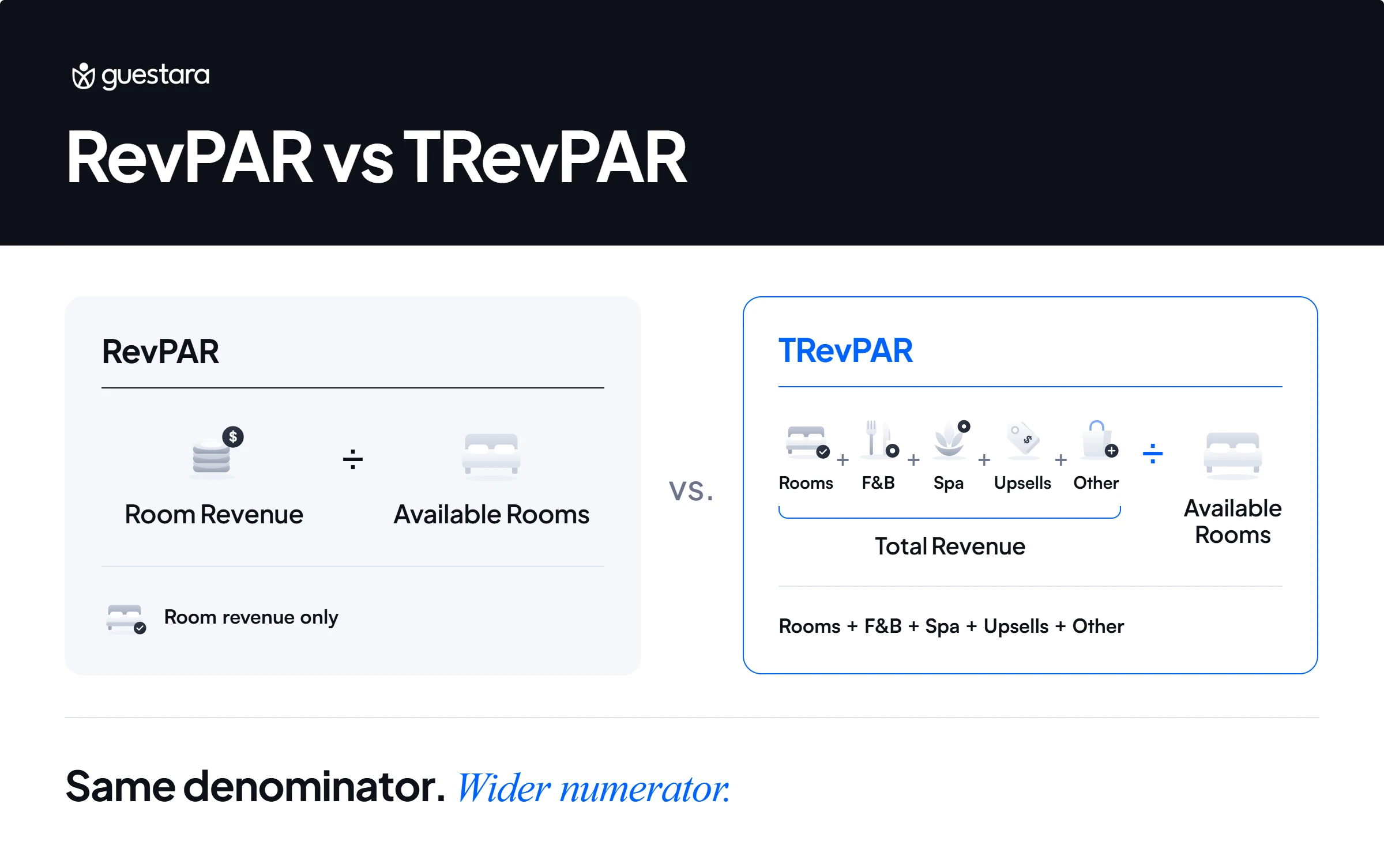
RevPAR measures room revenue per available room; TRevPAR measures total revenue, from every stream, per available room. Same denominator, wider numerator. The gap between them is your ancillary revenue per available room, which is exactly what total revenue management is built to grow.
RevPAR and TRevPAR are calculated the same way, over the same available rooms. Only the revenue they count differs:
Because total revenue is always at least room revenue, TRevPAR is always greater than or equal to RevPAR. The difference between the two is the share of your business that has nothing to do with the room rate.
Take the 100-room hotel used across this cluster, over one month (3,000 available room-nights):
Now compare two hotels with identical RevPAR:
On rooms they look identical. On total business they are worlds apart, and only TRevPAR shows it. This is the core reason resorts and full-service hotels cannot manage on RevPAR alone.
Lead with RevPAR when rooms are the business. For limited-service and rooms-focused properties, and for any benchmarking against a competitive set, RevPAR is the right lens. It is the industry-standard comparable, so it is what performance reports and comp-set indexes are built on.
Lead with TRevPAR when ancillary revenue is material. Resorts, full-service hotels, and any property with meaningful F&B, spa, experience, or upsell revenue need TRevPAR to see their true commercial performance. It is also the metric that tells you whether a total revenue management strategy is actually working.
Use the gap between them as its own KPI. TRevPAR minus RevPAR is your ancillary contribution per available room. Watching that gap widen over time is a direct read on how well your upsell and ancillary programs are performing.
TRevPAR does not replace RevPAR, it builds on it. RevPAR keeps room pricing and occupancy honest; TRevPAR shows whether the rest of the property is pulling its weight. Read together, they separate room performance from total performance so you can act on each.
The fastest way to widen the gap between them is upselling, because it adds ancillary revenue to rooms you have already sold. Guestara's hotel upsell software automates upgrade and add-on offers across the guest journey, and hotels using it see up to 200% more upsells, which shows up directly as a growing TRevPAR over RevPAR.
One shared blind spot: neither metric measures profit. A high TRevPAR built on low-margin ancillary revenue may not lift the bottom line much, which is where GOPPAR takes over.
Room revenue or total revenue? Which lens actually fits your property.
RevPAR measures room revenue per available room; TRevPAR measures total revenue, from every stream, per available room. Same denominator, wider numerator. The gap between them is your ancillary revenue per available room, which is exactly what total revenue management is built to grow.
RevPAR and TRevPAR are calculated the same way, over the same available rooms. Only the revenue they count differs:
Because total revenue is always at least room revenue, TRevPAR is always greater than or equal to RevPAR. The difference between the two is the share of your business that has nothing to do with the room rate.
Take the 100-room hotel used across this cluster, over one month (3,000 available room-nights):
Now compare two hotels with identical RevPAR:
On rooms they look identical. On total business they are worlds apart, and only TRevPAR shows it. This is the core reason resorts and full-service hotels cannot manage on RevPAR alone.
Lead with RevPAR when rooms are the business. For limited-service and rooms-focused properties, and for any benchmarking against a competitive set, RevPAR is the right lens. It is the industry-standard comparable, so it is what performance reports and comp-set indexes are built on.
Lead with TRevPAR when ancillary revenue is material. Resorts, full-service hotels, and any property with meaningful F&B, spa, experience, or upsell revenue need TRevPAR to see their true commercial performance. It is also the metric that tells you whether a total revenue management strategy is actually working.
Use the gap between them as its own KPI. TRevPAR minus RevPAR is your ancillary contribution per available room. Watching that gap widen over time is a direct read on how well your upsell and ancillary programs are performing.
TRevPAR does not replace RevPAR, it builds on it. RevPAR keeps room pricing and occupancy honest; TRevPAR shows whether the rest of the property is pulling its weight. Read together, they separate room performance from total performance so you can act on each.
The fastest way to widen the gap between them is upselling, because it adds ancillary revenue to rooms you have already sold. Guestara's hotel upsell software automates upgrade and add-on offers across the guest journey, and hotels using it see up to 200% more upsells, which shows up directly as a growing TRevPAR over RevPAR.
One shared blind spot: neither metric measures profit. A high TRevPAR built on low-margin ancillary revenue may not lift the bottom line much, which is where GOPPAR takes over.
RevPAR counts room revenue per available room; TRevPAR counts total revenue per available room. Same formula and denominator, but TRevPAR includes F&B, spa, upsells, and all other ancillary income.
Yes, or equal. Total revenue is never less than room revenue, so TRevPAR is greater than or equal to RevPAR, and they match only when a property has no ancillary revenue.
It depends on your property. Rooms-focused and limited-service hotels can lead with RevPAR; resorts and full-service hotels need TRevPAR. Most revenue teams track both and watch the gap.
No. Both are revenue metrics. To factor in cost and profit per available room, use GOPPAR.


