RGI compares your RevPAR to the RevPAR of your competitive set. An RGI of 100 means you are capturing exactly your fair share of the market's revenue. Above 100 means you are taking share from competitors, below 100 means you are losing it. It is the headline number on a STAR report and the one metric that tells you whether a good month was actually good or just a rising tide.
Revenue Generating Index (RGI), also called the RevPAR Index, measures your performance against your competitors rather than against yourself.
This matters because internal metrics are blind to context. A hotel can grow RevPAR 8% year over year and still be losing, if the market grew 15%. It can watch RevPAR fall and still be winning, if the market fell further. RGI is what turns an absolute number into a judgment.
The logic rests on fair share. If your hotel is one of five similar properties in a comp set, each with similar room counts, your fair share of the market's revenue is roughly a fifth of it. RGI expresses whether you are capturing that share, more than it, or less, on a scale where 100 is exactly fair. The index normalizes for property size, so a 100-room hotel and a 400-room hotel in the same comp set are compared on equal terms.
RGI is one of three comp set indexes that are read together. MPI covers occupancy share, ARI covers rate share, and RGI combines both into the revenue picture.
RGI = (Your RevPAR / Competitive Set RevPAR) × 100
Some reports express the index as a decimal (1.20) rather than a number out of 100 (120). The meaning is identical. This page uses the 100 convention, which is the more common one.
There is also an exact relationship worth knowing, because RevPAR is occupancy multiplied by rate:
RGI = (MPI × ARI) / 100
That identity is what makes RGI diagnosable rather than just a score, and it is the basis of the most useful section on this page.
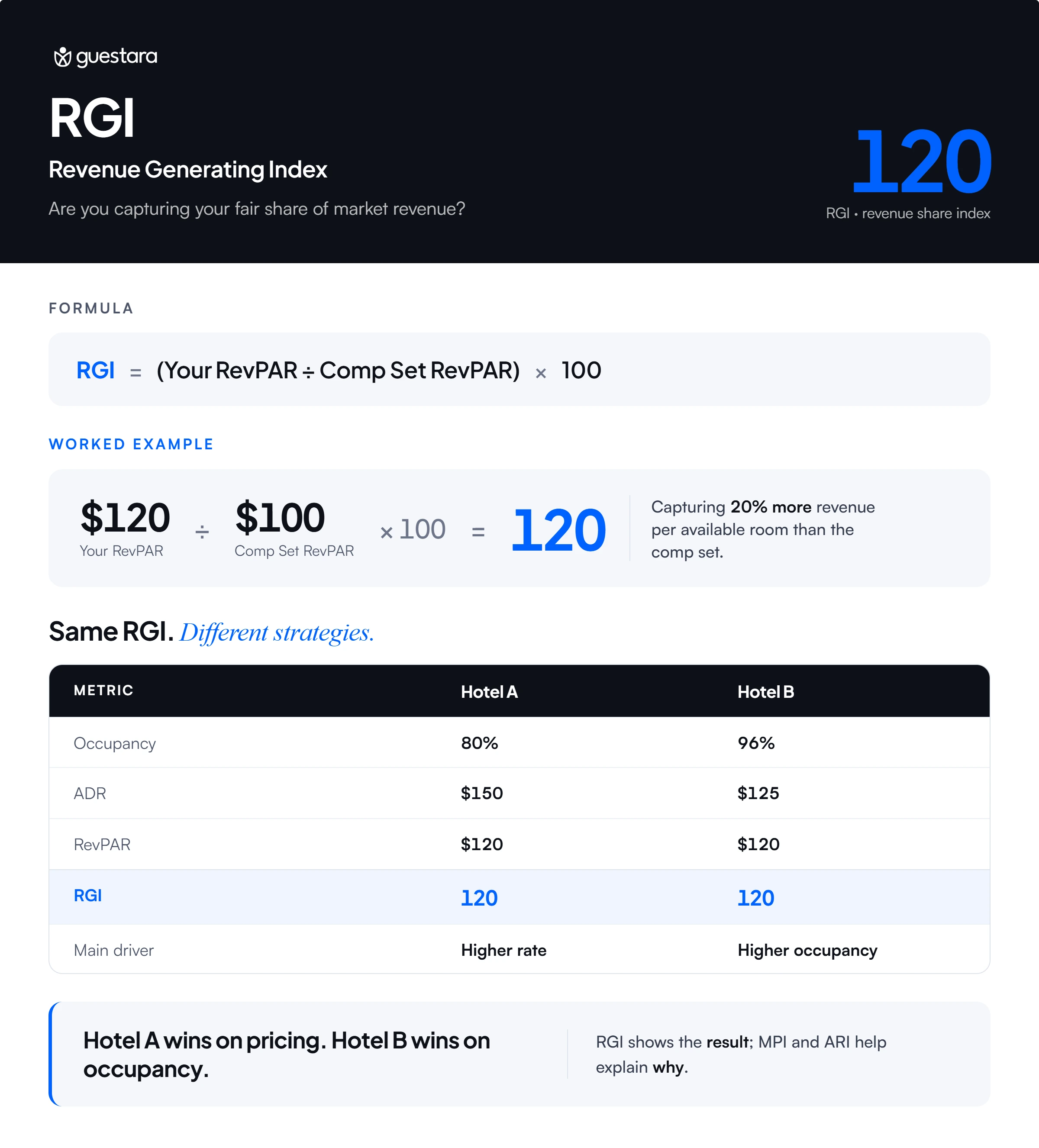
Take the same 100-room hotel used across this cluster: 80% occupancy, $150 ADR, so RevPAR is $120. Its comp set over the same period runs 80% occupancy at a $125 ADR, giving a comp set RevPAR of $100.
RGI = ($120 / $100) × 100 = 120
The hotel is capturing 120% of its fair share of comp set revenue, or 20% more revenue per available room than the market it competes in.
Read the index as a percentage of fair share and the arithmetic stays intuitive:
An RGI on its own tells you the outcome but not how you got there, and two hotels can post an identical 120 while running completely different businesses. This is where the MPI and ARI decomposition earns its place.
Both hotels below sit in the same comp set (80% occupancy, $125 ADR, $100 RevPAR) and both post an RGI of 120:
Hotel A wins entirely on rate. It fills the same share of rooms as the market but charges a 20% premium, which usually means stronger positioning, brand, or product. Hotel B wins entirely on volume. It matches the market's rate but runs sixteen points of occupancy above it, which suggests it is the preferred choice at the going price and may well have room to push rate.
Same score, opposite diagnoses, opposite next moves. Hotel A should ask whether it is leaving occupancy on the table. Hotel B should ask whether it is underpricing. Looking at RGI alone, neither question gets asked, which is why the three indexes belong on the same report.
RGI is the one metric on this cluster where the benchmark is built into the definition: 100 is fair share, and that is the reference point.
What still needs judgment is the comp set itself, because the index is only as honest as the hotels in it:
Two practical notes. First, read RGI as a trend rather than a snapshot, because a single period can swing on one competitor's renovation or a group piece that landed somewhere else. Second, resist re-cutting the comp set when the number disappoints. The index is only comparable over time if its basis holds still.
RGI moves when your RevPAR grows faster than the market's, which means the levers are the familiar ones, applied with an eye on relative rather than absolute performance.
Acting on all of that depends on reading your own performance and booking data quickly enough to respond while the period is still open. Guestara's hospitality AI surfaces patterns across guest and booking data, so comp set movements can be met with a decision rather than noticed in a report after the month has closed.
Your share of the comp set’s revenue, and how to decode what is actually driving it.
RGI compares your RevPAR to the RevPAR of your competitive set. An RGI of 100 means you are capturing exactly your fair share of the market's revenue. Above 100 means you are taking share from competitors, below 100 means you are losing it. It is the headline number on a STAR report and the one metric that tells you whether a good month was actually good or just a rising tide.
Revenue Generating Index (RGI), also called the RevPAR Index, measures your performance against your competitors rather than against yourself.
This matters because internal metrics are blind to context. A hotel can grow RevPAR 8% year over year and still be losing, if the market grew 15%. It can watch RevPAR fall and still be winning, if the market fell further. RGI is what turns an absolute number into a judgment.
The logic rests on fair share. If your hotel is one of five similar properties in a comp set, each with similar room counts, your fair share of the market's revenue is roughly a fifth of it. RGI expresses whether you are capturing that share, more than it, or less, on a scale where 100 is exactly fair. The index normalizes for property size, so a 100-room hotel and a 400-room hotel in the same comp set are compared on equal terms.
RGI is one of three comp set indexes that are read together. MPI covers occupancy share, ARI covers rate share, and RGI combines both into the revenue picture.
RGI = (Your RevPAR / Competitive Set RevPAR) × 100
Some reports express the index as a decimal (1.20) rather than a number out of 100 (120). The meaning is identical. This page uses the 100 convention, which is the more common one.
There is also an exact relationship worth knowing, because RevPAR is occupancy multiplied by rate:
RGI = (MPI × ARI) / 100
That identity is what makes RGI diagnosable rather than just a score, and it is the basis of the most useful section on this page.
Take the same 100-room hotel used across this cluster: 80% occupancy, $150 ADR, so RevPAR is $120. Its comp set over the same period runs 80% occupancy at a $125 ADR, giving a comp set RevPAR of $100.
RGI = ($120 / $100) × 100 = 120
The hotel is capturing 120% of its fair share of comp set revenue, or 20% more revenue per available room than the market it competes in.
Read the index as a percentage of fair share and the arithmetic stays intuitive:
An RGI on its own tells you the outcome but not how you got there, and two hotels can post an identical 120 while running completely different businesses. This is where the MPI and ARI decomposition earns its place.
Both hotels below sit in the same comp set (80% occupancy, $125 ADR, $100 RevPAR) and both post an RGI of 120:
Hotel A wins entirely on rate. It fills the same share of rooms as the market but charges a 20% premium, which usually means stronger positioning, brand, or product. Hotel B wins entirely on volume. It matches the market's rate but runs sixteen points of occupancy above it, which suggests it is the preferred choice at the going price and may well have room to push rate.
Same score, opposite diagnoses, opposite next moves. Hotel A should ask whether it is leaving occupancy on the table. Hotel B should ask whether it is underpricing. Looking at RGI alone, neither question gets asked, which is why the three indexes belong on the same report.
RGI is the one metric on this cluster where the benchmark is built into the definition: 100 is fair share, and that is the reference point.
What still needs judgment is the comp set itself, because the index is only as honest as the hotels in it:
Two practical notes. First, read RGI as a trend rather than a snapshot, because a single period can swing on one competitor's renovation or a group piece that landed somewhere else. Second, resist re-cutting the comp set when the number disappoints. The index is only comparable over time if its basis holds still.
RGI moves when your RevPAR grows faster than the market's, which means the levers are the familiar ones, applied with an eye on relative rather than absolute performance.
Acting on all of that depends on reading your own performance and booking data quickly enough to respond while the period is still open. Guestara's hospitality AI surfaces patterns across guest and booking data, so comp set movements can be met with a decision rather than noticed in a report after the month has closed.
Anything above 100 means you are capturing more than your fair share of comp set revenue. Most hotels target a sustained figure above 100 and track the trend, since a one-period spike can come from a single competitor's closure or renovation.
It means your RevPAR exactly matches your competitive set's, so you are capturing precisely your fair share of the market's revenue, no more and no less.
RGI equals MPI multiplied by ARI, divided by 100. Because RevPAR is occupancy multiplied by rate, the revenue index is the product of the occupancy index and the rate index. That is why two hotels with the same RGI can have opposite underlying performance.
Yes. The two terms are used interchangeably, and benchmarking reports may use either label for the same calculation.


