
RevPASH measures restaurant revenue against seats and time together, not against covers or spend alone. It is the F&B equivalent of RevPAR: a capacity metric that exposes whether a busy outlet is actually productive, and the only standard way to see which hours of service are earning and which are just open.
Revenue per Available Seat Hour (RevPASH) measures how much revenue each seat generates for each hour it is available to be sold.
Restaurant performance is usually tracked with two figures: covers, meaning how many guests were served, and average check, meaning how much each spent. Both are useful and neither accounts for capacity. A restaurant serving 200 covers at a $40 average check looks identical whether those covers arrived across a packed two-hour dinner or trickled through a ten-hour day with most seats empty.
RevPASH fixes this by treating the seat-hour as the unit of inventory, exactly as hotel revenue management treats the room-night. A seat that sits empty for an hour is inventory you can never sell again, in precisely the way last night's unsold room is gone.
That reframing makes an outlet yieldable. Once you can see revenue by seat-hour, you can see which service periods are genuinely productive, where capacity is wasted, and whether the answer to a weak period is more guests, a higher check, or faster turns.
RevPASH = Total Outlet Revenue / (Available Seats × Hours Open)
Two things to settle before the number is trustworthy. Count seats honestly: a 100-seat restaurant that cannot realistically seat parties into every chair should use its practical capacity. Match the hours to the question: RevPASH across a full day averages the dead hours into the busy ones, which is why the metric earns its keep when calculated per service period or per hour rather than per day.
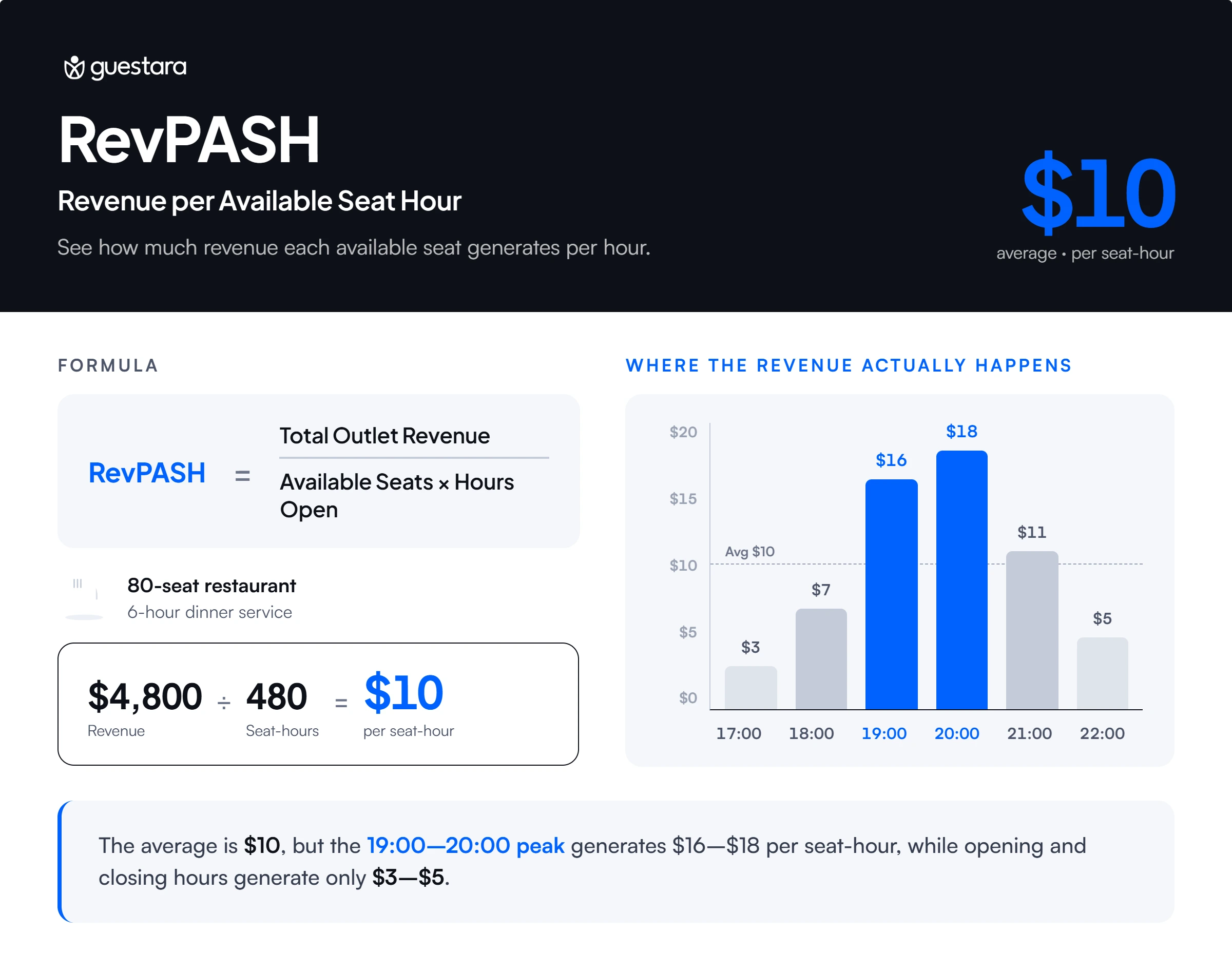
Take the restaurant in the same 100-room hotel used across this cluster. It has 80 seats and runs a six-hour dinner service, taking $4,800 over the evening.
RevPASH = $4,800 / (80 seats × 6 hours) RevPASH = $4,800 / 480 seat-hours = $10 per seat-hour
A single figure like that is close to useless on its own. The value appears when you break the same service into its hours:
The average of $10 describes none of the actual hours. Two hours carry the service at $16 and $18, the opening and closing hours run at $3 and $5, and the operational questions follow immediately: can demand be shifted out of the 20:00 peak into the 18:00 shoulder, is the 22:00 hour worth staffing, and is the 19:00 to 20:00 peak capacity-constrained in a way that a faster turn would relieve?
Covers and average check cannot raise those questions. RevPASH does, which is the entire argument for it.
There is no cross-industry RevPASH benchmark worth quoting. The figure depends on price point, service style, seat count, and opening hours, so a fine-dining room and a casual all-day outlet are not comparable even inside the same hotel.
Use it internally and comparatively:
RevPASH has three levers, since revenue per seat-hour rises when you serve more guests, sell more to each, or free up seat-hours faster.
The ordering friction in that third lever and the off-seat demand in the last are closely related, and both are addressable without adding staff. Guestara's mobile food ordering system lets guests order and pay from their phone, in the outlet or from the room, which compresses the time each table spends waiting and captures demand that never occupies a seat.
The F&B answer to RevPAR. Which hours of service earn, and which are only open.
RevPASH measures restaurant revenue against seats and time together, not against covers or spend alone. It is the F&B equivalent of RevPAR: a capacity metric that exposes whether a busy outlet is actually productive, and the only standard way to see which hours of service are earning and which are just open.
Revenue per Available Seat Hour (RevPASH) measures how much revenue each seat generates for each hour it is available to be sold.
Restaurant performance is usually tracked with two figures: covers, meaning how many guests were served, and average check, meaning how much each spent. Both are useful and neither accounts for capacity. A restaurant serving 200 covers at a $40 average check looks identical whether those covers arrived across a packed two-hour dinner or trickled through a ten-hour day with most seats empty.
RevPASH fixes this by treating the seat-hour as the unit of inventory, exactly as hotel revenue management treats the room-night. A seat that sits empty for an hour is inventory you can never sell again, in precisely the way last night's unsold room is gone.
That reframing makes an outlet yieldable. Once you can see revenue by seat-hour, you can see which service periods are genuinely productive, where capacity is wasted, and whether the answer to a weak period is more guests, a higher check, or faster turns.
RevPASH = Total Outlet Revenue / (Available Seats × Hours Open)
Two things to settle before the number is trustworthy. Count seats honestly: a 100-seat restaurant that cannot realistically seat parties into every chair should use its practical capacity. Match the hours to the question: RevPASH across a full day averages the dead hours into the busy ones, which is why the metric earns its keep when calculated per service period or per hour rather than per day.
Take the restaurant in the same 100-room hotel used across this cluster. It has 80 seats and runs a six-hour dinner service, taking $4,800 over the evening.
RevPASH = $4,800 / (80 seats × 6 hours) RevPASH = $4,800 / 480 seat-hours = $10 per seat-hour
A single figure like that is close to useless on its own. The value appears when you break the same service into its hours:
The average of $10 describes none of the actual hours. Two hours carry the service at $16 and $18, the opening and closing hours run at $3 and $5, and the operational questions follow immediately: can demand be shifted out of the 20:00 peak into the 18:00 shoulder, is the 22:00 hour worth staffing, and is the 19:00 to 20:00 peak capacity-constrained in a way that a faster turn would relieve?
Covers and average check cannot raise those questions. RevPASH does, which is the entire argument for it.
There is no cross-industry RevPASH benchmark worth quoting. The figure depends on price point, service style, seat count, and opening hours, so a fine-dining room and a casual all-day outlet are not comparable even inside the same hotel.
Use it internally and comparatively:
RevPASH has three levers, since revenue per seat-hour rises when you serve more guests, sell more to each, or free up seat-hours faster.
The ordering friction in that third lever and the off-seat demand in the last are closely related, and both are addressable without adding staff. Guestara's mobile food ordering system lets guests order and pay from their phone, in the outlet or from the room, which compresses the time each table spends waiting and captures demand that never occupies a seat.
There is no meaningful industry figure, because it scales with price point and service style. A fine-dining room and a casual café will differ by multiples. Benchmark against your own outlet's history, hour by hour and period by period.
Average check is revenue per guest and ignores capacity entirely. RevPASH is revenue per seat-hour and accounts for both how full you were and for how long. A high average check with low RevPASH means a quiet room serving expensive meals.
Hourly, or at least per service period. A daily figure averages the strong and dead hours together and hides exactly the pattern the metric exists to reveal.
Use practically sellable seats rather than theoretical maximum capacity. Counting chairs you cannot realistically fill deflates RevPASH and makes the trend less useful.


