
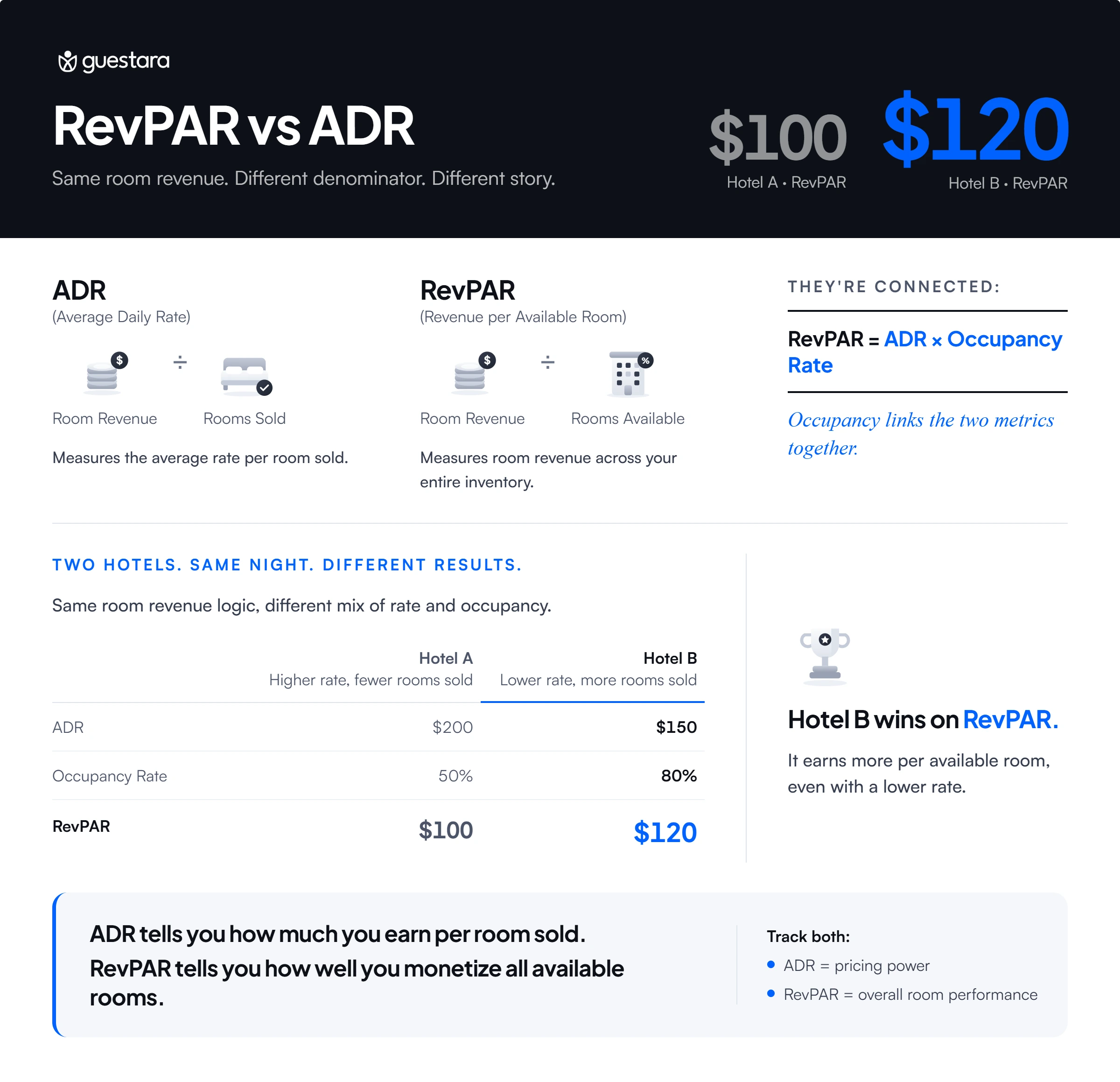
ADR measures the average rate per room sold; RevPAR measures room revenue per room available. ADR shows your pricing power; RevPAR shows how well you monetize your whole inventory, because it factors in occupancy. They are complementary, not competing: RevPAR = ADR x Occupancy Rate.
ADR and RevPAR answer two different questions:
The single difference driving everything else is the denominator. ADR divides room revenue by rooms sold. RevPAR divides it by rooms available. That is why RevPAR quietly accounts for empty rooms and ADR does not.
This is the classic trap that shows why ADR alone misleads. Compare two hotels on the same night:
Hotel A charges more per room and looks stronger on ADR. But Hotel B earns more per available room and wins on RevPAR, which is the number that reflects actual room-revenue performance. Judge on ADR alone and you would back the wrong property.
Reach for ADR when you are working on rate. Setting or reviewing pricing strategy, comparing rates across segments, channels, or room types, and negotiating corporate or group rates are all ADR questions, because you want price isolated from volume.
Reach for RevPAR when you are judging performance. Comparing to your competitive set or prior periods, reporting to owners and boards, and forecasting all call for RevPAR, because it reflects how well you filled and priced inventory together.
Use them together to diagnose. If your RevPAR lags the comp set, break it down: is it an ADR problem (underpricing) or an occupancy problem (not enough demand)? ADR and occupancy are the two dials behind every RevPAR result.
RevPAR is the bridge between the two:
RevPAR = ADR x Occupancy Rate
Raising ADR only lifts RevPAR if occupancy does not fall far enough to cancel it out, and filling more rooms only helps if you do not gut the rate to do it. The art of revenue management is moving both without sacrificing one for the other. One direct way to nudge ADR upward without touching occupancy is upselling: Guestara's hotel upsell software drives up to 200% more upsells on rooms you have already sold, lifting ADR and RevPAR together.
Both metrics share one blind spot: they only count room revenue. Neither reflects F&B, spa, or other ancillary spend (use TRevPAR for that) or cost and profit (use GOPPAR).
RevPAR vs ADR explained: ADR is revenue per room sold, RevPAR per room available.
ADR measures the average rate per room sold; RevPAR measures room revenue per room available. ADR shows your pricing power; RevPAR shows how well you monetize your whole inventory, because it factors in occupancy. They are complementary, not competing: RevPAR = ADR x Occupancy Rate.
ADR and RevPAR answer two different questions:
The single difference driving everything else is the denominator. ADR divides room revenue by rooms sold. RevPAR divides it by rooms available. That is why RevPAR quietly accounts for empty rooms and ADR does not.
This is the classic trap that shows why ADR alone misleads. Compare two hotels on the same night:
Hotel A charges more per room and looks stronger on ADR. But Hotel B earns more per available room and wins on RevPAR, which is the number that reflects actual room-revenue performance. Judge on ADR alone and you would back the wrong property.
Reach for ADR when you are working on rate. Setting or reviewing pricing strategy, comparing rates across segments, channels, or room types, and negotiating corporate or group rates are all ADR questions, because you want price isolated from volume.
Reach for RevPAR when you are judging performance. Comparing to your competitive set or prior periods, reporting to owners and boards, and forecasting all call for RevPAR, because it reflects how well you filled and priced inventory together.
Use them together to diagnose. If your RevPAR lags the comp set, break it down: is it an ADR problem (underpricing) or an occupancy problem (not enough demand)? ADR and occupancy are the two dials behind every RevPAR result.
RevPAR is the bridge between the two:
RevPAR = ADR x Occupancy Rate
Raising ADR only lifts RevPAR if occupancy does not fall far enough to cancel it out, and filling more rooms only helps if you do not gut the rate to do it. The art of revenue management is moving both without sacrificing one for the other. One direct way to nudge ADR upward without touching occupancy is upselling: Guestara's hotel upsell software drives up to 200% more upsells on rooms you have already sold, lifting ADR and RevPAR together.
Both metrics share one blind spot: they only count room revenue. Neither reflects F&B, spa, or other ancillary spend (use TRevPAR for that) or cost and profit (use GOPPAR).
RevPAR is the headline metric for overall room performance, but ADR is essential for diagnosing it. It is not either/or: you track RevPAR to know how you are doing and ADR to understand why.
Yes, but only at 100% occupancy. At any occupancy below full, RevPAR is lower than ADR.
No. Both are room revenue only. To capture total revenue per available room, use TRevPAR; to factor in profit, use GOPPAR.
Only if occupancy holds. A rate increase that pushes too many bookings away can lower occupancy enough to drop RevPAR even as ADR rises.


