
RevPAC measures total revenue, rooms plus everything else, divided by the number of guests. It is the metric that treats the guest rather than the room as the unit of business, which is the only way to see what a guest is actually worth to a property with meaningful outlet, spa, or activity revenue.
Revenue per Available Customer (RevPAC) is the per-guest view of total revenue. It captures everything a guest spends across their stay, the room and every outlet, and expresses it as a figure per person.
Every other headline metric in hospitality is built on the room. ADR is revenue per room sold, RevPAR per room available, TRevPAR adds ancillary revenue but still divides by rooms. All of them answer the same underlying question: what is a room worth?
RevPAC asks a different one: what is a guest worth? For a limited-service hotel where the room is almost the entire business, the distinction is academic. For a resort, a full-service hotel, or any property where guests eat, drink, book treatments, and join activities, it is the difference between measuring your inventory and measuring your customers.
That shift matters for a practical reason. Rooms are fixed, so room-based metrics are capped by your room count. Guest spend is not capped the same way, which means RevPAC measures the part of the business that can grow without building anything.
RevPAC = Total Revenue / Total Number of Guests
Two definitional notes. First, some properties compute RevPAC on revenue rather than profit, which is the convention used here, so read it as a revenue measure and not a contribution measure. Second, the name says "available customer," but in practice the denominator is guests actually accommodated, because unlike rooms, there is no meaningful count of available customers.
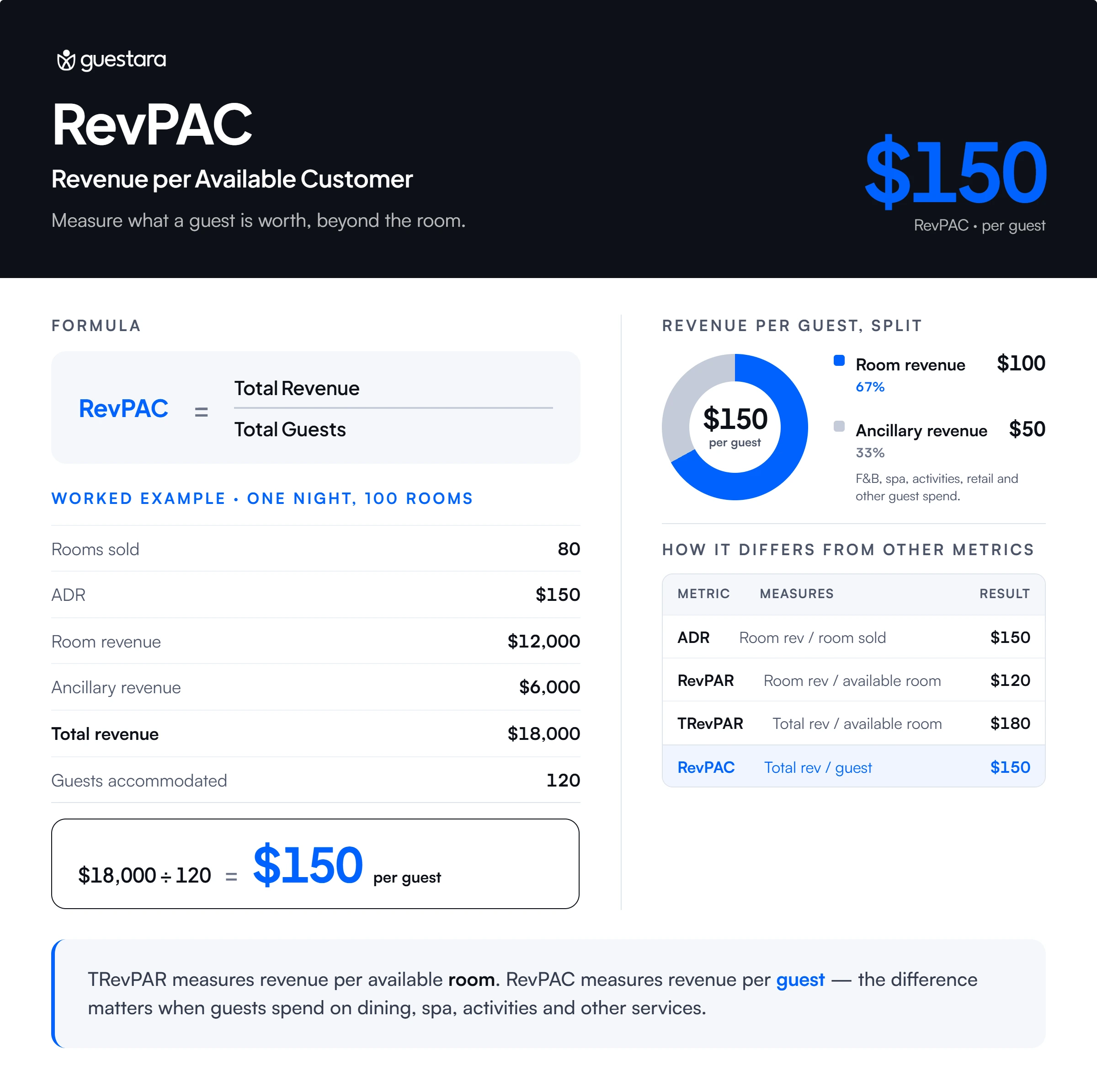
Take the same 100-room hotel used across this cluster. Over one night it sells 80 rooms at a $150 ADR and accommodates 120 guests, a double occupancy of 1.5. Ancillary spend runs $75 per occupied room.
Room revenue = 80 × $150 = $12,000 Ancillary revenue = 80 × $75 = $6,000 Total revenue = $18,000 RevPAC = $18,000 / 120 guests = $150 per guest
So each guest is worth $150 across their stay, of which $100 is the room (the ARG figure) and $50 is everything else.
One thing to notice before it confuses anyone: RevPAC here is $150 and ADR is also $150. That is a coincidence of this example, not a relationship. ADR is per room sold, RevPAC is per guest, and the two numbers happen to land in the same place because this property's double occupancy and ancillary spend offset each other. Change either and they separate immediately.
Here is the full set of per-unit views of the same night's trading, which is the clearest way to see what each metric is actually dividing by:
Five numbers, one night, one business. They disagree because they answer different questions, and RevPAC is the only one that answers a question about people.
The caution that comes with it: RevPAC is a revenue metric, so a high figure driven by low-margin outlet revenue is not automatically profitable. Read it alongside the margin on that spend, and use ARPAR when the question is contribution rather than revenue.
RevPAC is not reported by benchmarking providers, so there is no comp set figure to index against. It is an internal metric, and the comparisons that matter are your own.
RevPAC rises when total revenue grows faster than guest count, which makes it a question of what guests do once they arrive rather than how many of them there are.
The pre-arrival window is the highest-yield of these, because intent is highest and capacity is still open. Guestara's hotel upsell software presents relevant add-ons and experiences across booking and pre-arrival, converting that intent into spend that lands in the RevPAC numerator.
What a guest is worth rather than what a room is worth, across rooms and every outlet.
RevPAC measures total revenue, rooms plus everything else, divided by the number of guests. It is the metric that treats the guest rather than the room as the unit of business, which is the only way to see what a guest is actually worth to a property with meaningful outlet, spa, or activity revenue.
Revenue per Available Customer (RevPAC) is the per-guest view of total revenue. It captures everything a guest spends across their stay, the room and every outlet, and expresses it as a figure per person.
Every other headline metric in hospitality is built on the room. ADR is revenue per room sold, RevPAR per room available, TRevPAR adds ancillary revenue but still divides by rooms. All of them answer the same underlying question: what is a room worth?
RevPAC asks a different one: what is a guest worth? For a limited-service hotel where the room is almost the entire business, the distinction is academic. For a resort, a full-service hotel, or any property where guests eat, drink, book treatments, and join activities, it is the difference between measuring your inventory and measuring your customers.
That shift matters for a practical reason. Rooms are fixed, so room-based metrics are capped by your room count. Guest spend is not capped the same way, which means RevPAC measures the part of the business that can grow without building anything.
RevPAC = Total Revenue / Total Number of Guests
Two definitional notes. First, some properties compute RevPAC on revenue rather than profit, which is the convention used here, so read it as a revenue measure and not a contribution measure. Second, the name says "available customer," but in practice the denominator is guests actually accommodated, because unlike rooms, there is no meaningful count of available customers.
Take the same 100-room hotel used across this cluster. Over one night it sells 80 rooms at a $150 ADR and accommodates 120 guests, a double occupancy of 1.5. Ancillary spend runs $75 per occupied room.
Room revenue = 80 × $150 = $12,000 Ancillary revenue = 80 × $75 = $6,000 Total revenue = $18,000 RevPAC = $18,000 / 120 guests = $150 per guest
So each guest is worth $150 across their stay, of which $100 is the room (the ARG figure) and $50 is everything else.
One thing to notice before it confuses anyone: RevPAC here is $150 and ADR is also $150. That is a coincidence of this example, not a relationship. ADR is per room sold, RevPAC is per guest, and the two numbers happen to land in the same place because this property's double occupancy and ancillary spend offset each other. Change either and they separate immediately.
Here is the full set of per-unit views of the same night's trading, which is the clearest way to see what each metric is actually dividing by:
Five numbers, one night, one business. They disagree because they answer different questions, and RevPAC is the only one that answers a question about people.
The caution that comes with it: RevPAC is a revenue metric, so a high figure driven by low-margin outlet revenue is not automatically profitable. Read it alongside the margin on that spend, and use ARPAR when the question is contribution rather than revenue.
RevPAC is not reported by benchmarking providers, so there is no comp set figure to index against. It is an internal metric, and the comparisons that matter are your own.
RevPAC rises when total revenue grows faster than guest count, which makes it a question of what guests do once they arrive rather than how many of them there are.
The pre-arrival window is the highest-yield of these, because intent is highest and capacity is still open. Guestara's hotel upsell software presents relevant add-ons and experiences across booking and pre-arrival, converting that intent into spend that lands in the RevPAC numerator.
Both count total revenue. TRevPAR divides by available rooms, RevPAC divides by guests. TRevPAR tells you what your inventory produced, RevPAC tells you what your customers were worth.
ARG counts room revenue only. RevPAC counts room revenue plus all ancillary spend. The gap between them is what your guests spend beyond the room.
There is no industry benchmark, and the figure depends heavily on your service level. A resort with extensive outlets will report multiples of a select-service hotel's RevPAC. Track your own trend and compare across segments.
No. RevPAR is standardized and benchmarkable, which RevPAC is not. RevPAC sits alongside it as an internal metric for properties where guest spend is a meaningful part of the business.


