MPI compares your occupancy to your competitive set's. An MPI of 100 means you are filling exactly your fair share of the market's rooms. Above 100 means you are taking occupancy share from competitors, below 100 means you are losing it. It is the volume half of comp set performance, and it is the index that tells you whether your rate strategy is actually attracting demand.
Market Penetration Index (MPI), also called the Occupancy Index, measures how well you fill rooms relative to the hotels you compete with.
Occupancy on its own is a weak signal because it moves with the market. A hotel can run 72% in a soft month and be outperforming every competitor around it, or run 85% in a compression period and still be the last choice in its market. MPI strips out the conditions nobody controls and leaves the part you do.
The underlying idea is fair share. If your hotel holds 100 of the 500 rooms in a market, you hold 20% of the supply, so you would expect to capture roughly 20% of the room-nights that market sells. MPI expresses whether you are hitting that expectation, beating it, or falling short, on a scale where 100 is exactly fair. Because it indexes against supply, it compares hotels of very different sizes on equal terms.
MPI is one of three comp set indexes. ARI covers rate, RGI combines rate and volume into revenue, and MPI is the demand-side view.
MPI = (Your Occupancy Rate / Competitive Set Occupancy Rate) × 100
The same index can be framed as a share calculation, which is where the fair-share language comes from:
MPI = (Your share of the market's occupied rooms / Your share of the market's available rooms) × 100
Both framings describe the same thing. Worth confirming with your provider, though: whether the comp set aggregate includes or excludes your own hotel. The two framings agree exactly when the comp set excludes you. When your own rooms sit inside the aggregate, your own performance moves the baseline you are being measured against, which pulls the index slightly toward 100 in both directions. It is a small effect, but it matters when you are comparing against a target or across markets where the convention differs.
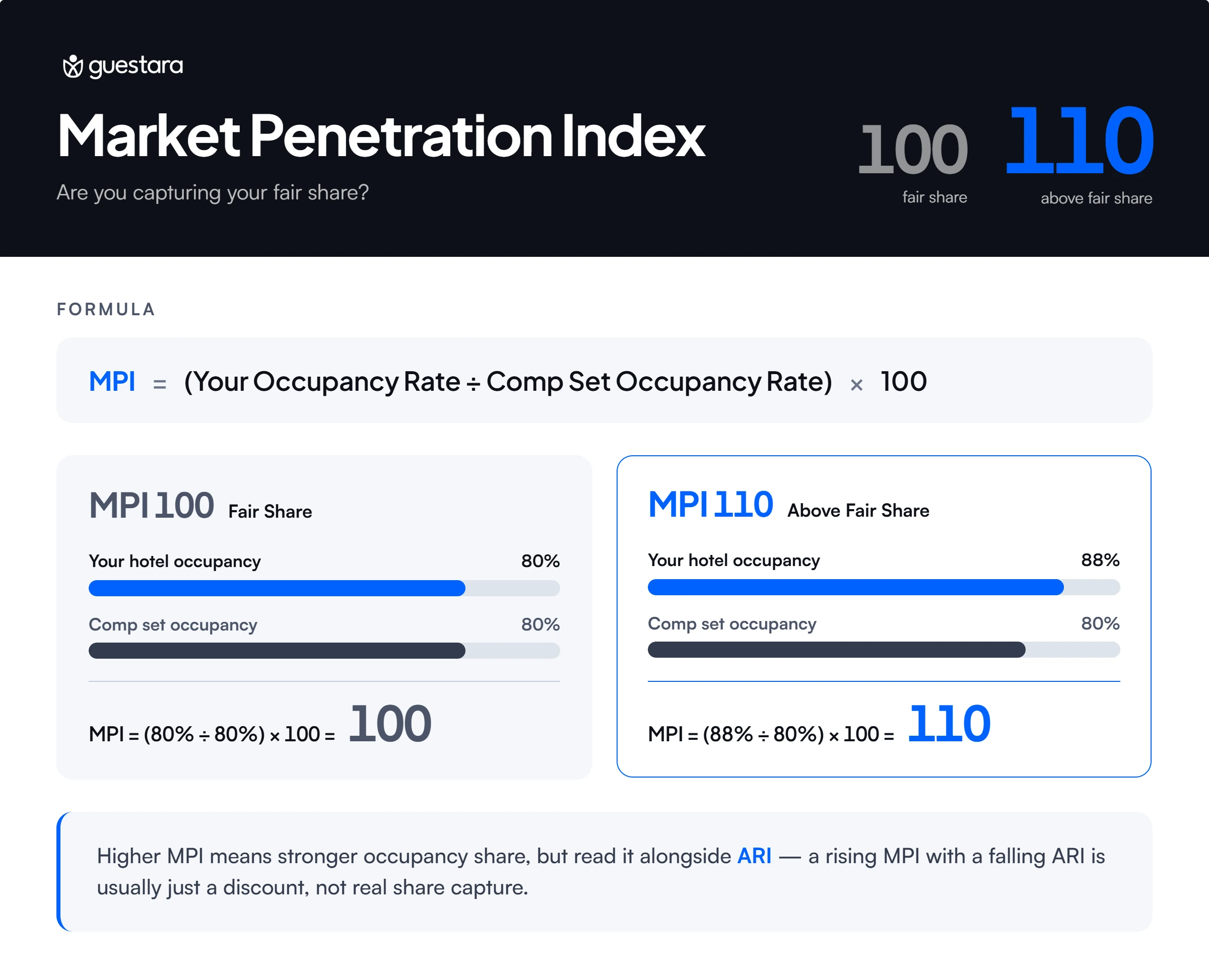
Take the same 100-room hotel used across this cluster, running 80% occupancy. Its comp set is four other properties totaling 400 rooms, running an aggregate 80% occupancy over the same period.
MPI = (80% / 80%) × 100 = 100
The hotel is capturing exactly its fair share of the market's demand. Check it against supply over a 30-day period and the fair-share logic holds:
The hotel holds 20% of the market's rooms (100 of 500) and captures 20% of its occupied room-nights (2,400 of 12,000). Supply share and demand share match, so the index is 100.
Now move one number. If occupancy climbs to 88% while the comp set holds at 80%:
MPI = (88% / 80%) × 100 = 110
The hotel is now filling 10% more of its rooms than the market fills of its own, capturing 2,640 room-nights where fair share would predict 2,400.
A high MPI is not automatically good news, and this is the mistake the index invites. Occupancy share is the easiest of the three indexes to buy, because you can always buy it with rate.
Compare two positions for the same hotel, against the same comp set (80% occupancy, $125 ADR, $100 RevPAR):
MPI jumps twenty points. On an occupancy-index dashboard the discount looks like a decisive win. But ARI fell by exactly as much, RGI did not move, and RevPAR is unchanged at $120. The hotel traded a rate premium for volume and ended up in the same place, with more rooms to clean, more variable cost per occupied room, and a market now anchored to a lower price.
The rule that falls out of this: MPI is only meaningful read next to ARI. A rising MPI with a stable ARI is genuine share capture. A rising MPI with a falling ARI is usually just a discount with extra steps.
Like the other comp set indexes, MPI has its benchmark built in: 100 is fair share.
What needs judgment is the comp set and the reading:
MPI rises when your occupancy grows faster than the comp set's, which means the levers are about demand capture rather than price.
That last lever is the slowest to show up in an index and the most durable once it does. Guestara's hospitality AI works across guest and booking data to support the experience and follow-up that turn one-time guests into repeat demand, which lifts occupancy share without buying it back with rate.
Your share of the market’s demand, and why a high one is not always good news.
MPI compares your occupancy to your competitive set's. An MPI of 100 means you are filling exactly your fair share of the market's rooms. Above 100 means you are taking occupancy share from competitors, below 100 means you are losing it. It is the volume half of comp set performance, and it is the index that tells you whether your rate strategy is actually attracting demand.
Market Penetration Index (MPI), also called the Occupancy Index, measures how well you fill rooms relative to the hotels you compete with.
Occupancy on its own is a weak signal because it moves with the market. A hotel can run 72% in a soft month and be outperforming every competitor around it, or run 85% in a compression period and still be the last choice in its market. MPI strips out the conditions nobody controls and leaves the part you do.
The underlying idea is fair share. If your hotel holds 100 of the 500 rooms in a market, you hold 20% of the supply, so you would expect to capture roughly 20% of the room-nights that market sells. MPI expresses whether you are hitting that expectation, beating it, or falling short, on a scale where 100 is exactly fair. Because it indexes against supply, it compares hotels of very different sizes on equal terms.
MPI is one of three comp set indexes. ARI covers rate, RGI combines rate and volume into revenue, and MPI is the demand-side view.
MPI = (Your Occupancy Rate / Competitive Set Occupancy Rate) × 100
The same index can be framed as a share calculation, which is where the fair-share language comes from:
MPI = (Your share of the market's occupied rooms / Your share of the market's available rooms) × 100
Both framings describe the same thing. Worth confirming with your provider, though: whether the comp set aggregate includes or excludes your own hotel. The two framings agree exactly when the comp set excludes you. When your own rooms sit inside the aggregate, your own performance moves the baseline you are being measured against, which pulls the index slightly toward 100 in both directions. It is a small effect, but it matters when you are comparing against a target or across markets where the convention differs.
Take the same 100-room hotel used across this cluster, running 80% occupancy. Its comp set is four other properties totaling 400 rooms, running an aggregate 80% occupancy over the same period.
MPI = (80% / 80%) × 100 = 100
The hotel is capturing exactly its fair share of the market's demand. Check it against supply over a 30-day period and the fair-share logic holds:
The hotel holds 20% of the market's rooms (100 of 500) and captures 20% of its occupied room-nights (2,400 of 12,000). Supply share and demand share match, so the index is 100.
Now move one number. If occupancy climbs to 88% while the comp set holds at 80%:
MPI = (88% / 80%) × 100 = 110
The hotel is now filling 10% more of its rooms than the market fills of its own, capturing 2,640 room-nights where fair share would predict 2,400.
A high MPI is not automatically good news, and this is the mistake the index invites. Occupancy share is the easiest of the three indexes to buy, because you can always buy it with rate.
Compare two positions for the same hotel, against the same comp set (80% occupancy, $125 ADR, $100 RevPAR):
MPI jumps twenty points. On an occupancy-index dashboard the discount looks like a decisive win. But ARI fell by exactly as much, RGI did not move, and RevPAR is unchanged at $120. The hotel traded a rate premium for volume and ended up in the same place, with more rooms to clean, more variable cost per occupied room, and a market now anchored to a lower price.
The rule that falls out of this: MPI is only meaningful read next to ARI. A rising MPI with a stable ARI is genuine share capture. A rising MPI with a falling ARI is usually just a discount with extra steps.
Like the other comp set indexes, MPI has its benchmark built in: 100 is fair share.
What needs judgment is the comp set and the reading:
MPI rises when your occupancy grows faster than the comp set's, which means the levers are about demand capture rather than price.
That last lever is the slowest to show up in an index and the most durable once it does. Guestara's hospitality AI works across guest and booking data to support the experience and follow-up that turn one-time guests into repeat demand, which lifts occupancy share without buying it back with rate.
Above 100 means you are capturing more than your fair share of the market's demand. But judge it alongside ARI, because an MPI well above 100 paired with an ARI below 100 usually means you are underpriced rather than outperforming.
Your occupancy matches your competitive set's exactly, so you are capturing precisely the share of room-nights your share of the market's supply would predict.
MPI indexes occupancy only. RGI indexes RevPAR, so it captures both occupancy and rate. A hotel can have a strong MPI and a weak RGI if it filled those rooms by discounting.
Yes. The two labels refer to the same calculation, and benchmarking reports may use either.


