
Displacement analysis asks whether accepting a piece of business, usually a group, costs you more in the transient revenue it pushes out than it brings in. On dates that would have sold anyway, the group's rate is not the question. The question is what those rooms would have earned without it.
Displacement happens when accepting one booking prevents you from selling the same rooms to someone else. The rooms are finite, so a group taking 40 of them on a date that would have sold 80 to transient guests does not simply add 40 rooms of business. It replaces some of what was already coming.
The distinction that matters is whether displacement occurs at all:
This is why group rates cannot be evaluated in isolation. A $110 group rate is excellent on a Tuesday in February and potentially destructive on a Saturday during a citywide event, and the rate card looks identical in both cases.
Displacement analysis is the calculation that settles it. It compares total expected value with the group against total expected value without it, and the output is a decision plus a minimum rate at which the business becomes worth taking.
The method is a comparison of two scenarios over the dates in question.
Step 1. Forecast unconstrained demand. Establish what transient demand you expect without the group, meaning the demand that exists before capacity limits it. This is the single most important input, and it is where most displacement analyses go wrong.
Step 2. Calculate displaced rooms.
Displaced Rooms = (Group Rooms + Forecast Transient Demand) − Total Available Rooms
If the result is zero or negative, nothing is displaced.
Step 3. Value both scenarios. Compare total expected revenue with and without the group, including ancillary spend, since group and transient guests spend very differently on property.
Step 4. Judge on contribution, not revenue. Group business often carries different variable costs, and group guests typically spend less per room in outlets. The honest comparison nets out the variable cost of servicing each occupied room.
Accept if: Group Contribution > Contribution Lost from Displaced Transient
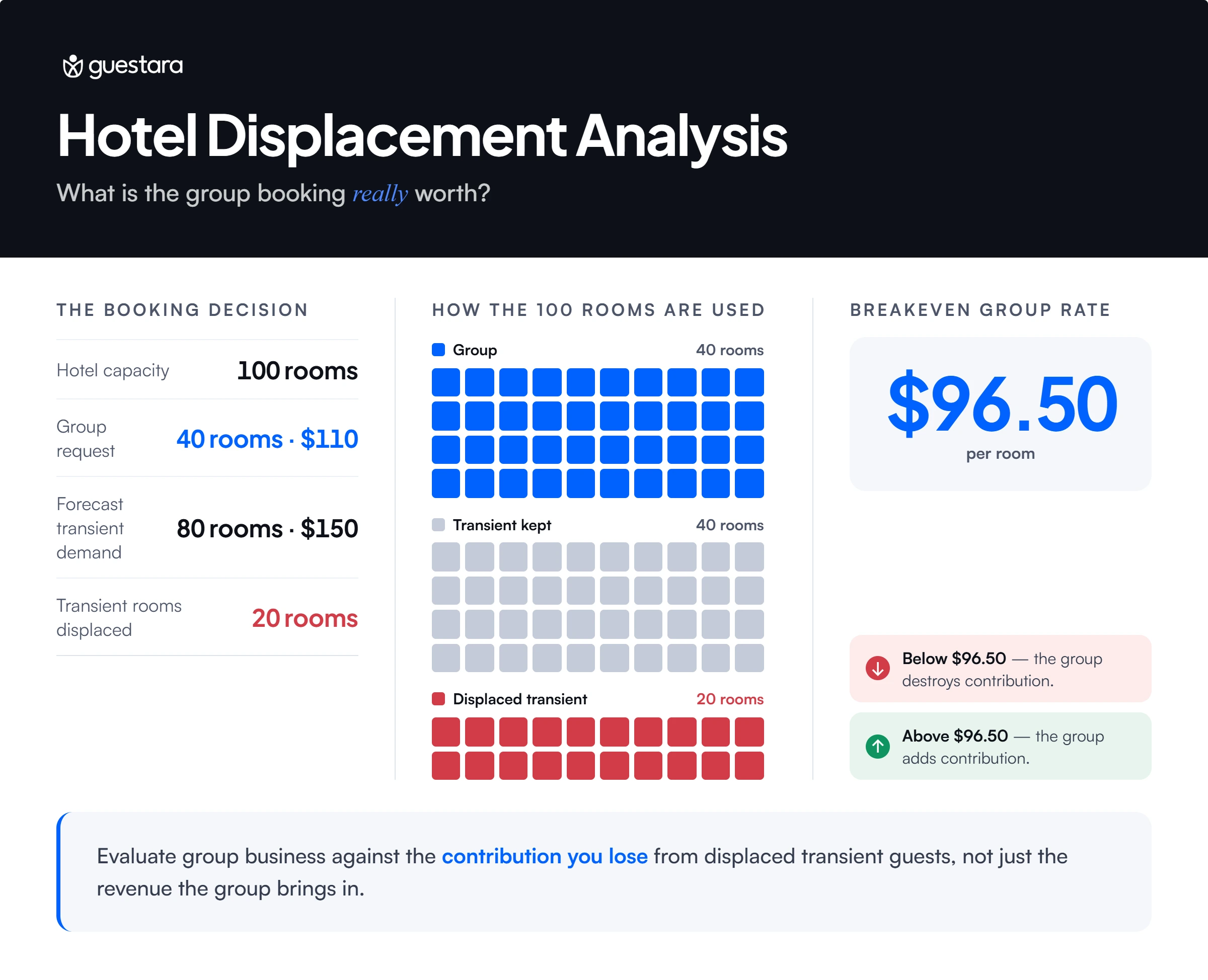
Take the same 100-room hotel used across this cluster. A group requests 40 rooms at $110 for a date where transient demand is forecast at 80 rooms at a $150 ADR.
Displaced rooms:
(40 group + 80 transient) − 100 available = 20 transient rooms displaced
The hotel cannot take both in full. Twenty transient bookings will be turned away.
Revenue comparison, using the cluster's ancillary figures of $75 per occupied room for transient and $40 for group:
On revenue the group adds $1,500 and the answer looks like an easy yes.
Contribution comparison, netting out variable cost of $45 per occupied room and counting ancillary at a 40% margin:
Still positive, but the gain shrinks from $1,500 of revenue to $540 of contribution. Twenty extra occupied rooms brought twenty rooms' worth of servicing cost with them, and the group's lower outlet spend did not make it back.
The decision is still yes. But it is a thin yes that a revenue-only analysis would have presented as comfortable, and that difference is the entire reason to run the contribution version.
The more useful output is the rate at which the answer flips. Accepting the group has to recover the $2,700 of transient contribution it displaces:
40 rooms × (Rate − $45 + $16) = $2,700 Rate − $29 = $67.50 Breakeven group rate = $96.50
Below $96.50 this group destroys value on this date. Above it, it adds. That number is worth more than the accept-or-decline verdict, because it is what you negotiate with.
The arithmetic is simple. The inputs are not, and three errors account for most bad decisions.
A fourth, less quantifiable factor: a group that returns annually, fills shoulder dates, or brings future transient business carries value beyond the dates in question. That does not belong in the arithmetic, but it belongs in the decision.
The constraint in practice is time. A proper analysis needs a current demand forecast for the specific dates, and group requests rarely arrive with a convenient window to prepare one. Guestara's hospitality AI works across booking and pace data to keep a current view of how each date is building, so a displacement question can be answered against where demand actually stands rather than against last year's result.
Whether a group is worth the transient business it pushes out, and the rate where the answer flips.
Displacement analysis asks whether accepting a piece of business, usually a group, costs you more in the transient revenue it pushes out than it brings in. On dates that would have sold anyway, the group's rate is not the question. The question is what those rooms would have earned without it.
Displacement happens when accepting one booking prevents you from selling the same rooms to someone else. The rooms are finite, so a group taking 40 of them on a date that would have sold 80 to transient guests does not simply add 40 rooms of business. It replaces some of what was already coming.
The distinction that matters is whether displacement occurs at all:
This is why group rates cannot be evaluated in isolation. A $110 group rate is excellent on a Tuesday in February and potentially destructive on a Saturday during a citywide event, and the rate card looks identical in both cases.
Displacement analysis is the calculation that settles it. It compares total expected value with the group against total expected value without it, and the output is a decision plus a minimum rate at which the business becomes worth taking.
The method is a comparison of two scenarios over the dates in question.
Step 1. Forecast unconstrained demand. Establish what transient demand you expect without the group, meaning the demand that exists before capacity limits it. This is the single most important input, and it is where most displacement analyses go wrong.
Step 2. Calculate displaced rooms.
Displaced Rooms = (Group Rooms + Forecast Transient Demand) − Total Available Rooms
If the result is zero or negative, nothing is displaced.
Step 3. Value both scenarios. Compare total expected revenue with and without the group, including ancillary spend, since group and transient guests spend very differently on property.
Step 4. Judge on contribution, not revenue. Group business often carries different variable costs, and group guests typically spend less per room in outlets. The honest comparison nets out the variable cost of servicing each occupied room.
Accept if: Group Contribution > Contribution Lost from Displaced Transient
Take the same 100-room hotel used across this cluster. A group requests 40 rooms at $110 for a date where transient demand is forecast at 80 rooms at a $150 ADR.
Displaced rooms:
(40 group + 80 transient) − 100 available = 20 transient rooms displaced
The hotel cannot take both in full. Twenty transient bookings will be turned away.
Revenue comparison, using the cluster's ancillary figures of $75 per occupied room for transient and $40 for group:
On revenue the group adds $1,500 and the answer looks like an easy yes.
Contribution comparison, netting out variable cost of $45 per occupied room and counting ancillary at a 40% margin:
Still positive, but the gain shrinks from $1,500 of revenue to $540 of contribution. Twenty extra occupied rooms brought twenty rooms' worth of servicing cost with them, and the group's lower outlet spend did not make it back.
The decision is still yes. But it is a thin yes that a revenue-only analysis would have presented as comfortable, and that difference is the entire reason to run the contribution version.
The more useful output is the rate at which the answer flips. Accepting the group has to recover the $2,700 of transient contribution it displaces:
40 rooms × (Rate − $45 + $16) = $2,700 Rate − $29 = $67.50 Breakeven group rate = $96.50
Below $96.50 this group destroys value on this date. Above it, it adds. That number is worth more than the accept-or-decline verdict, because it is what you negotiate with.
The arithmetic is simple. The inputs are not, and three errors account for most bad decisions.
A fourth, less quantifiable factor: a group that returns annually, fills shoulder dates, or brings future transient business carries value beyond the dates in question. That does not belong in the arithmetic, but it belongs in the decision.
The constraint in practice is time. A proper analysis needs a current demand forecast for the specific dates, and group requests rarely arrive with a convenient window to prepare one. Guestara's hospitality AI works across booking and pace data to keep a current view of how each date is building, so a displacement question can be answered against where demand actually stands rather than against last year's result.
It is the transient business you lose by accepting another booking, usually a group, on a date where demand would have exceeded the rooms available. If the date would not have sold out, nothing is displaced.
Add the group rooms to your forecast transient demand and subtract total available rooms. A positive result is the number of transient rooms displaced. Zero or negative means no displacement.
The rate at which the group's contribution exactly replaces the contribution of the transient business it displaces. Below it the group destroys value on that date, above it the group adds value.
Contribution, meaning revenue net of the variable cost of servicing each occupied room. Revenue-only analysis ignores that more occupied rooms cost more to service, and tends to recommend accepting business that barely pays.


