
Booking Pickup

What Is Booking Pickup? Hotel Pickup Explained
TL;DR — Key Takeaways

Pickup is the number of rooms or amount of revenue added to the books between two points in time. Where booking pace tells you where a date stands, pickup tells you how fast it is moving and in which direction, which is what turns a static forecast into a decision.

What is pickup in hotel revenue management?

Pickup measures change. Take a reading of what is on the books for a future date today, take another next week, and the difference is the pickup for that week.

That simple idea does a lot of work, because a position without a rate of change is not actionable. A date sitting at 55 rooms a month out could be comfortably on track or quietly failing, and the only way to tell is how many rooms arrived in the last seven days and whether that number is rising or falling.

Pickup is also the raw material for forecasting. If you know a date typically picks up 25 rooms in its final month, and it currently has 55 on the books with a month to go, you have a defensible forecast of about 80. Every pickup-based forecast works this way: current position plus expected remaining pickup.

Two things are commonly called pickup, so it is worth separating them:

  • Pickup for a future date, meaning rooms added for one arrival date between two readings. This is the revenue management sense used throughout this page.
  • Daily pickup, meaning all reservations taken yesterday across every future date. This is an operational sales figure, useful for watching booking activity but not for managing a specific date.

How pickup is calculated

Pickup = On the Books (current reading) − On the Books (previous reading)

  • On the books (OTB): rooms or revenue confirmed for a specific arrival date as of a given moment.
  • The two readings must be for the same arrival date, taken at two different times.

Three variants, all in common use:

Room pickup counts rooms added. The standard operational measure.

Revenue pickup counts revenue added, which reveals the rate at which those rooms sold.

Net pickup subtracts cancellations and reductions, so it reflects what actually remains rather than gross new bookings.

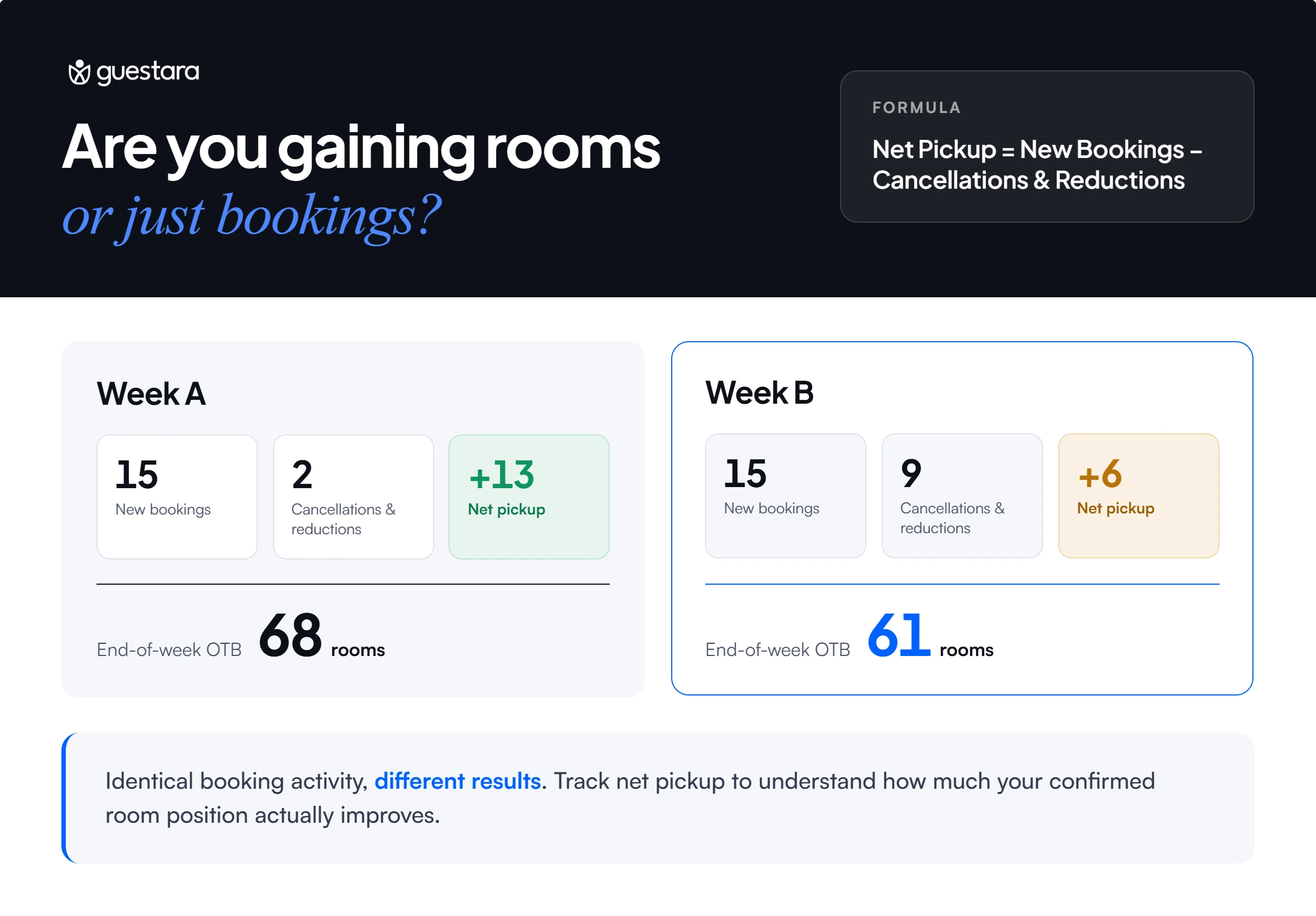
Net is the one that matters for decisions. Gross pickup of 15 rooms against 9 cancellations is net pickup of 6, and a report showing only the 15 is describing activity rather than position.
Pickup worked example (USD)

Guestara glossary infographic explaining hotel Net Pickup, the difference between new bookings and cancellations or reductions. A side-by-side comparison shows Week A with 15 new bookings, 2 cancellations or reductions, and a net pickup of 13 rooms, resulting in 68 end-of-week rooms on the books (OTB). Week B has the same 15 new bookings but 9 cancellations or reductions, resulting in a net pickup of 6 rooms and 61 rooms on the books. The visual highlights why tracking net pickup helps hotels measure actual booking growth.

Take the same 100-room hotel used across this cluster, tracking a single arrival date that finishes at 80 rooms sold. These are the same readings used on the booking pace page, now read as intervals rather than positions:

Interval (days before arrival) OTB at start OTB at end Pickup Rooms per day
90 to 60 20 38 +18 0.60
60 to 30 38 55 +17 0.57
30 to 14 55 68 +13 0.81
14 to 7 68 74 +6 0.86
7 to 0 74 80 +6 0.86

The raw pickup numbers fall steadily, from 18 rooms to 6, which looks like demand fading. The rooms-per-day column says the opposite: the daily rate rises from 0.60 to 0.86 as the date approaches. The intervals are simply getting shorter.

This is the most common misreading of pickup, and it is worth being blunt about. Pickup is only comparable across intervals of equal length. Compare a 30-day window against a 30-day window, or normalize to a daily rate, or the metric will tell you demand is collapsing every single time a date gets closer.

Using pickup to forecast

With the pattern established, the forecast falls out. At 30 days before arrival the date holds 55 rooms. History says the final 30 days deliver about 25 rooms of net pickup:

Forecast = 55 on the books + 25 expected pickup = 80 rooms

The forecast is only as good as the pickup history behind it, which is why pickup data is worth keeping by segment, day of week, and season rather than as a single blended average.

Booking Pickup Calculator

Pick a future month or date range. Enter the room nights booked for it at an earlier reading and today to see how much business you picked up in between.

Pickup (room nights)0
Pickup per day0.0
Change0.0%

Reading pickup against cancellations

Gross pickup flatters a date that is quietly unravelling. Two weeks for the same arrival date, both showing healthy new bookings:

Week A Week B
New bookings 15 15
Cancellations and reductions 2 9
Net pickup +13 +6
OTB at week end 68 61

Identical booking activity, and a seven-room difference in where the date actually sits. Week B is showing a cancellation pattern worth investigating, perhaps a group releasing rooms, a tightening market, or a rate that guests are rebooking away from. A gross pickup report shows two identical weeks.

Track net, and watch cancellations as their own line rather than letting them disappear into a single number.

Why pickup matters for revenue management

  • It is the earliest signal you get. Pickup slowing for a date is visible well before that date shows up as a problem in pace or occupancy.
  • It drives the forecast. Current position plus expected remaining pickup is the standard forecasting method, and its accuracy depends entirely on good pickup history.
  • It tells you whether an action worked. Change a rate or open a restriction, then watch the pickup over the following days. It is the fastest feedback loop in revenue management.
  • It separates activity from progress. Net pickup against gross pickup is the difference between knowing you are selling and knowing you are filling.
  • It prices the remaining inventory. How fast rooms are moving determines what the last ones are worth, which is the core yield decision.

Benchmarking pickup

Pickup has no external benchmark. It is measured against your own history for comparable dates.

  • Build a pickup curve by segment and day of week. Transient and group pick up on completely different schedules, and blending them produces an average that describes neither.
  • Compare equal intervals only. The single most important discipline with this metric.
  • Use net, not gross, for anything that drives a decision.
  • Hold your reading schedule steady. Pickup read on inconsistent days produces intervals you cannot compare.
  • Keep enough history to be seasonal. A pickup pattern from a peak period will mislead you about a shoulder date.

How to improve pickup

Pickup responds faster than almost any other metric, which makes it the natural test bed for revenue actions.

  • Act on the slowdown, not the shortfall. By the time a date is visibly short, the cheap responses have expired. Falling pickup against the curve is the moment to move.
  • Test one change at a time. Change rate and restrictions together and the pickup response cannot tell you which worked.
  • Open restrictions first. Minimum stay and release conditions often suppress pickup more than rate does, and relaxing them costs nothing in rate.
  • Target the segment that is missing. Pickup gaps are usually concentrated, so a broad rate cut overpays to fix a narrow problem.
  • Watch the cancellation line. Strong gross pickup with rising cancellations needs a different response from weak pickup, usually around deposit and cancellation terms rather than price.
  • Give strong dates less inventory, not more. Dates picking up ahead of the curve are candidates for rate increases, and reacting to those is as valuable as rescuing weak ones.

The practical difficulty is that pickup only signals clearly when read against the expected curve for that specific date and segment, which is more comparison than a team can do by hand across a full calendar. Guestara's hospitality AI works across booking data to surface where pickup is diverging from its usual pattern, so the dates that need attention come to the team rather than waiting to be found.

One Platform

Run your entire guest journey from one platform

Automate check-in, messaging, upsells and reviews, all in one place.

Get a demo

Booking Pickup

How fast a future date is filling, and the reading error that makes demand look like it is collapsing.

What Is Booking Pickup? Hotel Pickup Explained
TL;DR — Key Takeaways

Pickup is the number of rooms or amount of revenue added to the books between two points in time. Where booking pace tells you where a date stands, pickup tells you how fast it is moving and in which direction, which is what turns a static forecast into a decision.

What is pickup in hotel revenue management?

Pickup measures change. Take a reading of what is on the books for a future date today, take another next week, and the difference is the pickup for that week.

That simple idea does a lot of work, because a position without a rate of change is not actionable. A date sitting at 55 rooms a month out could be comfortably on track or quietly failing, and the only way to tell is how many rooms arrived in the last seven days and whether that number is rising or falling.

Pickup is also the raw material for forecasting. If you know a date typically picks up 25 rooms in its final month, and it currently has 55 on the books with a month to go, you have a defensible forecast of about 80. Every pickup-based forecast works this way: current position plus expected remaining pickup.

Two things are commonly called pickup, so it is worth separating them:

  • Pickup for a future date, meaning rooms added for one arrival date between two readings. This is the revenue management sense used throughout this page.
  • Daily pickup, meaning all reservations taken yesterday across every future date. This is an operational sales figure, useful for watching booking activity but not for managing a specific date.

How pickup is calculated

Pickup = On the Books (current reading) − On the Books (previous reading)

  • On the books (OTB): rooms or revenue confirmed for a specific arrival date as of a given moment.
  • The two readings must be for the same arrival date, taken at two different times.

Three variants, all in common use:

Room pickup counts rooms added. The standard operational measure.

Revenue pickup counts revenue added, which reveals the rate at which those rooms sold.

Net pickup subtracts cancellations and reductions, so it reflects what actually remains rather than gross new bookings.

Net is the one that matters for decisions. Gross pickup of 15 rooms against 9 cancellations is net pickup of 6, and a report showing only the 15 is describing activity rather than position.

Pickup worked example (USD)

Guestara glossary infographic explaining hotel Net Pickup, the difference between new bookings and cancellations or reductions. A side-by-side comparison shows Week A with 15 new bookings, 2 cancellations or reductions, and a net pickup of 13 rooms, resulting in 68 end-of-week rooms on the books (OTB). Week B has the same 15 new bookings but 9 cancellations or reductions, resulting in a net pickup of 6 rooms and 61 rooms on the books. The visual highlights why tracking net pickup helps hotels measure actual booking growth.

Take the same 100-room hotel used across this cluster, tracking a single arrival date that finishes at 80 rooms sold. These are the same readings used on the booking pace page, now read as intervals rather than positions:

Interval (days before arrival) OTB at start OTB at end Pickup Rooms per day
90 to 60 20 38 +18 0.60
60 to 30 38 55 +17 0.57
30 to 14 55 68 +13 0.81
14 to 7 68 74 +6 0.86
7 to 0 74 80 +6 0.86

The raw pickup numbers fall steadily, from 18 rooms to 6, which looks like demand fading. The rooms-per-day column says the opposite: the daily rate rises from 0.60 to 0.86 as the date approaches. The intervals are simply getting shorter.

This is the most common misreading of pickup, and it is worth being blunt about. Pickup is only comparable across intervals of equal length. Compare a 30-day window against a 30-day window, or normalize to a daily rate, or the metric will tell you demand is collapsing every single time a date gets closer.

Using pickup to forecast

With the pattern established, the forecast falls out. At 30 days before arrival the date holds 55 rooms. History says the final 30 days deliver about 25 rooms of net pickup:

Forecast = 55 on the books + 25 expected pickup = 80 rooms

The forecast is only as good as the pickup history behind it, which is why pickup data is worth keeping by segment, day of week, and season rather than as a single blended average.

Booking Pickup Calculator

Pick a future month or date range. Enter the room nights booked for it at an earlier reading and today to see how much business you picked up in between.

Pickup (room nights)0
Pickup per day0.0
Change0.0%

Reading pickup against cancellations

Gross pickup flatters a date that is quietly unravelling. Two weeks for the same arrival date, both showing healthy new bookings:

Week A Week B
New bookings 15 15
Cancellations and reductions 2 9
Net pickup +13 +6
OTB at week end 68 61

Identical booking activity, and a seven-room difference in where the date actually sits. Week B is showing a cancellation pattern worth investigating, perhaps a group releasing rooms, a tightening market, or a rate that guests are rebooking away from. A gross pickup report shows two identical weeks.

Track net, and watch cancellations as their own line rather than letting them disappear into a single number.

Why pickup matters for revenue management

  • It is the earliest signal you get. Pickup slowing for a date is visible well before that date shows up as a problem in pace or occupancy.
  • It drives the forecast. Current position plus expected remaining pickup is the standard forecasting method, and its accuracy depends entirely on good pickup history.
  • It tells you whether an action worked. Change a rate or open a restriction, then watch the pickup over the following days. It is the fastest feedback loop in revenue management.
  • It separates activity from progress. Net pickup against gross pickup is the difference between knowing you are selling and knowing you are filling.
  • It prices the remaining inventory. How fast rooms are moving determines what the last ones are worth, which is the core yield decision.

Benchmarking pickup

Pickup has no external benchmark. It is measured against your own history for comparable dates.

  • Build a pickup curve by segment and day of week. Transient and group pick up on completely different schedules, and blending them produces an average that describes neither.
  • Compare equal intervals only. The single most important discipline with this metric.
  • Use net, not gross, for anything that drives a decision.
  • Hold your reading schedule steady. Pickup read on inconsistent days produces intervals you cannot compare.
  • Keep enough history to be seasonal. A pickup pattern from a peak period will mislead you about a shoulder date.

How to improve pickup

Pickup responds faster than almost any other metric, which makes it the natural test bed for revenue actions.

  • Act on the slowdown, not the shortfall. By the time a date is visibly short, the cheap responses have expired. Falling pickup against the curve is the moment to move.
  • Test one change at a time. Change rate and restrictions together and the pickup response cannot tell you which worked.
  • Open restrictions first. Minimum stay and release conditions often suppress pickup more than rate does, and relaxing them costs nothing in rate.
  • Target the segment that is missing. Pickup gaps are usually concentrated, so a broad rate cut overpays to fix a narrow problem.
  • Watch the cancellation line. Strong gross pickup with rising cancellations needs a different response from weak pickup, usually around deposit and cancellation terms rather than price.
  • Give strong dates less inventory, not more. Dates picking up ahead of the curve are candidates for rate increases, and reacting to those is as valuable as rescuing weak ones.

The practical difficulty is that pickup only signals clearly when read against the expected curve for that specific date and segment, which is more comparison than a team can do by hand across a full calendar. Guestara's hospitality AI works across booking data to surface where pickup is diverging from its usual pattern, so the dates that need attention come to the team rather than waiting to be found.

Frequently Asked Questions

What is the difference between booking pickup and booking pace?

Pickup is the change between two readings. Pace is your position compared against a reference curve. Pickup is velocity, pace is location.

What is net booking pickup?

Rooms or revenue added minus cancellations and reductions over the same interval. It reflects the actual change in position, unlike gross pickup, which counts only new bookings.

How often should booking pickup be measured?

Daily for near-term dates and weekly for dates further out is a common pattern. What matters most is consistency, since inconsistent readings produce intervals that cannot be compared.

Why does booking pickup always seem to fall as the date gets closer?

Usually because the intervals are shorter, not because demand is fading. Normalize to rooms per day, or compare equal-length windows, before concluding anything.