
Booking pace is the rate at which reservations accumulate for a future date, compared against a reference curve from a prior year or a forecast. It is how revenue managers know whether a date is tracking ahead or behind while there is still time to act, rather than discovering it after the date has passed.
Booking pace describes the shape of demand arriving over time for a given arrival date.
Rooms for any future date do not sell evenly. They accumulate along a curve, slowly at first when the date is distant, then steepening as it approaches, with the exact shape set by your market and segments. A city hotel serving corporate demand fills late and fast. A resort in school holidays fills months out. A convention date fills in blocks the moment the group commits.
Pace is the comparison of this year's curve against a reference, which is usually the same date last year at the same number of days before arrival, or your forecast for that date. The comparison is what makes it meaningful. Knowing you have 55 rooms on the books for a date next month tells you almost nothing on its own. Knowing you had 52 at the same point last year and finished at 78 tells you where you stand.
The key discipline is comparing like for like in time. Pace comparisons only work when both readings are taken at the same distance from arrival. Comparing today's position against last year's final result is not a pace comparison, and it is the most common way the analysis gets misused.
Booking pace is not a single formula. It is a comparison between two positions at the same point on the booking curve, usually expressed three ways:
Pace variance (rooms) = Current On the Books − Reference On the Books at the same days out
Pace variance (%) = (Pace variance in rooms / Reference On the Books) × 100
The underlying quantity is on the books (OTB), the rooms or revenue already reserved for a future date as of today. Pace tracks how OTB builds; pickup measures what was added between two readings.
Pace can be tracked on rooms, revenue, or both, and the two can disagree. Rooms ahead with revenue behind means the date is filling at lower rates than last year, which is a different problem from simply being behind.
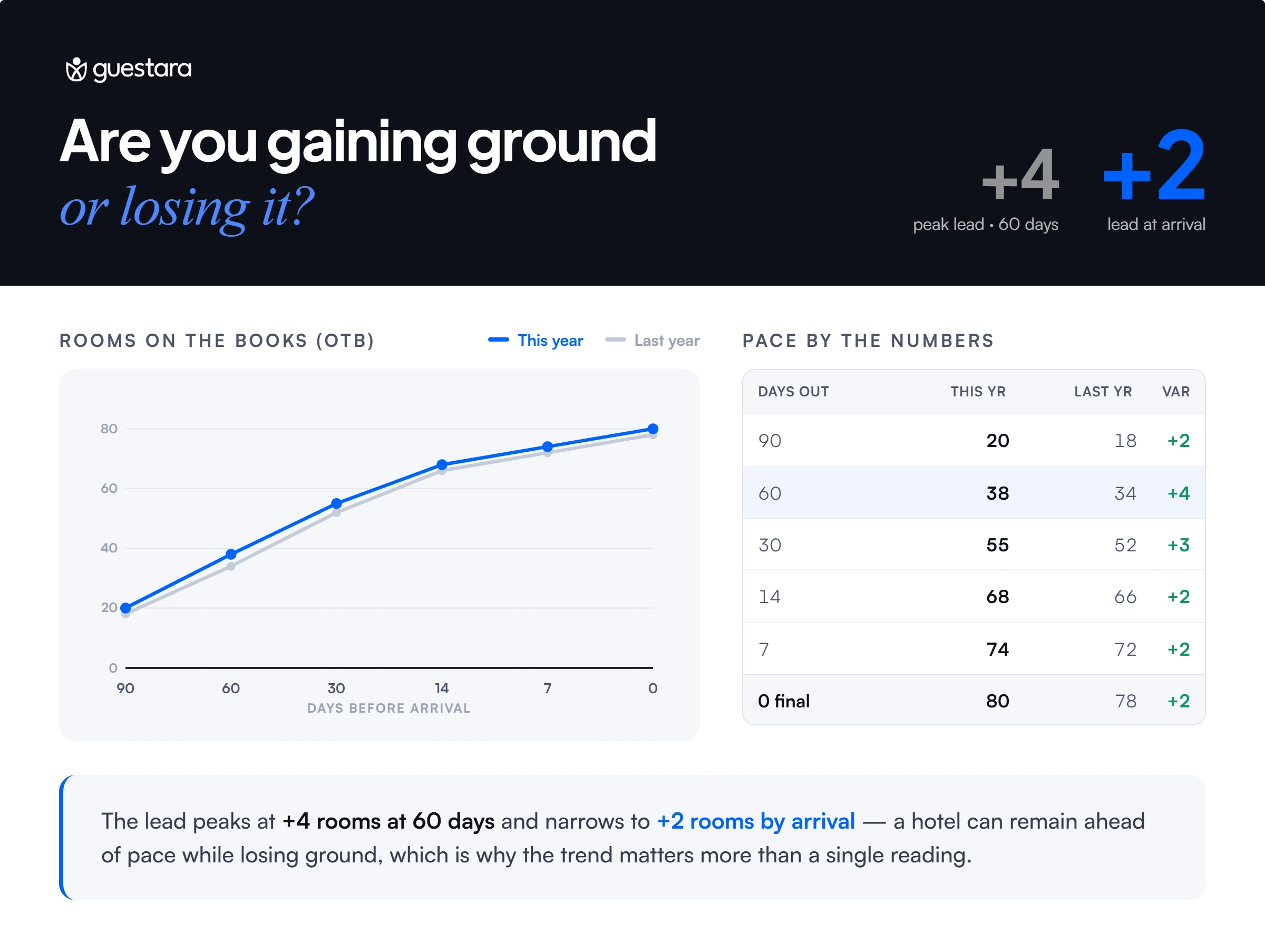
Take the same 100-room hotel used across this cluster, looking at a single arrival date that will finish at 80 rooms sold. Here is the booking curve against the same date last year, which finished at 78:
The date is ahead of last year at every reading, which reads as good news. But the useful detail is in how the gap behaves: the lead peaks at 60 days out at +4 rooms and then narrows steadily to +2 by arrival.
That decay is the signal. The hotel built an early advantage and then picked up more slowly than last year through the final month. If the trend had been spotted at 30 days, when the lead was still +3 and the gap was starting to close, there was still a month of selling time to respond. By 7 days out, the room to act is almost gone.
This is why pace is read as a sequence rather than a snapshot. The direction of the variance matters more than the variance itself. A date 5% behind and closing the gap is in better shape than a date 5% ahead and losing ground.
Rooms pace and revenue pace can tell opposite stories, and the divergence is usually the more useful finding.
Take the same date at 30 days out, with two different outcomes:
Identical rooms pace. In Scenario A the date is genuinely ahead. In Scenario B the hotel has bought its position by discounting, is three rooms ahead on volume and 8% behind on revenue, and a rooms-only pace report would have shown nothing wrong at all.
Track both, and when they disagree, trust the revenue line for pricing decisions.
Pace has no external benchmark. It is inherently a comparison against your own history, so the reference curve is the thing that needs care.
Pace is a diagnostic rather than something you improve directly, but a date that is tracking behind has a reasonably standard set of responses, in order of how much damage they do.
Acting at the right moment is the hard part, since a pace problem is cheapest to fix at the point it is least obvious. Guestara's hospitality AI works across booking data to surface shifts in how dates are building, so a date losing ground reaches the revenue team while the selling window is still open.
Where a future date stands against last year, while there is still time to act on it.
Booking pace is the rate at which reservations accumulate for a future date, compared against a reference curve from a prior year or a forecast. It is how revenue managers know whether a date is tracking ahead or behind while there is still time to act, rather than discovering it after the date has passed.
Booking pace describes the shape of demand arriving over time for a given arrival date.
Rooms for any future date do not sell evenly. They accumulate along a curve, slowly at first when the date is distant, then steepening as it approaches, with the exact shape set by your market and segments. A city hotel serving corporate demand fills late and fast. A resort in school holidays fills months out. A convention date fills in blocks the moment the group commits.
Pace is the comparison of this year's curve against a reference, which is usually the same date last year at the same number of days before arrival, or your forecast for that date. The comparison is what makes it meaningful. Knowing you have 55 rooms on the books for a date next month tells you almost nothing on its own. Knowing you had 52 at the same point last year and finished at 78 tells you where you stand.
The key discipline is comparing like for like in time. Pace comparisons only work when both readings are taken at the same distance from arrival. Comparing today's position against last year's final result is not a pace comparison, and it is the most common way the analysis gets misused.
Booking pace is not a single formula. It is a comparison between two positions at the same point on the booking curve, usually expressed three ways:
Pace variance (rooms) = Current On the Books − Reference On the Books at the same days out
Pace variance (%) = (Pace variance in rooms / Reference On the Books) × 100
The underlying quantity is on the books (OTB), the rooms or revenue already reserved for a future date as of today. Pace tracks how OTB builds; pickup measures what was added between two readings.
Pace can be tracked on rooms, revenue, or both, and the two can disagree. Rooms ahead with revenue behind means the date is filling at lower rates than last year, which is a different problem from simply being behind.
Take the same 100-room hotel used across this cluster, looking at a single arrival date that will finish at 80 rooms sold. Here is the booking curve against the same date last year, which finished at 78:
The date is ahead of last year at every reading, which reads as good news. But the useful detail is in how the gap behaves: the lead peaks at 60 days out at +4 rooms and then narrows steadily to +2 by arrival.
That decay is the signal. The hotel built an early advantage and then picked up more slowly than last year through the final month. If the trend had been spotted at 30 days, when the lead was still +3 and the gap was starting to close, there was still a month of selling time to respond. By 7 days out, the room to act is almost gone.
This is why pace is read as a sequence rather than a snapshot. The direction of the variance matters more than the variance itself. A date 5% behind and closing the gap is in better shape than a date 5% ahead and losing ground.
Rooms pace and revenue pace can tell opposite stories, and the divergence is usually the more useful finding.
Take the same date at 30 days out, with two different outcomes:
Identical rooms pace. In Scenario A the date is genuinely ahead. In Scenario B the hotel has bought its position by discounting, is three rooms ahead on volume and 8% behind on revenue, and a rooms-only pace report would have shown nothing wrong at all.
Track both, and when they disagree, trust the revenue line for pricing decisions.
Pace has no external benchmark. It is inherently a comparison against your own history, so the reference curve is the thing that needs care.
Pace is a diagnostic rather than something you improve directly, but a date that is tracking behind has a reasonably standard set of responses, in order of how much damage they do.
Acting at the right moment is the hard part, since a pace problem is cheapest to fix at the point it is least obvious. Guestara's hospitality AI works across booking data to surface shifts in how dates are building, so a date losing ground reaches the revenue team while the selling window is still open.
Pace is your position at a point in time compared to a reference. Pickup is the volume added between two points in time. Pace tells you where you stand, pickup tells you how fast you are moving.
You have more rooms or revenue on the books for a future date than your reference had at the same number of days before arrival. It usually argues for holding or raising rate rather than discounting.
As far out as your booking window genuinely extends, which varies by segment and market. Tracking a date before meaningful demand exists for it generates noise rather than signal.
Both. Rooms pace shows demand, revenue pace shows what that demand is worth. When they disagree, the revenue line is the one that should drive pricing decisions.


