
Average Rate per Guest (ARG) is room revenue divided by the number of guests, rather than by the number of rooms. Where ADR tells you what a room earned, ARG tells you what each person in it earned, which is the view that matters when occupancy per room varies and when you sell anything priced per person.
Average Rate per Guest is a per-person view of room revenue. It takes the same room revenue that ADR uses and divides it by guests served instead of rooms sold.
The difference matters because rooms do not hold a fixed number of people. A hotel running a $150 ADR with mostly solo business travelers and the same hotel running a $150 ADR with couples and families are serving very different numbers of people for the same money. The first is earning $150 per guest. The second might be earning $75 or less. Same ADR, half the revenue per person, and a very different operation underneath: more breakfasts, more towels, more wear, more demand on every outlet.
ARG is most useful in properties where occupancy per room swings, which in practice means resorts, leisure properties, family hotels, and anywhere per-person pricing, per-person packages, or all-inclusive rates are in play.
The ratio sitting behind it has its own name. Double occupancy, sometimes called the guest-per-room ratio, is guests divided by rooms sold, and it is the bridge between ADR and ARG.
Average Rate per Guest = Total Room Revenue / Total Number of Guests
Because both metrics share a numerator, they are linked directly:
ARG = ADR / Double Occupancy, where Double Occupancy = Guests / Rooms Sold
That relationship is the practical reason to track ARG. If ADR holds steady but ARG falls, your double occupancy rose, meaning you are serving more people for the same revenue.
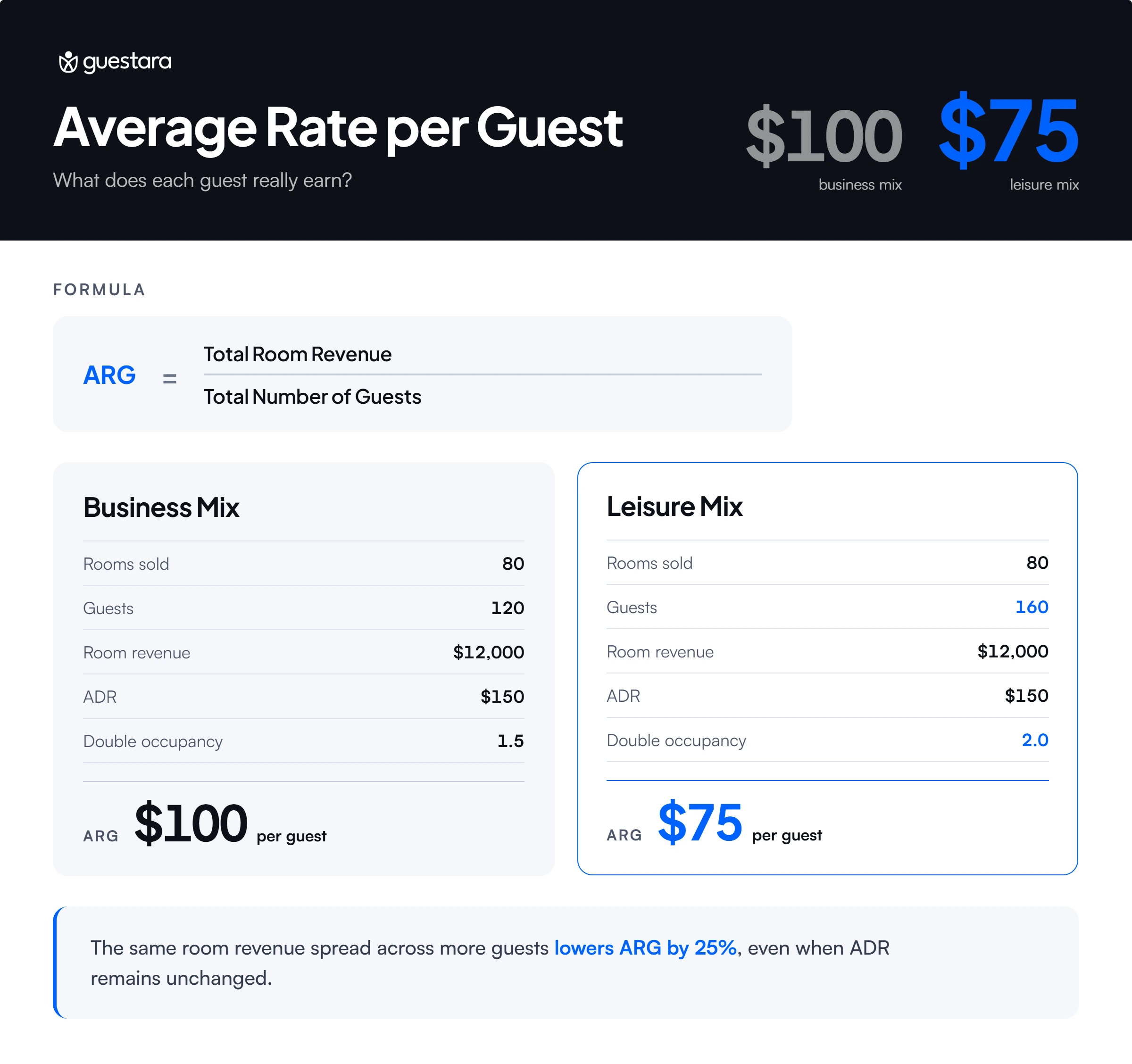
Take the same 100-room hotel used across this cluster, running 80% occupancy at a $150 ADR. Over one night it sells 80 rooms and accommodates 120 guests, a double occupancy of 1.5.
Room revenue = 80 × $150 = $12,000 ARG = $12,000 / 120 guests = $100 per guest
So a $150 room rate is $100 per person once you account for how many people are actually staying.
Now hold ADR still and change the mix. The same hotel sells the same 80 rooms at the same $150, but a group booking pushes double occupancy to 2.0, so 160 guests arrive:
ADR is identical. The hotel is serving forty more people, generating no additional room revenue, and earning 25% less per person. Every per-person cost in the building just went up and nothing on the rate side moved to cover it.
ARG is not a published benchmark. Comp set reporting covers ADR, occupancy, and RevPAR, so there is no external ARG to measure against.
Treat it as an internal metric:
The add-on lever is where most properties have the most room to move, because per-person extras are usually left to be offered in person or not at all. Guestara's hotel upsell software puts per-guest offers in front of guests across the booking and pre-arrival journey, lifting what each guest contributes rather than what each room is priced at.
Room revenue per person, and what ADR hides when the guests per room start moving.
Average Rate per Guest (ARG) is room revenue divided by the number of guests, rather than by the number of rooms. Where ADR tells you what a room earned, ARG tells you what each person in it earned, which is the view that matters when occupancy per room varies and when you sell anything priced per person.
Average Rate per Guest is a per-person view of room revenue. It takes the same room revenue that ADR uses and divides it by guests served instead of rooms sold.
The difference matters because rooms do not hold a fixed number of people. A hotel running a $150 ADR with mostly solo business travelers and the same hotel running a $150 ADR with couples and families are serving very different numbers of people for the same money. The first is earning $150 per guest. The second might be earning $75 or less. Same ADR, half the revenue per person, and a very different operation underneath: more breakfasts, more towels, more wear, more demand on every outlet.
ARG is most useful in properties where occupancy per room swings, which in practice means resorts, leisure properties, family hotels, and anywhere per-person pricing, per-person packages, or all-inclusive rates are in play.
The ratio sitting behind it has its own name. Double occupancy, sometimes called the guest-per-room ratio, is guests divided by rooms sold, and it is the bridge between ADR and ARG.
Average Rate per Guest = Total Room Revenue / Total Number of Guests
Because both metrics share a numerator, they are linked directly:
ARG = ADR / Double Occupancy, where Double Occupancy = Guests / Rooms Sold
That relationship is the practical reason to track ARG. If ADR holds steady but ARG falls, your double occupancy rose, meaning you are serving more people for the same revenue.
Take the same 100-room hotel used across this cluster, running 80% occupancy at a $150 ADR. Over one night it sells 80 rooms and accommodates 120 guests, a double occupancy of 1.5.
Room revenue = 80 × $150 = $12,000 ARG = $12,000 / 120 guests = $100 per guest
So a $150 room rate is $100 per person once you account for how many people are actually staying.
Now hold ADR still and change the mix. The same hotel sells the same 80 rooms at the same $150, but a group booking pushes double occupancy to 2.0, so 160 guests arrive:
ADR is identical. The hotel is serving forty more people, generating no additional room revenue, and earning 25% less per person. Every per-person cost in the building just went up and nothing on the rate side moved to cover it.
ARG is not a published benchmark. Comp set reporting covers ADR, occupancy, and RevPAR, so there is no external ARG to measure against.
Treat it as an internal metric:
The add-on lever is where most properties have the most room to move, because per-person extras are usually left to be offered in person or not at all. Guestara's hotel upsell software puts per-guest offers in front of guests across the booking and pre-arrival journey, lifting what each guest contributes rather than what each room is priced at.
Both use the same room revenue. ADR divides it by rooms sold, ARG divides it by guests. They are equal only when every room holds exactly one guest, and they diverge as double occupancy rises.
There is no benchmark, because it depends entirely on your double occupancy. A business hotel near 1.2 guests per room and a resort near 2.0 will report very different ARG at the same ADR, and neither is better. Judge it against your own trend.
Divide total guests by rooms sold for the period. A result of 1.5 means an average of one and a half guests per occupied room.
Your mix shifted toward larger parties. More guests are arriving per room, so the same room revenue is spread across more people. Check ARG against double occupancy to confirm.


