
Average Bed Rate is room revenue divided by beds, rather than by rooms. It is the right rate metric wherever the bed is what you actually sell: hostels, dorm rooms, shared accommodation, staff housing, and group or tour business priced per person. For those properties, ADR describes a unit nobody is buying.
Average Bed Rate (ABR) measures rate against bed inventory instead of room inventory.
Most hotel metrics assume the room is the sellable unit, because in most hotels it is. Book a room, get the room, and how many beds are in it is a detail. But a large part of the accommodation market does not work that way. In a hostel dormitory, six beds in one room can be sold to six unrelated travelers on six separate reservations at six different rates. The room is a container. The bed is the product.
For those properties, ADR is close to meaningless. A dorm room that sold all six beds and one that sold two are both "one room sold," and ADR cannot tell them apart. Average Bed Rate can.
It also applies beyond hostels. Properties selling per-person rates for tour groups, shared or quad-occupancy rooms, student and staff accommodation, and some all-inclusive resorts all price against beds or people rather than rooms, and their rate reporting should follow.
Average Bed Rate = Total Room Revenue / Number of Beds Sold
There is a second version that mirrors RevPAR by using capacity rather than sales:
Revenue per Available Bed = Total Room Revenue / Beds Available
The relationship between them is bed occupancy, exactly as ADR and RevPAR relate through room occupancy:
Revenue per Available Bed = Average Bed Rate × Bed Occupancy
Decide which one you mean and label it clearly, because "bed rate" gets used loosely for both and the two numbers are far apart at anything below full occupancy.
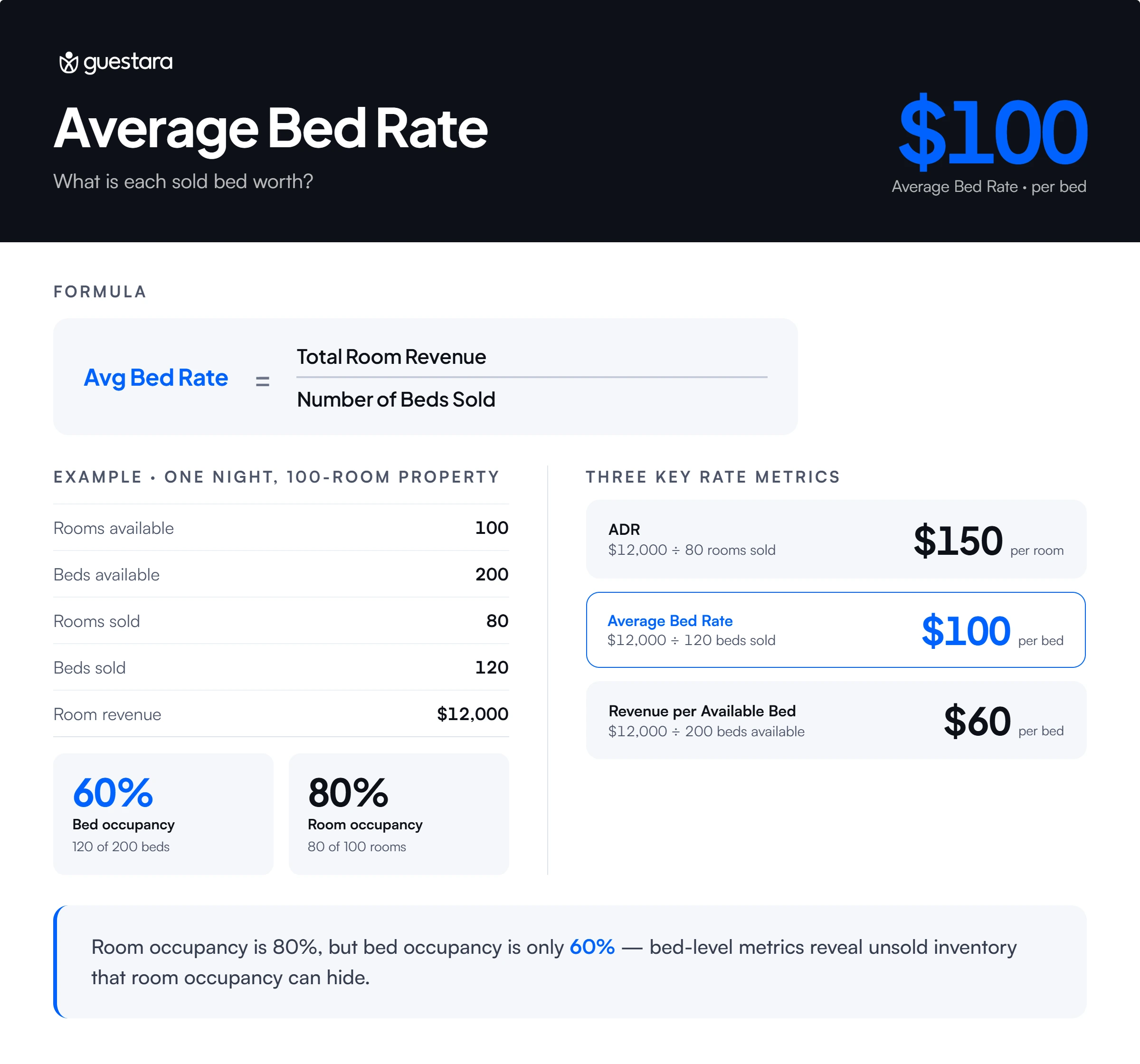
Take the same 100-room hotel used across this cluster, with two beds in each room, so 200 beds available. Over one night it sells 80 rooms at a $150 ADR, accommodating 120 guests, each in one bed.
Room revenue = 80 × $150 = $12,000 Average Bed Rate = $12,000 / 120 beds sold = $100 per bed Bed occupancy = 120 / 200 = 60% Revenue per available bed = $12,000 / 200 = $60
Three rate figures from one night's trading, and the spread between them is the point:
Room occupancy is 80% and looks healthy. Bed occupancy is 60%, because most rooms are selling with one bed empty. In a hotel that gap is irrelevant, since the second bed was never separately sellable. In a hostel it is the single most important number on the page, because every unsold bed is lost inventory in exactly the way an unsold room is.
These two metrics are often close enough to be mistaken for each other, and it is worth being direct about why.
When every guest occupies exactly one bed, beds sold equals guests, so Average Bed Rate and Average Rate per Guest produce the same number. In the example above, both are $100.
They separate when the ratio breaks, which happens in both directions:
The practical difference is less about arithmetic than about intent. Average Rate per Guest is a people metric, used to understand per-person revenue against per-person cost. Average Bed Rate is an inventory metric, used where the bed is the unit you sell, forecast, and yield. Pick the one that matches what you are actually selling.
Bed-level metrics are not covered by mainstream hotel benchmarking providers, whose reporting is built on rooms. Hostel-sector sources and channel data are the closest external reference, and coverage is thin.
That last lever is where automated offers do the most work, since the decision is usually made at or just before arrival. Guestara's hotel upsell software surfaces room and configuration upgrades across the pre-arrival journey, moving guests into higher-rate inventory without a conversation at the desk.
Rate measured per bed instead of per room, for hostels, dorms and per-person inventory.
Average Bed Rate is room revenue divided by beds, rather than by rooms. It is the right rate metric wherever the bed is what you actually sell: hostels, dorm rooms, shared accommodation, staff housing, and group or tour business priced per person. For those properties, ADR describes a unit nobody is buying.
Average Bed Rate (ABR) measures rate against bed inventory instead of room inventory.
Most hotel metrics assume the room is the sellable unit, because in most hotels it is. Book a room, get the room, and how many beds are in it is a detail. But a large part of the accommodation market does not work that way. In a hostel dormitory, six beds in one room can be sold to six unrelated travelers on six separate reservations at six different rates. The room is a container. The bed is the product.
For those properties, ADR is close to meaningless. A dorm room that sold all six beds and one that sold two are both "one room sold," and ADR cannot tell them apart. Average Bed Rate can.
It also applies beyond hostels. Properties selling per-person rates for tour groups, shared or quad-occupancy rooms, student and staff accommodation, and some all-inclusive resorts all price against beds or people rather than rooms, and their rate reporting should follow.
Average Bed Rate = Total Room Revenue / Number of Beds Sold
There is a second version that mirrors RevPAR by using capacity rather than sales:
Revenue per Available Bed = Total Room Revenue / Beds Available
The relationship between them is bed occupancy, exactly as ADR and RevPAR relate through room occupancy:
Revenue per Available Bed = Average Bed Rate × Bed Occupancy
Decide which one you mean and label it clearly, because "bed rate" gets used loosely for both and the two numbers are far apart at anything below full occupancy.
Take the same 100-room hotel used across this cluster, with two beds in each room, so 200 beds available. Over one night it sells 80 rooms at a $150 ADR, accommodating 120 guests, each in one bed.
Room revenue = 80 × $150 = $12,000 Average Bed Rate = $12,000 / 120 beds sold = $100 per bed Bed occupancy = 120 / 200 = 60% Revenue per available bed = $12,000 / 200 = $60
Three rate figures from one night's trading, and the spread between them is the point:
Room occupancy is 80% and looks healthy. Bed occupancy is 60%, because most rooms are selling with one bed empty. In a hotel that gap is irrelevant, since the second bed was never separately sellable. In a hostel it is the single most important number on the page, because every unsold bed is lost inventory in exactly the way an unsold room is.
These two metrics are often close enough to be mistaken for each other, and it is worth being direct about why.
When every guest occupies exactly one bed, beds sold equals guests, so Average Bed Rate and Average Rate per Guest produce the same number. In the example above, both are $100.
They separate when the ratio breaks, which happens in both directions:
The practical difference is less about arithmetic than about intent. Average Rate per Guest is a people metric, used to understand per-person revenue against per-person cost. Average Bed Rate is an inventory metric, used where the bed is the unit you sell, forecast, and yield. Pick the one that matches what you are actually selling.
Bed-level metrics are not covered by mainstream hotel benchmarking providers, whose reporting is built on rooms. Hostel-sector sources and channel data are the closest external reference, and coverage is thin.
That last lever is where automated offers do the most work, since the decision is usually made at or just before arrival. Guestara's hotel upsell software surfaces room and configuration upgrades across the pre-arrival journey, moving guests into higher-rate inventory without a conversation at the desk.
ADR divides room revenue by rooms sold, ABR divides it by beds sold. In a hotel selling whole rooms the two describe the same transaction differently. In a hostel selling individual beds, ADR describes a unit nobody actually buys.
They are the same number when each guest occupies one bed. They differ when guests share a bed, or when a booking blocks beds it does not use. ABR is an inventory metric, ARG is a per-person metric.
No, though hostels are where it matters most. Any property selling per-person rates, shared or quad occupancy, tour group accommodation, or staff and student housing has the same measurement need.
Bed-nights sold divided by bed-nights available. It is the bed-level equivalent of occupancy rate, and it can be far lower than room occupancy when rooms sell with beds unused.


