Learn how to manage WhatsApp, OTA inboxes, SMS, email, and social media messaging together without losing messages, context, or your team's sanity.




Your guests are already messaging you from five different places.
WhatsApp from the guest who booked direct. Booking.com inbox from the family checking in tomorrow. An Instagram DM from someone asking if you have connecting rooms. An SMS from a guest already on property wanting extra towels. An email from a corporate traveler with a room change request.
Every one of those is a real opportunity: to confirm a booking, capture an upsell, resolve a problem, or turn a question into a relationship.
And in most hotels, at least two of them go unanswered or arrive too late to matter.
Multi-channel messaging is not complicated in theory. In practice, it becomes chaotic when each channel lives in a different tool, gets checked at different times, and gets handled by whoever happens to be available. The result is inconsistent, slow, and incomplete communication that guests experience as indifference, even when the team is working hard.
This blog is a practical guide to managing hotel messaging channels together. Not just what each channel is for, but how to build a system that makes all of them work.
Multi-channel messaging for hotels means communicating with guests across multiple platforms: WhatsApp, OTA inboxes, SMS, email, and social media direct messages, in a coordinated way throughout the guest journey.
The key word is coordinated. Having five channels is not multi-channel messaging. That is just five separate inboxes. Multi-channel messaging means those channels operate with a shared strategy: each one has a defined role, messages are routed to the right team member, and the conversation history is visible in one place regardless of which channel the guest used.
This is different from omnichannel communication, a term often used interchangeably but which specifically implies that the experience feels continuous to the guest. Switching channels does not require starting over. Multi-channel is the foundation. Omnichannel is the goal.
For most hotels, the starting point is understanding what each channel is actually for and stopping the pattern of using all channels for all things, which is how teams end up overwhelmed and guests end up ignored.
The market is moving fast on this. Industry research into hotel guest messaging platforms shows accelerating adoption as properties shift from managing channels in isolation to centralised, unified communication systems. Hotels that build this infrastructure now are not adopting a niche capability. They are catching up with where guest expectations already are.
Understanding what hotel guest messaging actually means, the channels it covers and the problems it solves, is where the strategy starts.
Most hotels did not choose to have five messaging channels. They accumulated them.
Email came first. It was always there, part of every PMS and booking confirmation flow. Then Booking.com messaging came with the OTA connection, mandatory and unavoidable. WhatsApp was added because guests started messaging the front desk number directly and the team needed a way to manage it. SMS was bolted on for check-in reminders. Instagram DMs started coming in when the hotel posted a promotion and someone asked a question.
Each addition made sense in isolation. Nobody sat down and said "let's build a five-channel communication system with no unified view." It just happened.
The problem is that every channel added without a clear operating model is a channel that will occasionally fail. A message arrives in the Expedia inbox at 11pm. Nobody is monitoring it. The guest books elsewhere. A WhatsApp arrives during peak check-in. The person who normally handles it is with guests at the desk. The message sits for 90 minutes. The guest gets irritated, though they never say why.
These are not dramatic failures. They are the quiet, daily friction that adds up to lower satisfaction scores, fewer repeat bookings, and a team that feels like they are always catching up.
This is not a problem unique to any one property. Industry analysis of guest communication trends consistently notes that managing guest interactions across multiple platforms — emails, WhatsApp, Instagram, and OTA messaging — is actively straining hotel teams across the sector. The fragmentation is the problem, and the operating model is the fix.
The fix is not more staff. It is a clearer operating model for the channels you already have.
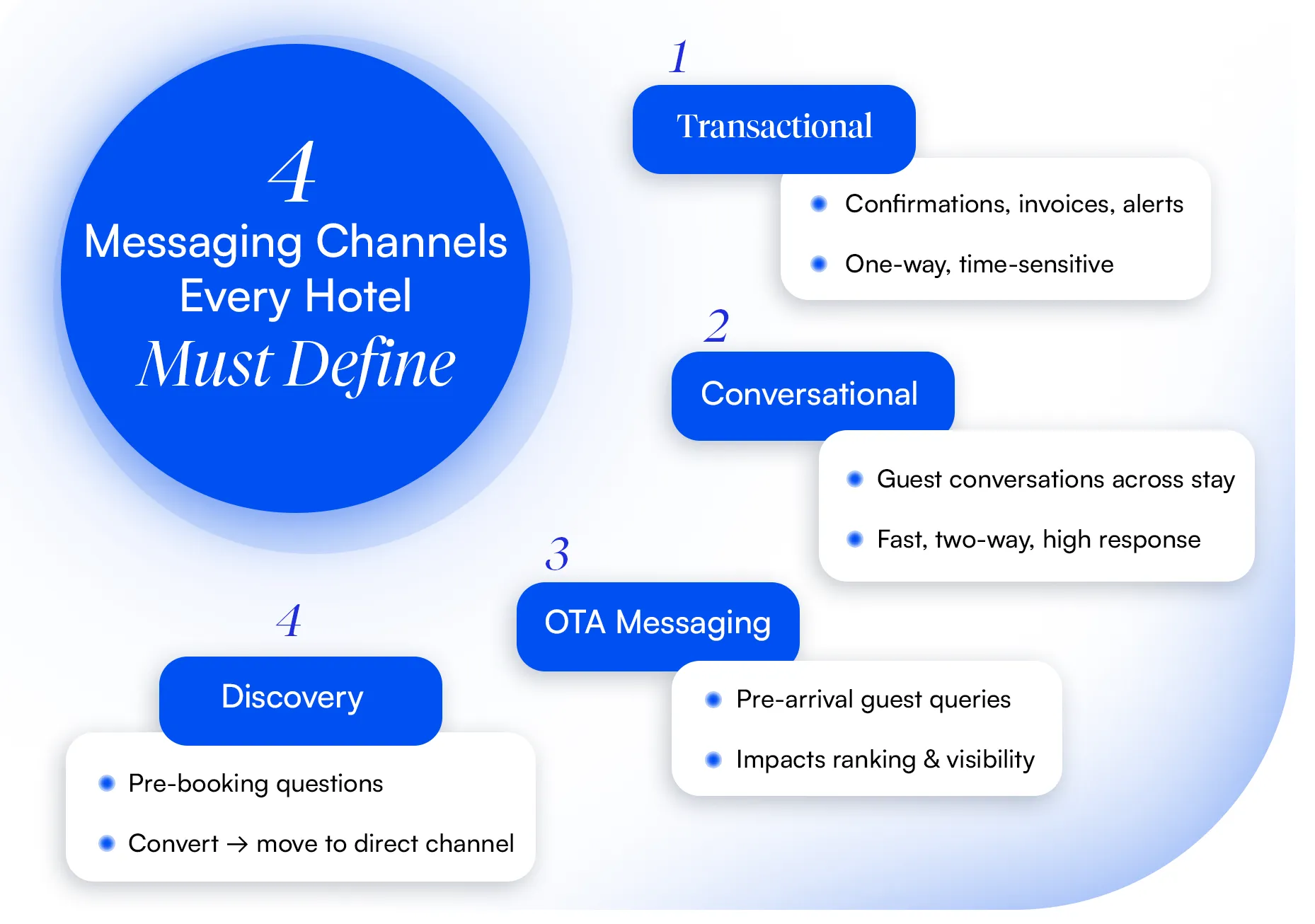
Before building a multi-channel strategy, you need to understand what each type of channel is actually suited for. Using the wrong channel for the wrong purpose is one of the most common and least recognized errors in hotel communication.
What they are for: Confirmed information, legal documentation, and time-sensitive single-action notifications.
Email is where guests expect to receive booking confirmations, invoices, formal correspondence, and anything they might need to reference later. The open rate for transactional hotel emails, including booking confirmations and check-in reminders, exceeds 60% when sent immediately after the trigger event. Marketing emails average around 35%. The gap is explained by context: guests open what they asked for.
SMS is for urgency and brevity. A room-ready notification. A checkout reminder. A digital key link. A same-day arrival instruction. SMS achieves open rates comparable to WhatsApp, but the format demands concision. Long SMS messages get ignored or feel like spam. SMS works when the message is short, specific, and time-bound.
Neither email nor SMS is suited for back-and-forth conversation. A guest who receives an SMS and replies with a follow-up question needs that reply routed to a human within minutes. If it is not, the SMS that was meant to be efficient becomes a frustration point.
What it is for: Two-way conversations throughout the guest journey, from pre-arrival questions to in-stay requests to post-stay follow-up.
WhatsApp has over 2 billion active users globally, and more than 175 million people message businesses on the platform daily. For hotels, this represents reach that no other messaging channel matches across international guest demographics. WhatsApp messages achieve open rates of up to 98%, significantly higher than email or SMS for conversational outreach.
The channel's strength is familiarity. Guests communicate on WhatsApp the same way they communicate with friends: casually, directly, and with an expectation of a relatively quick reply. For hotels, this means WhatsApp conversations surface both the routine and the sensitive: a question about parking, a complaint about noise, a request to extend checkout, a note about a birthday surprise.
WhatsApp is where the relationship happens. It is not a broadcast channel. It is not suited for sending promotional blasts to guest lists who did not opt in. Hotels that treat it as a marketing broadcast tool damage the channel's effectiveness quickly. Guests who feel spammed on WhatsApp block the number. That contact is gone permanently.
The operational requirement for WhatsApp is coverage. If you commit to it as a guest communication channel, someone needs to be monitoring it during all operating hours. An automated routing system also works, as long as messages reach the right person within your SLA window.
What it is for: Managing guest communication on the platforms that generated the booking, particularly before the guest's contact details are available for direct messaging.
OTA messaging is non-optional. If a guest books through Booking.com and sends a pre-arrival question through the platform, that message needs a response. OTAs track response rates and response times as factors in their ranking algorithms. A slow response rate on Booking.com does not just affect the guest experience. It affects your property's visibility in search results on that platform.
The challenge with OTA messaging is that it lives in a separate environment. Booking.com has its own inbox. Expedia has its own. Airbnb has its own. Each requires a separate login. Each has its own notification settings. In a busy hotel where the front desk team is managing arrivals, a message that arrives in the Expedia inbox at 2pm on a Friday can easily go unseen until Monday.
The operational fix is connecting OTA inboxes to your unified messaging system so that a Booking.com message and a WhatsApp message appear in the same view, with the same urgency, and get routed to the same team member. This is one of the most significant operational gains from a hotel unified inbox. It eliminates the need to log into five different OTA extranets to check messages.
What they are for: Top-of-funnel guest discovery, vibe checks, and the earliest pre-booking questions from guests who have not yet committed to a stay.
A traveler scrolling Instagram sees a photo of your rooftop bar. They DM: "Do you have rooms available in August?" That guest is in discovery mode. They are comparing options. They are not yet a confirmed guest, but they are a high-intent prospect.
Social media DMs are not where you manage operational requests. They are where you capture pre-booking intent and move the conversation toward a booking. The job of an Instagram or Facebook response is not to answer every question in detail. It is to acknowledge quickly, answer the immediate question, and guide the conversation toward a booking channel or a more direct communication like WhatsApp or email.
Hotels that try to manage full operational guest service through Instagram DMs create a channel that is slow, prone to dropping context, and difficult to staff consistently. Social DMs work as a top-of-funnel intake. They do not work as a service channel.
The biggest mistake in hotel multi-channel messaging is not having too many channels. It is having no clear rule about which channel to use at which moment.
Here is the framework that works across property types.
This framework is the foundation of a well-structured hotel guest communication journey. Without it, channels get used randomly and the guest experience is inconsistent. Different guests on the same stay type receive different quality of communication depending on who was working and which channel happened to get checked first.
Industry analysis of guest communication trends confirms this is a live operational problem: managing guest interactions across multiple platforms, including emails, WhatsApp, Instagram, and OTA messaging, is actively straining hotel teams, and centralised tools that consolidate channels into a single interface are the proven fix.
OTA inboxes are where a significant share of pre-arrival guest communication happens, and they are also where the most messages get missed.
Online travel agencies currently hold about 55% of the hotel booking market. That means more than half of your arriving guests first interacted with your property through an OTA platform. When those guests send a pre-arrival question, they send it through the OTA inbox, because that is where their booking lives and where they feel most comfortable communicating before they have any direct relationship with your team.
What happens to those messages in most hotels is this: they arrive in the OTA extranet, which requires a separate login from your PMS and your email. During a busy check-in period, nobody is logged in to the extranet. The message sits. The OTA flags the response time. The guest either waits or books elsewhere.
Booking.com's messaging system, specifically, tracks your response rate and response time as part of your property score. A low response rate can reduce your visibility in search results on the platform. That means missed messages do not just cost you the individual inquiry. They compound into lower ranking and fewer future bookings.
Three things fix the OTA messaging problem:
Connect OTA inboxes to your unified dashboard. When a Booking.com message arrives in the same view as your WhatsApp conversations, it gets seen and responded to at the same pace. The separate login problem disappears.
Set up response templates for common OTA questions. Pre-arrival check-in questions, early arrival requests, accessibility needs. These repeat daily. Templates cut response time from minutes to seconds and ensure consistency regardless of who is responding.
Use automation for the questions that don't need a human. Many OTA messages are simple requests for information that your digital guidebook or FAQ automation can answer. Routing these to auto-responses immediately satisfies the OTA response rate metric while freeing your team for conversations that genuinely need human judgment.
WhatsApp is the most powerful guest communication channel available to hotels right now. It is also the easiest to misuse.
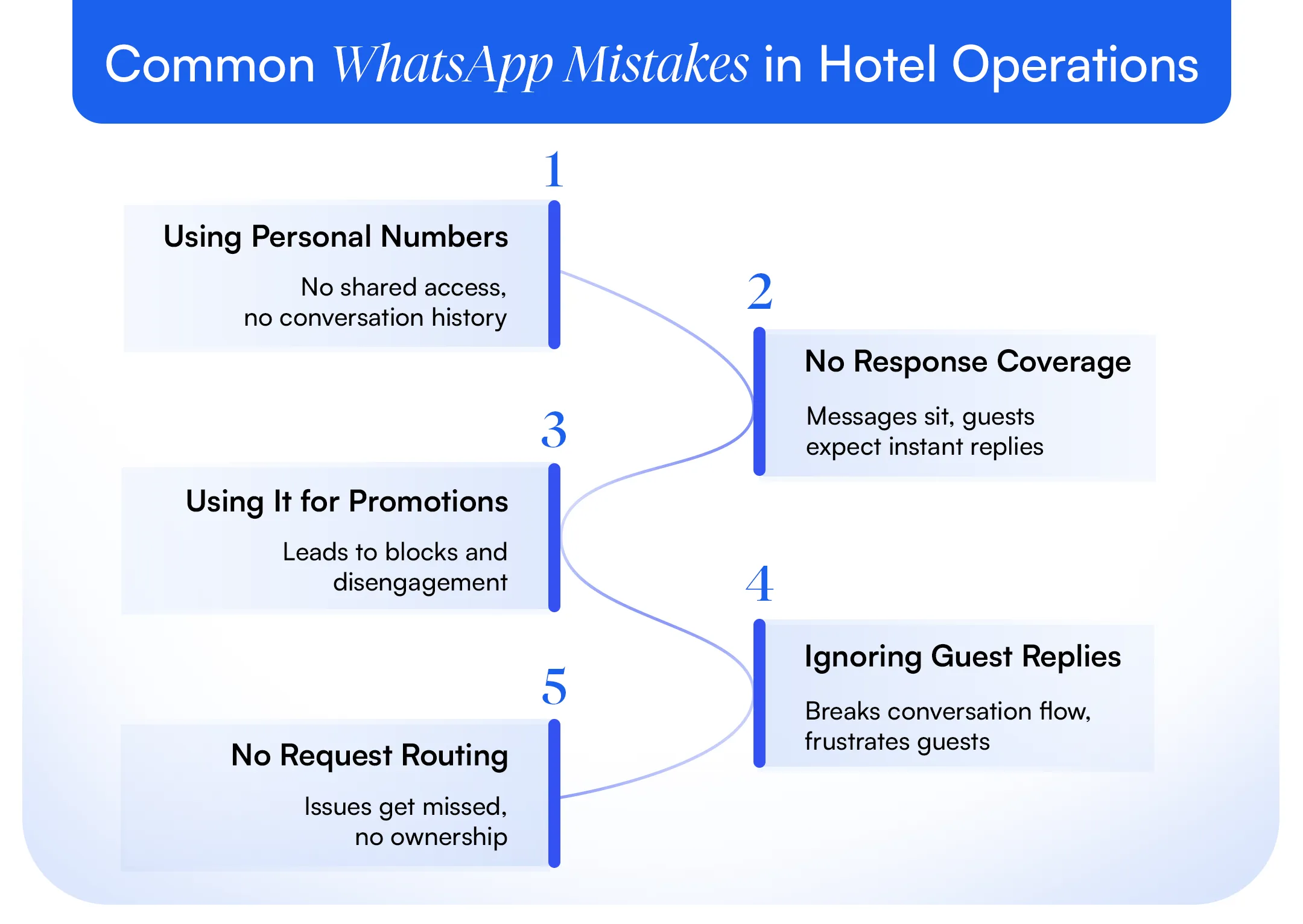
The most common mistakes:
When a staff member's personal WhatsApp becomes the hotel's guest communication channel, every message is siloed to that person. They leave, change shifts, or go on holiday and the conversation history goes with them. Guests who message back receive no reply. There is no record of what was discussed. This is one of the most widespread and damaging operational gaps in independent hotels.
WhatsApp only works as a service channel if someone is monitoring it. A guest who sends an in-stay request at 10pm and receives no reply until 7am the next morning is not experiencing WhatsApp as a service improvement. They are experiencing a slow response in a channel that feels personal, and slow responses feel worse on personal channels.
Sending promotional messages to guest contact lists who did not specifically opt in for marketing on WhatsApp is a fast way to accumulate blocks and erode the channel's effectiveness. WhatsApp's terms require explicit consent for marketing messages. More importantly, guests who feel spammed on a personal channel disengage permanently.
A guest WhatsApps about a maintenance issue. The front desk sees it, means to forward it to facilities, gets interrupted, and forgets. The issue is never resolved. The guest sends a follow-up. Nobody has context. This is not a WhatsApp problem. It is a workflow problem. WhatsApp messages need to route to a task system that tracks completion.
The operational standard for WhatsApp that works:
Most hotel social media strategies focus on content: what to post, when to post, which hashtags to use. Far less attention goes to the DMs that arrive as a result of that content.
A guest who DMs your Instagram after seeing a photo of your restaurant is not just asking a question. They are self-selecting as a high-interest prospect. They chose to reach out. The quality of that response determines whether that interaction becomes a booking.
The mistake most hotels make with social DMs is treating them as either too low-priority, taking days to respond, or trying to handle full operational service through them, which they are not suited for.
The right approach is a two-step model:
Step 1: Respond fast and answer the immediate question.
A DM that gets a reply within 30 minutes converts at a dramatically higher rate than one that waits until the next day. The response does not need to be long. It needs to be prompt and genuinely helpful.
Step 2: Move the conversation to a better channel.
For any inquiry that requires back-and-forth, such as availability, room details, or special requests, direct the guest to WhatsApp, email, or your booking engine. "Happy to help. You can reach us directly on WhatsApp at [number] or book at [link]" moves the conversation to a channel you can actually service well.
Social DMs should never be where you manage ongoing guest relationships or handle in-stay requests. The context is wrong, the notification systems are unreliable, and the conversation history is hard for team members to access during handoffs.
Here is a scenario that plays out in hundreds of hotels every week.
A guest discovers your property on Instagram and DMs with a question. Your social media manager responds and gives them your WhatsApp number. The guest contacts WhatsApp. A different staff member picks it up. The guest has to re-explain who they are and what they want. They book the stay. Their OTA booking generates a pre-arrival message in the Booking.com inbox. A third team member sees it but has no record of the Instagram or WhatsApp conversation. They respond generically. The guest arrives feeling like the hotel does not know them at all.
Every channel switch that loses context is a reset. The guest goes from feeling like an ongoing relationship to feeling like a new inquiry. That reset creates friction, the same friction discussed in the hidden gaps of the hotel guest journey, and it accumulates silently.
The solution is a unified conversation record. When all channels feed into one platform, a staff member picking up a WhatsApp conversation can see the Instagram DM that preceded it. The person handling the Booking.com message can see the WhatsApp conversation the guest already had with the team. Context does not reset. The guest does not have to start over.
The business case for getting this right is significant. Research on omnichannel communication in hospitality shows that companies with strong omnichannel customer engagement retain on average 89% of their customers, a figure that reflects not just satisfaction but the compounding effect of guests who never experienced the friction of starting over on every channel switch.
This is the core value of everything a unified inbox provides for hotels. Not just the ability to see messages in one place, but the ability to carry conversation context across channels so that every team member handling a guest has the full picture.
The worst thing a hotel team can do is try to be active and responsive on every available channel with no additional infrastructure to support it.
A hotel that adds Instagram DMs, Facebook Messenger, WhatsApp, Booking.com, Expedia, Airbnb, SMS, and email to its communication mix without a unified system or clear staffing model will respond badly on most of them. And bad responses on a personal channel like WhatsApp or Instagram do more damage than no presence at all.
Here is a practical decision framework for choosing which channels to run:
Look at your booking source data. If 60% of your bookings come from Booking.com, the OTA inbox is non-negotiable. If 20% of your inquiries over the past six months came through Instagram, that is a channel worth resourcing. If you have never received a guest message through Facebook Messenger, do not build a workflow around it.
One channel needs to be where guests can reach you reliably for operational requests: room issues, special requests, logistics, and in-stay questions. In most markets, this is WhatsApp. In markets where WhatsApp penetration is lower, it is SMS. Pick one and staff it accordingly. Everything else is secondary.
One channel handles discovery and pre-booking inquiries. For most hotels, this is Instagram or the hotel website chat. Its job is to capture intent and route it toward booking. Not to handle the full guest relationship.
This is the decision most hotels avoid making. If you are not resourced to respond to Twitter DMs within 30 minutes, do not put Twitter DMs in your operating model. A channel that is theoretically available but practically unmonitored does more harm than not having the channel at all.
For every secondary channel, define at what point a conversation moves to the primary service channel. The answer should be clear and simple. Any inquiry that becomes operational, such as reservation modifications, service requests, or billing questions, moves to WhatsApp or email. Any inquiry that requires personal data, such as passport details or payment information, moves to email or a secure direct channel.
Many hotels understand what they should be doing with messaging channels. Fewer understand what it actually takes to do it consistently.
The honest operational requirements:
This is not optional for a multi-channel setup. Without it, the system breaks during every busy period, every staff change, and every situation where the person who saw a message is unavailable to follow up. When a guest's WhatsApp, OTA message, and email all appear in the same view, timestamped and attributed to the same booking, the operational load of multi-channel messaging drops dramatically.
The scale of industry investment reflects exactly this need. The hospitality guest messaging platforms market was valued at USD 425 million in 2024 and is projected to reach USD 1,200 million by 2033, growing at a CAGR of 11.2% and research tracking hotel guest messaging platform adoption shows the shift is being driven specifically by hotels moving from fragmented channel tools to unified communication systems. Guestara is built exactly for this: a single platform where WhatsApp, SMS, OTA messages, and email are managed together, connected to your PMS, and visible to your entire team.
A messaging system is only as good as the humans monitoring it. Define which team member owns the inbox during each shift. Define the SLA for each channel: under 5 minutes for in-stay WhatsApp, under 30 minutes for OTA messages, under 2 hours for email inquiries. Put it in writing. Track it.
Pre-arrival information requests, check-in instructions, late checkout responses, room service confirmation, review requests. These repeat daily. Templates cut response time and ensure consistency. They are not a replacement for personalization. They are the starting point that gets personalized.
WiFi password, breakfast hours, checkout time, parking instructions, pool access. These should be handled by auto-reply or FAQ automation. Every message your automation handles correctly is one fewer message your team needs to respond to manually.
Maintenance request goes to the facilities team. F&B request goes to the restaurant. Billing question goes to the front office manager. Without routing rules, messages land in the inbox and wait for whoever happens to see them first, which is not a system.
Managing WhatsApp, OTA inboxes, SMS, and email from separate tools is how hotel teams end up in the reactive, always-catching-up communication pattern that drains staff and frustrates guests.
If you are still building the foundations of your hotel's messaging setup, understanding what hotel guest messaging means, the channels it covers and the problems it solves, is the right starting point before building the multi-channel layer on top.
Guestara consolidates all of these into one unified inbox, connected to your PMS so every message is attached to a booking, every conversation has context, and every team member working the inbox has the full picture.
Pre-arrival automation runs across WhatsApp and email simultaneously, with the right message going to the right channel based on the guest's preference and opt-in status. OTA messages arrive alongside WhatsApp conversations. Routing rules send specific request types to the relevant department automatically.
The complete guide to hotel guest communication and journey automation covers how this plays out across the full guest lifecycle, from the first confirmation message through to the post-stay review request.
If you want to see what a consolidated multi-channel messaging setup looks like for your specific property and booking mix, book a demo with the Guestara team.


Learn how to manage WhatsApp, OTA inboxes, SMS, email, and social media messaging together without losing messages, context, or your team's sanity.
Your guests are already messaging you from five different places.
WhatsApp from the guest who booked direct. Booking.com inbox from the family checking in tomorrow. An Instagram DM from someone asking if you have connecting rooms. An SMS from a guest already on property wanting extra towels. An email from a corporate traveler with a room change request.
Every one of those is a real opportunity: to confirm a booking, capture an upsell, resolve a problem, or turn a question into a relationship.
And in most hotels, at least two of them go unanswered or arrive too late to matter.
Multi-channel messaging is not complicated in theory. In practice, it becomes chaotic when each channel lives in a different tool, gets checked at different times, and gets handled by whoever happens to be available. The result is inconsistent, slow, and incomplete communication that guests experience as indifference, even when the team is working hard.
This blog is a practical guide to managing hotel messaging channels together. Not just what each channel is for, but how to build a system that makes all of them work.
Multi-channel messaging for hotels means communicating with guests across multiple platforms: WhatsApp, OTA inboxes, SMS, email, and social media direct messages, in a coordinated way throughout the guest journey.
The key word is coordinated. Having five channels is not multi-channel messaging. That is just five separate inboxes. Multi-channel messaging means those channels operate with a shared strategy: each one has a defined role, messages are routed to the right team member, and the conversation history is visible in one place regardless of which channel the guest used.
This is different from omnichannel communication, a term often used interchangeably but which specifically implies that the experience feels continuous to the guest. Switching channels does not require starting over. Multi-channel is the foundation. Omnichannel is the goal.
For most hotels, the starting point is understanding what each channel is actually for and stopping the pattern of using all channels for all things, which is how teams end up overwhelmed and guests end up ignored.
The market is moving fast on this. Industry research into hotel guest messaging platforms shows accelerating adoption as properties shift from managing channels in isolation to centralised, unified communication systems. Hotels that build this infrastructure now are not adopting a niche capability. They are catching up with where guest expectations already are.
Understanding what hotel guest messaging actually means, the channels it covers and the problems it solves, is where the strategy starts.
Most hotels did not choose to have five messaging channels. They accumulated them.
Email came first. It was always there, part of every PMS and booking confirmation flow. Then Booking.com messaging came with the OTA connection, mandatory and unavoidable. WhatsApp was added because guests started messaging the front desk number directly and the team needed a way to manage it. SMS was bolted on for check-in reminders. Instagram DMs started coming in when the hotel posted a promotion and someone asked a question.
Each addition made sense in isolation. Nobody sat down and said "let's build a five-channel communication system with no unified view." It just happened.
The problem is that every channel added without a clear operating model is a channel that will occasionally fail. A message arrives in the Expedia inbox at 11pm. Nobody is monitoring it. The guest books elsewhere. A WhatsApp arrives during peak check-in. The person who normally handles it is with guests at the desk. The message sits for 90 minutes. The guest gets irritated, though they never say why.
These are not dramatic failures. They are the quiet, daily friction that adds up to lower satisfaction scores, fewer repeat bookings, and a team that feels like they are always catching up.
This is not a problem unique to any one property. Industry analysis of guest communication trends consistently notes that managing guest interactions across multiple platforms — emails, WhatsApp, Instagram, and OTA messaging — is actively straining hotel teams across the sector. The fragmentation is the problem, and the operating model is the fix.
The fix is not more staff. It is a clearer operating model for the channels you already have.
Before building a multi-channel strategy, you need to understand what each type of channel is actually suited for. Using the wrong channel for the wrong purpose is one of the most common and least recognized errors in hotel communication.
What they are for: Confirmed information, legal documentation, and time-sensitive single-action notifications.
Email is where guests expect to receive booking confirmations, invoices, formal correspondence, and anything they might need to reference later. The open rate for transactional hotel emails, including booking confirmations and check-in reminders, exceeds 60% when sent immediately after the trigger event. Marketing emails average around 35%. The gap is explained by context: guests open what they asked for.
SMS is for urgency and brevity. A room-ready notification. A checkout reminder. A digital key link. A same-day arrival instruction. SMS achieves open rates comparable to WhatsApp, but the format demands concision. Long SMS messages get ignored or feel like spam. SMS works when the message is short, specific, and time-bound.
Neither email nor SMS is suited for back-and-forth conversation. A guest who receives an SMS and replies with a follow-up question needs that reply routed to a human within minutes. If it is not, the SMS that was meant to be efficient becomes a frustration point.
What it is for: Two-way conversations throughout the guest journey, from pre-arrival questions to in-stay requests to post-stay follow-up.
WhatsApp has over 2 billion active users globally, and more than 175 million people message businesses on the platform daily. For hotels, this represents reach that no other messaging channel matches across international guest demographics. WhatsApp messages achieve open rates of up to 98%, significantly higher than email or SMS for conversational outreach.
The channel's strength is familiarity. Guests communicate on WhatsApp the same way they communicate with friends: casually, directly, and with an expectation of a relatively quick reply. For hotels, this means WhatsApp conversations surface both the routine and the sensitive: a question about parking, a complaint about noise, a request to extend checkout, a note about a birthday surprise.
WhatsApp is where the relationship happens. It is not a broadcast channel. It is not suited for sending promotional blasts to guest lists who did not opt in. Hotels that treat it as a marketing broadcast tool damage the channel's effectiveness quickly. Guests who feel spammed on WhatsApp block the number. That contact is gone permanently.
The operational requirement for WhatsApp is coverage. If you commit to it as a guest communication channel, someone needs to be monitoring it during all operating hours. An automated routing system also works, as long as messages reach the right person within your SLA window.
What it is for: Managing guest communication on the platforms that generated the booking, particularly before the guest's contact details are available for direct messaging.
OTA messaging is non-optional. If a guest books through Booking.com and sends a pre-arrival question through the platform, that message needs a response. OTAs track response rates and response times as factors in their ranking algorithms. A slow response rate on Booking.com does not just affect the guest experience. It affects your property's visibility in search results on that platform.
The challenge with OTA messaging is that it lives in a separate environment. Booking.com has its own inbox. Expedia has its own. Airbnb has its own. Each requires a separate login. Each has its own notification settings. In a busy hotel where the front desk team is managing arrivals, a message that arrives in the Expedia inbox at 2pm on a Friday can easily go unseen until Monday.
The operational fix is connecting OTA inboxes to your unified messaging system so that a Booking.com message and a WhatsApp message appear in the same view, with the same urgency, and get routed to the same team member. This is one of the most significant operational gains from a hotel unified inbox. It eliminates the need to log into five different OTA extranets to check messages.
What they are for: Top-of-funnel guest discovery, vibe checks, and the earliest pre-booking questions from guests who have not yet committed to a stay.
A traveler scrolling Instagram sees a photo of your rooftop bar. They DM: "Do you have rooms available in August?" That guest is in discovery mode. They are comparing options. They are not yet a confirmed guest, but they are a high-intent prospect.
Social media DMs are not where you manage operational requests. They are where you capture pre-booking intent and move the conversation toward a booking. The job of an Instagram or Facebook response is not to answer every question in detail. It is to acknowledge quickly, answer the immediate question, and guide the conversation toward a booking channel or a more direct communication like WhatsApp or email.
Hotels that try to manage full operational guest service through Instagram DMs create a channel that is slow, prone to dropping context, and difficult to staff consistently. Social DMs work as a top-of-funnel intake. They do not work as a service channel.
The biggest mistake in hotel multi-channel messaging is not having too many channels. It is having no clear rule about which channel to use at which moment.
Here is the framework that works across property types.
This framework is the foundation of a well-structured hotel guest communication journey. Without it, channels get used randomly and the guest experience is inconsistent. Different guests on the same stay type receive different quality of communication depending on who was working and which channel happened to get checked first.
Industry analysis of guest communication trends confirms this is a live operational problem: managing guest interactions across multiple platforms, including emails, WhatsApp, Instagram, and OTA messaging, is actively straining hotel teams, and centralised tools that consolidate channels into a single interface are the proven fix.
OTA inboxes are where a significant share of pre-arrival guest communication happens, and they are also where the most messages get missed.
Online travel agencies currently hold about 55% of the hotel booking market. That means more than half of your arriving guests first interacted with your property through an OTA platform. When those guests send a pre-arrival question, they send it through the OTA inbox, because that is where their booking lives and where they feel most comfortable communicating before they have any direct relationship with your team.
What happens to those messages in most hotels is this: they arrive in the OTA extranet, which requires a separate login from your PMS and your email. During a busy check-in period, nobody is logged in to the extranet. The message sits. The OTA flags the response time. The guest either waits or books elsewhere.
Booking.com's messaging system, specifically, tracks your response rate and response time as part of your property score. A low response rate can reduce your visibility in search results on the platform. That means missed messages do not just cost you the individual inquiry. They compound into lower ranking and fewer future bookings.
Three things fix the OTA messaging problem:
Connect OTA inboxes to your unified dashboard. When a Booking.com message arrives in the same view as your WhatsApp conversations, it gets seen and responded to at the same pace. The separate login problem disappears.
Set up response templates for common OTA questions. Pre-arrival check-in questions, early arrival requests, accessibility needs. These repeat daily. Templates cut response time from minutes to seconds and ensure consistency regardless of who is responding.
Use automation for the questions that don't need a human. Many OTA messages are simple requests for information that your digital guidebook or FAQ automation can answer. Routing these to auto-responses immediately satisfies the OTA response rate metric while freeing your team for conversations that genuinely need human judgment.
WhatsApp is the most powerful guest communication channel available to hotels right now. It is also the easiest to misuse.
The most common mistakes:
When a staff member's personal WhatsApp becomes the hotel's guest communication channel, every message is siloed to that person. They leave, change shifts, or go on holiday and the conversation history goes with them. Guests who message back receive no reply. There is no record of what was discussed. This is one of the most widespread and damaging operational gaps in independent hotels.
WhatsApp only works as a service channel if someone is monitoring it. A guest who sends an in-stay request at 10pm and receives no reply until 7am the next morning is not experiencing WhatsApp as a service improvement. They are experiencing a slow response in a channel that feels personal, and slow responses feel worse on personal channels.
Sending promotional messages to guest contact lists who did not specifically opt in for marketing on WhatsApp is a fast way to accumulate blocks and erode the channel's effectiveness. WhatsApp's terms require explicit consent for marketing messages. More importantly, guests who feel spammed on a personal channel disengage permanently.
A guest WhatsApps about a maintenance issue. The front desk sees it, means to forward it to facilities, gets interrupted, and forgets. The issue is never resolved. The guest sends a follow-up. Nobody has context. This is not a WhatsApp problem. It is a workflow problem. WhatsApp messages need to route to a task system that tracks completion.
The operational standard for WhatsApp that works:
Most hotel social media strategies focus on content: what to post, when to post, which hashtags to use. Far less attention goes to the DMs that arrive as a result of that content.
A guest who DMs your Instagram after seeing a photo of your restaurant is not just asking a question. They are self-selecting as a high-interest prospect. They chose to reach out. The quality of that response determines whether that interaction becomes a booking.
The mistake most hotels make with social DMs is treating them as either too low-priority, taking days to respond, or trying to handle full operational service through them, which they are not suited for.
The right approach is a two-step model:
Step 1: Respond fast and answer the immediate question.
A DM that gets a reply within 30 minutes converts at a dramatically higher rate than one that waits until the next day. The response does not need to be long. It needs to be prompt and genuinely helpful.
Step 2: Move the conversation to a better channel.
For any inquiry that requires back-and-forth, such as availability, room details, or special requests, direct the guest to WhatsApp, email, or your booking engine. "Happy to help. You can reach us directly on WhatsApp at [number] or book at [link]" moves the conversation to a channel you can actually service well.
Social DMs should never be where you manage ongoing guest relationships or handle in-stay requests. The context is wrong, the notification systems are unreliable, and the conversation history is hard for team members to access during handoffs.
Here is a scenario that plays out in hundreds of hotels every week.
A guest discovers your property on Instagram and DMs with a question. Your social media manager responds and gives them your WhatsApp number. The guest contacts WhatsApp. A different staff member picks it up. The guest has to re-explain who they are and what they want. They book the stay. Their OTA booking generates a pre-arrival message in the Booking.com inbox. A third team member sees it but has no record of the Instagram or WhatsApp conversation. They respond generically. The guest arrives feeling like the hotel does not know them at all.
Every channel switch that loses context is a reset. The guest goes from feeling like an ongoing relationship to feeling like a new inquiry. That reset creates friction, the same friction discussed in the hidden gaps of the hotel guest journey, and it accumulates silently.
The solution is a unified conversation record. When all channels feed into one platform, a staff member picking up a WhatsApp conversation can see the Instagram DM that preceded it. The person handling the Booking.com message can see the WhatsApp conversation the guest already had with the team. Context does not reset. The guest does not have to start over.
The business case for getting this right is significant. Research on omnichannel communication in hospitality shows that companies with strong omnichannel customer engagement retain on average 89% of their customers, a figure that reflects not just satisfaction but the compounding effect of guests who never experienced the friction of starting over on every channel switch.
This is the core value of everything a unified inbox provides for hotels. Not just the ability to see messages in one place, but the ability to carry conversation context across channels so that every team member handling a guest has the full picture.
The worst thing a hotel team can do is try to be active and responsive on every available channel with no additional infrastructure to support it.
A hotel that adds Instagram DMs, Facebook Messenger, WhatsApp, Booking.com, Expedia, Airbnb, SMS, and email to its communication mix without a unified system or clear staffing model will respond badly on most of them. And bad responses on a personal channel like WhatsApp or Instagram do more damage than no presence at all.
Here is a practical decision framework for choosing which channels to run:
Look at your booking source data. If 60% of your bookings come from Booking.com, the OTA inbox is non-negotiable. If 20% of your inquiries over the past six months came through Instagram, that is a channel worth resourcing. If you have never received a guest message through Facebook Messenger, do not build a workflow around it.
One channel needs to be where guests can reach you reliably for operational requests: room issues, special requests, logistics, and in-stay questions. In most markets, this is WhatsApp. In markets where WhatsApp penetration is lower, it is SMS. Pick one and staff it accordingly. Everything else is secondary.
One channel handles discovery and pre-booking inquiries. For most hotels, this is Instagram or the hotel website chat. Its job is to capture intent and route it toward booking. Not to handle the full guest relationship.
This is the decision most hotels avoid making. If you are not resourced to respond to Twitter DMs within 30 minutes, do not put Twitter DMs in your operating model. A channel that is theoretically available but practically unmonitored does more harm than not having the channel at all.
For every secondary channel, define at what point a conversation moves to the primary service channel. The answer should be clear and simple. Any inquiry that becomes operational, such as reservation modifications, service requests, or billing questions, moves to WhatsApp or email. Any inquiry that requires personal data, such as passport details or payment information, moves to email or a secure direct channel.
Many hotels understand what they should be doing with messaging channels. Fewer understand what it actually takes to do it consistently.
The honest operational requirements:
This is not optional for a multi-channel setup. Without it, the system breaks during every busy period, every staff change, and every situation where the person who saw a message is unavailable to follow up. When a guest's WhatsApp, OTA message, and email all appear in the same view, timestamped and attributed to the same booking, the operational load of multi-channel messaging drops dramatically.
The scale of industry investment reflects exactly this need. The hospitality guest messaging platforms market was valued at USD 425 million in 2024 and is projected to reach USD 1,200 million by 2033, growing at a CAGR of 11.2% and research tracking hotel guest messaging platform adoption shows the shift is being driven specifically by hotels moving from fragmented channel tools to unified communication systems. Guestara is built exactly for this: a single platform where WhatsApp, SMS, OTA messages, and email are managed together, connected to your PMS, and visible to your entire team.
A messaging system is only as good as the humans monitoring it. Define which team member owns the inbox during each shift. Define the SLA for each channel: under 5 minutes for in-stay WhatsApp, under 30 minutes for OTA messages, under 2 hours for email inquiries. Put it in writing. Track it.
Pre-arrival information requests, check-in instructions, late checkout responses, room service confirmation, review requests. These repeat daily. Templates cut response time and ensure consistency. They are not a replacement for personalization. They are the starting point that gets personalized.
WiFi password, breakfast hours, checkout time, parking instructions, pool access. These should be handled by auto-reply or FAQ automation. Every message your automation handles correctly is one fewer message your team needs to respond to manually.
Maintenance request goes to the facilities team. F&B request goes to the restaurant. Billing question goes to the front office manager. Without routing rules, messages land in the inbox and wait for whoever happens to see them first, which is not a system.
Managing WhatsApp, OTA inboxes, SMS, and email from separate tools is how hotel teams end up in the reactive, always-catching-up communication pattern that drains staff and frustrates guests.
If you are still building the foundations of your hotel's messaging setup, understanding what hotel guest messaging means, the channels it covers and the problems it solves, is the right starting point before building the multi-channel layer on top.
Guestara consolidates all of these into one unified inbox, connected to your PMS so every message is attached to a booking, every conversation has context, and every team member working the inbox has the full picture.
Pre-arrival automation runs across WhatsApp and email simultaneously, with the right message going to the right channel based on the guest's preference and opt-in status. OTA messages arrive alongside WhatsApp conversations. Routing rules send specific request types to the relevant department automatically.
The complete guide to hotel guest communication and journey automation covers how this plays out across the full guest lifecycle, from the first confirmation message through to the post-stay review request.
If you want to see what a consolidated multi-channel messaging setup looks like for your specific property and booking mix, book a demo with the Guestara team.
Multi-channel messaging for hotels means communicating with guests across multiple platforms: WhatsApp, OTA inboxes, SMS, email, and social media, in a coordinated way throughout the guest journey. It is not simply having multiple channels. It means each channel has a defined role, messages are routed to the right team member, and conversation history is visible in one place regardless of where the guest initially messaged. Hotels that run multi-channel messaging without a unified system typically find that messages fall through the cracks during busy periods, guests receive inconsistent responses across channels, and staff spend significant time switching between platforms rather than serving guests.
The most effective approach is connecting both channels to a unified messaging inbox, a single dashboard where WhatsApp conversations and OTA inbox messages appear alongside each other, timestamped and linked to the relevant booking. Without this, a message that arrives in the Booking.com inbox at 2pm gets missed while the team is focused on WhatsApp, or vice versa. A unified inbox eliminates the separate-login problem, ensures both channels are monitored at the same standard, and allows team members to see the full guest conversation context regardless of which channel the guest used.
In most markets, WhatsApp is the primary service channel for operational guest communication: pre-arrival logistics, in-stay requests, and post-stay follow-up. It achieves open rates of up to 98%, supports rich media, and feels conversational rather than transactional. In markets where WhatsApp penetration is lower, SMS serves the same purpose. Email is better suited for formal documentation and longer-form retargeting. OTA messaging handles communication with guests who initiated contact through the booking platform. Social media DMs are most effective as a top-of-funnel discovery channel, not as an operational service channel.
Booking.com tracks both your response rate and your response time as factors in your property's ranking and visibility on the platform. A low response rate, where messages go unanswered or take more than 24 hours, can reduce how prominently your property appears in search results. This means missed OTA messages do not just cost you the individual inquiry. They compound into fewer impressions and fewer future bookings. Connecting your Booking.com inbox to a unified messaging system, and setting up response templates for common pre-arrival questions, are the two most effective ways to maintain a strong OTA response rate without adding manual workload.
The biggest mistake is adding channels without building a system to support them. A hotel that is theoretically reachable on WhatsApp, Instagram, Booking.com, email, and SMS but has no unified view of those channels, no coverage rules, and no routing logic will respond slowly or inconsistently on most of them. In hospitality, a slow response on a personal channel like WhatsApp or Instagram does more damage than no channel at all. It signals that the hotel is present but inattentive. The fix is not adding more channels. It is building a clear operating model for the channels you already have, defining which channel does what, who monitors it when, and what triggers a handoff to a different channel or team member.
We work closely with the industry leaders to offer seamless solutions




We’re here to help your whole team stay ahead of the curve as you grow.

Get up and running quickly with a personalized onboarding plan

Connect with real people who really get it, 24/7

Checkout our vast library of free resources, templates and more
There's only so much we can say — so let us show you! Schedule a demo today and reach your business goals.


.png)