Learn the exact 4 requirements to become an Airbnb Superhost. Get actionable steps to increase bookings,boost your ratings, and earn exclusive rewards.




%20(2).png)
You've probably seen that shiny red and orange badge next to some Airbnb host profiles. That's the Superhost status, and it's not just a pretty decoration.
Superhosts earn significantly more money, get more bookings, and enjoy perks that regular hosts don't have access to. If you're serious about your Airbnb business, becoming a Superhost is one of the most important goals you can set.
Here's the good news: the path to Superhost status is clear and measurable. You don't need luck or connections. You need to hit four specific targets over 12 months.
This guide walks you through exactly what those targets are, how to hit them, and what you'll gain once you do.
An Airbnb Superhost is a host who stands out for delivering exceptional service and experiences to guests. Airbnb recognizes this with a special badge on your profile and listings.
Think of it this way: Superhost status is proof that you run your hosting business at the highest level. You communicate quickly, maintain your property well, honor your bookings, and consistently earn high ratings.
The badge matters because guests see it. 59% of guests say Superhost status makes them more confident in the quality of accommodation. This trust directly leads to more bookings.
Just being a host isn't enough to get the badge. Only a small percentage of hosts achieve this status. More than 1.3 million hosts have become Superhosts, which shows this is attainable, but it's still an exclusive group.
If you're just starting your Airbnb journey, check out our comprehensive Airbnb host checklist to understand everything you need to launch your listing properly. This foundation makes the path to Superhost status much smoother.
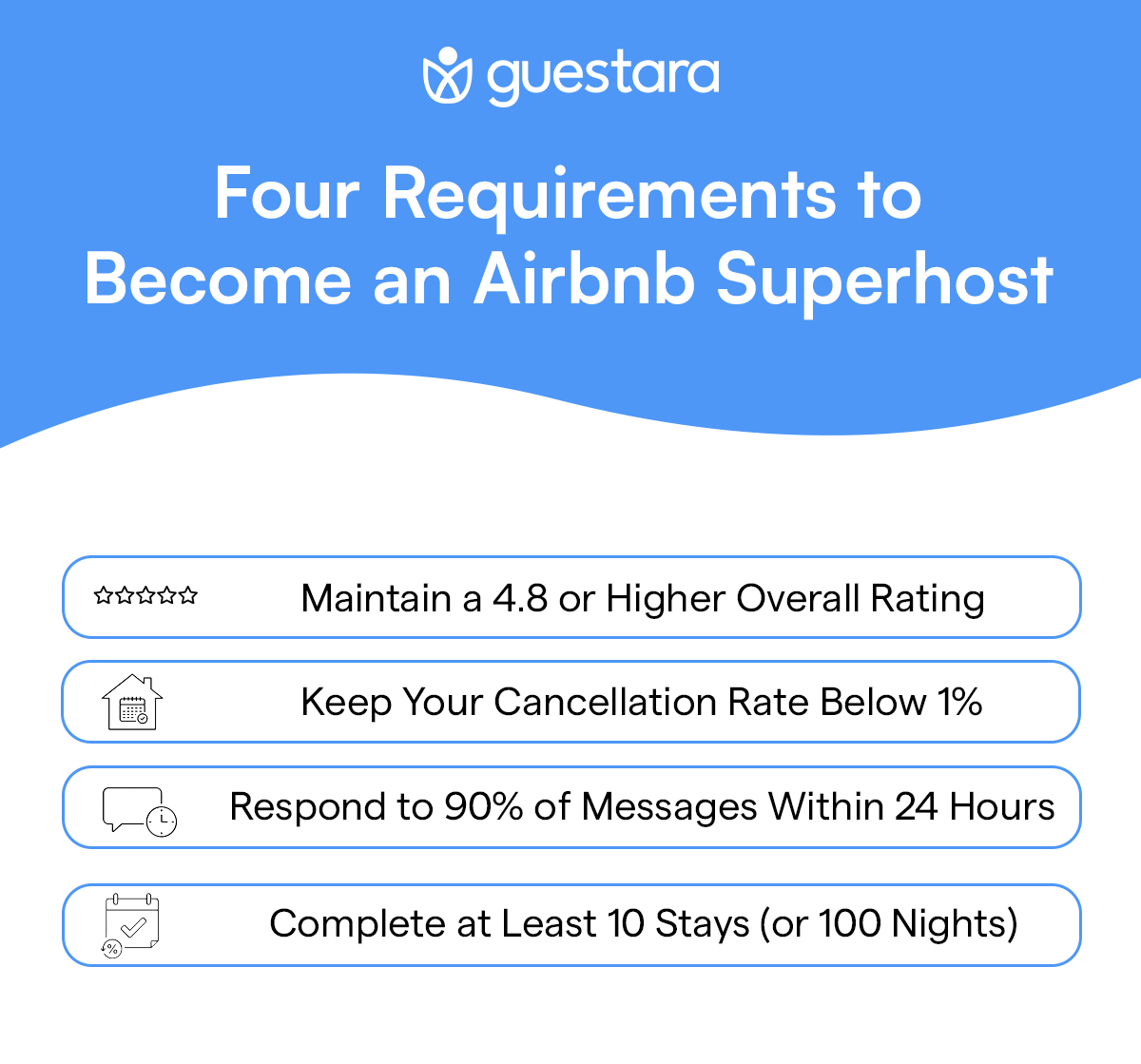
Airbnb evaluates hosts every three months on four specific metrics. You need to meet all four to qualify. Let's break down each one.
Your overall rating is calculated from guest reviews left over the past 12 months. This needs to be 4.8 stars or higher.
Guests rate you on several categories: overall experience, cleanliness, accuracy, value, communication, check-in, location, and amenities. A low score in any one area can drag down your overall rating.
The reality: this is the hardest requirement for most hosts to maintain. Many hosts get stuck here because they lack just a few five-star reviews to push them over the 4.8 threshold.
Achieving five-star reviews consistently means maintaining a spotless property. Use our detailed Airbnb cleaning checklist to ensure your space earns the highest marks every time guests leave. Small details like fresh linens, stocked amenities, and attention to hidden spaces (behind doors, under beds) make the difference between four and five stars.
What this means for you: Every review matters. You can't afford to have sloppy communication, a dirty property, or unclear listing descriptions. One bad experience can cost you the badge.
For deeper insights on what five-star guests expect, check out Airbnb's official 5-star hosting guide, which details the standards top hosts maintain.
You need to cancel fewer than one in every 100 reservations. This demonstrates reliability.
Airbnb understands that life happens. If you need to cancel due to a genuine emergency (major disruptive events, serious illness, jury duty), they'll make exceptions. You can learn more about what qualifies as an exception in Airbnb's guidance on major disruptive events.
If a cancellation is needed under these valid circumstances, contact Airbnb within 14 days to explain and request an exception.
Outside of these rare cases, cancellations hurt you badly because they damage guest trust and violate the Superhost promise.
What this means for you: Keep your calendar accurate. Block off dates you genuinely can't host. Never overbooking is the best strategy. If a guest requests a change and you can't accommodate them, your only option is to cancel, which counts against you.
Your response rate is the percentage of new guest messages you've answered within 24 hours over the past year. You need to hit 90% or higher.
This includes questions from potential guests and messages from people who've already booked.
Quick response times build trust. Guests get nervous when they don't hear back. They worry their booking will fall through or they won't get answers to important questions before arrival.
What this means for you: You need a system. Set up notifications on your phone. Aim to respond within an hour when possible. Even a quick acknowledgment counts. You don't need long, detailed replies, just proof that you're paying attention.
You need to have hosted guests at least 10 times in the past 12 months, OR you can have just 3 reservations that add up to 100+ nights total.
This rule levels the playing field. Some hosts do many short stays. Others focus on longer-term guests. Both paths lead to Superhost status.
The challenge: getting 10 bookings per year means your property needs to be attractive and reasonably priced. It also means staying consistent throughout the year, not just during peak season.
What this means for you: You can't get Superhost status with a listing you barely promote. You need to actively work to attract bookings. Lower prices, improve photos, write better descriptions, and offer competitive amenities.
Understanding your cost structure is crucial here. Many new hosts price too high because they don't understand how much Airbnb takes. Our guide to how much Airbnb takes from hosts breaks down all fees so you can price competitively while still staying profitable.
Airbnb runs Superhost evaluations every three months, on the first day of January, April, July, and October.
When you log into your Airbnb dashboard, go to your Performance tab. Under Opportunities, you'll see exactly where you stand on each requirement. You can track your rating, response rate, cancellation rate, and number of stays in real time.
If you meet all four requirements by an evaluation date, you automatically become a Superhost. Airbnb notifies you at the end of the assessment period. The badge can take up to a week to appear on your listings.
You don't need to apply or do anything special. Once you hit the numbers, the status is awarded automatically.
.png)
Let's talk about money, because that's ultimately why you're hosting.
Superhosts earn 60% more than hosts who aren't. That's not pocket change. If a regular host makes $10,000 per year, a Superhost could make $16,000 from the same property.
Here's where that extra revenue comes from:
Airbnb's algorithm ranks Superhosts higher in search results. When guests filter by "Superhost" status, your listing appears. This increased visibility means more potential customers see your property.
Guests are willing to pay more to stay with a Superhost. They know the property will be clean, communication will be fast, and the experience will match the listing description. This confidence allows you to charge higher nightly rates.
For a strategic approach to pricing, our complete guide to Airbnb pricing strategies explains how to balance higher rates with competitive positioning. Once you're a Superhost, you can implement premium pricing with confidence.
Guests are more likely to book a Superhost even with short notice. They trust that the stay will go smoothly, so they're less hesitant about quick decisions.
Extended-stay guests tend to choose Superhosts because they want reliability for a month or more. Longer bookings mean fewer turnovers and higher total revenue per guest.
Satisfied guests return. They know what to expect, and they trust you. Repeat business is the most profitable kind because you don't have to market to attract them.
Other financial perks:
Airbnb also rewards Superhosts with $100 in annual travel credits and a 20% bonus on referral fees when you refer other hosts to the platform.
If you're ready to build a real Airbnb business, review our in-depth Airbnb business plan guide that shows you how to structure your hosting as a profitable venture with sustainable growth.
Hitting 90% response rate is easier than most other requirements, but it requires discipline.
Set up push notifications on your phone for every Airbnb message. Treat messages like texts from important people in your life check them immediately.
Create quick reply templates for common questions. "When is check-in?" or "Do you allow pets?" These can be answered in seconds with a pre-written response.
Respond to everything, even if your answer is "I'll get back to you with details tomorrow." Showing you're engaged matters. An unanswered message tanks your response rate. A late but complete answer doesn't.
Keep your availability calendar updated. Turn off dates you can't host. This reduces booking requests that might turn into late cancellations. Fewer cancellations protect your rating and your cancellation rate.
Most hosts underestimate how much photos affect reviews.
If guests arrive and the space looks different from the photos, they're disappointed immediately. That leads to poor ratings in the "accuracy" category, which drags down your overall score.
Take new photos regularly. Lighting matters. Natural daylight, clean spaces, and clear shots of every room and amenity are essential.
If your budget allows, hire a professional photographer. The cost pays for itself in higher bookings and better ratings.
Make sure your photos showcase:
Guests should know exactly what to expect. No surprises on check-in day.
Your title and description matter as much as your photos.
Your title should be specific and appealing. "Cozy Apartment" doesn't work. "Bright 2-Bedroom Near Downtown with Free Parking" does.
Your description should be detailed and honest. Describe what guests will experience. What do they see when they walk in? What sounds will they hear? What amenities will they use?
Include everything you offer: WiFi, washer/dryer, heating/AC, parking, kitchen tools, local information, and any special touches.
The more amenities you list, the better. Guests search by amenities. Missing an important one from your list means you won't show up in their searches.
According to Airbnb data, the top amenities guests search for include self check-in, WiFi, a washing machine, a dryer, TV, cable, and a barbecue area.
If you don't have some of these, think about adding them. Even small upgrades can increase your bookings and your ability to hit the 10-stay requirement.
You need 10 bookings to qualify. Lower prices attract more bookings.
Research what similar properties charge in your area. Price slightly lower, especially for off-season or weekday stays.
Listings with prices lower than other similar listings nearby tend to rank higher in search results.
Offer discounts for longer stays (7+ nights or 28+ nights). Extended bookings are easier to manage and often come from serious guests who treat the property well.
Vary your rates by day of the week. Weekends can charge more. Weekdays can be cheaper to fill the calendar.
Use Airbnb's smart pricing tool if available in your market. It adjusts prices based on demand, taking manual work off your plate.
Before adjusting prices, understand your full cost picture. Learning about how much Airbnb takes from hosts helps you ensure every price point still leaves you profitable after fees, taxes, and cleaning costs.
You want 4.8+ rating. That means you need most guests giving you 5 stars.
Do the basics perfectly: clean property, accurate description, responsive communication, smooth check-in.
Then add touches that surprise guests and inspire five-star reviews:
None of these cost much, but they create memorable experiences. Memorable experiences turn into five-star reviews.
Use our Airbnb cleaning checklist as your baseline standard before every check-in. Guests notice when attention to detail extends beyond the obvious surfaces.
The only way to maintain a sub-1% cancellation rate is to avoid cancellations.
Never overbook. It's the most common reason hosts cancel. Confirm your calendar is correct before accepting any reservation.
Use a property management tool if you manage multiple listings. Manual calendar management across multiple properties is an easy way to double-book.
Get family or friends to cover during emergencies. Having a backup host who can manage your property in a pinch can prevent emergency cancellations.
Be flexible with guests within reason. If a guest asks for an early check-in and you can accommodate them, do it. These small accommodations prevent cancellation requests.
Keep your property maintained. Broken appliances or infrastructure issues sometimes force cancellations. Stay on top of repairs.
Check your Performance dashboard weekly. Know exactly where you stand on each metric.
If your response rate is dropping, you know to prioritize messages more. If your rating is slipping, investigate which areas guests are criticizing and fix them.
Don't wait for the quarterly evaluation to discover you're off track. By then, it's too late to course-correct.
Set personal targets above Airbnb's minimums. Aim for 95%+ response rate, not 90%. Aim for 4.85+ rating, not 4.8. This buffer protects you if you have one bad week.
Once you hit Superhost status, you'll notice changes almost immediately.
Your profile and listings get the Superhost badge. Guests see this before clicking. It increases click-through rates and booking likelihood.
You'll be eligible for Airbnb's Superhost search filter. Guests actively use this to narrow down options. Being visible here means passive bookings you wouldn't have gotten otherwise.
Nights booked with Superhosts increased by 21% according to Airbnb's Q3 2024 financial results. This shows the badge genuinely drives more business.
You gain access to priority support from Airbnb. When you have a question or issue, you get faster response times.
You become eligible for exclusive promotions and may be featured in Airbnb's newsletters.
Airbnb also sends travel coupons to Superhosts annually, which they sometimes share with guests as incentives.
You need 12 months of data to qualify.
The minimum timeline: get 10 bookings distributed across 12 months, maintain a 4.8+ rating throughout, never cancel, and respond to every message within 24 hours.
In reality, most hosts take longer because hitting all four requirements simultaneously is challenging.
If your rating is 4.7, you're one or two bad reviews away from losing Superhost eligibility. If your response rate drops to 89%, you're not qualifying this quarter.
Many hosts take 18-24 months to achieve and stabilize Superhost status. That's because they're not just hitting the minimums, they're building the systems and habits to sustain the requirements long-term.
The earlier you start working toward these metrics, the sooner you'll reach Superhost status. Every booking, every message, every review counts toward the goal.
Understanding these mistakes helps you avoid them:
Low rating: Guests are disappointed by dirty properties, poor communication, or inaccurate descriptions. Fix your property, improve your descriptions, and respond faster. Refer back to our Airbnb cleaning checklist to ensure every detail is covered.
Low response rate: Hosts forget to check messages or don't make messaging a priority. Set up notifications and treat messages as urgent.
Too few bookings: Property is overpriced, photos are poor, or descriptions are vague. Lower prices (see our pricing strategies guide), improve photos, and write detailed descriptions.
Cancellations: Overbooking, property damage, or poor planning leads to cancellations. Keep accurate calendars and maintain your property well.
Lack of consistency: Hosts achieve high ratings for a few months, then get lazy. Consistency matters. You need to maintain high standards every month for 12 months.
Yes, if you're running your Airbnb as a real business.
Extra revenue from higher bookings and higher rates more than justifies the effort of maintaining high standards. Superhosts earn 60% more than hosts who aren't. That money adds up quickly.
The Superhost badge becomes a marketing asset. It reduces guest hesitation and increases trust before they even contact you.
The habits you build to achieve Superhost status excellent communication, property maintenance, attention to detail are also the habits that make hosting less stressful and more enjoyable long-term.
If you're thinking about starting your Airbnb business or improving your current listings, aiming for Superhost status from the start is the smartest approach. It's not an accident that top hosts have this badge. It's a result of intentional systems and commitment.
Our Airbnb business plan guide walks you through structuring your hosting operation for long-term success, with Superhost status as a key milestone.
.png)
Becoming a Superhost on Airbnb doesn't require special skills or expensive renovations. It requires hitting four measurable targets over 12 months.
You need a 4.8+ rating, 90%+ response rate, <1% cancellation rate, and 10+ bookings (or 100 nights across 3 stays).
Start with the foundation: take better photos, write a clearer description, lower your price slightly, and set up message notifications on your phone.
From there, focus on exceeding guest expectations with clean spaces, fast communication, and thoughtful touches.
More than 1.3 million hosts have become Superhosts, which proves this is attainable for anyone willing to put in the work.
The financial reward is real. The competitive advantage is real. The time to start is now.


Learn the exact 4 requirements to become an Airbnb Superhost. Get actionable steps to increase bookings,boost your ratings, and earn exclusive rewards.
You've probably seen that shiny red and orange badge next to some Airbnb host profiles. That's the Superhost status, and it's not just a pretty decoration.
Superhosts earn significantly more money, get more bookings, and enjoy perks that regular hosts don't have access to. If you're serious about your Airbnb business, becoming a Superhost is one of the most important goals you can set.
Here's the good news: the path to Superhost status is clear and measurable. You don't need luck or connections. You need to hit four specific targets over 12 months.
This guide walks you through exactly what those targets are, how to hit them, and what you'll gain once you do.
An Airbnb Superhost is a host who stands out for delivering exceptional service and experiences to guests. Airbnb recognizes this with a special badge on your profile and listings.
Think of it this way: Superhost status is proof that you run your hosting business at the highest level. You communicate quickly, maintain your property well, honor your bookings, and consistently earn high ratings.
The badge matters because guests see it. 59% of guests say Superhost status makes them more confident in the quality of accommodation. This trust directly leads to more bookings.
Just being a host isn't enough to get the badge. Only a small percentage of hosts achieve this status. More than 1.3 million hosts have become Superhosts, which shows this is attainable, but it's still an exclusive group.
If you're just starting your Airbnb journey, check out our comprehensive Airbnb host checklist to understand everything you need to launch your listing properly. This foundation makes the path to Superhost status much smoother.
Airbnb evaluates hosts every three months on four specific metrics. You need to meet all four to qualify. Let's break down each one.
Your overall rating is calculated from guest reviews left over the past 12 months. This needs to be 4.8 stars or higher.
Guests rate you on several categories: overall experience, cleanliness, accuracy, value, communication, check-in, location, and amenities. A low score in any one area can drag down your overall rating.
The reality: this is the hardest requirement for most hosts to maintain. Many hosts get stuck here because they lack just a few five-star reviews to push them over the 4.8 threshold.
Achieving five-star reviews consistently means maintaining a spotless property. Use our detailed Airbnb cleaning checklist to ensure your space earns the highest marks every time guests leave. Small details like fresh linens, stocked amenities, and attention to hidden spaces (behind doors, under beds) make the difference between four and five stars.
What this means for you: Every review matters. You can't afford to have sloppy communication, a dirty property, or unclear listing descriptions. One bad experience can cost you the badge.
For deeper insights on what five-star guests expect, check out Airbnb's official 5-star hosting guide, which details the standards top hosts maintain.
You need to cancel fewer than one in every 100 reservations. This demonstrates reliability.
Airbnb understands that life happens. If you need to cancel due to a genuine emergency (major disruptive events, serious illness, jury duty), they'll make exceptions. You can learn more about what qualifies as an exception in Airbnb's guidance on major disruptive events.
If a cancellation is needed under these valid circumstances, contact Airbnb within 14 days to explain and request an exception.
Outside of these rare cases, cancellations hurt you badly because they damage guest trust and violate the Superhost promise.
What this means for you: Keep your calendar accurate. Block off dates you genuinely can't host. Never overbooking is the best strategy. If a guest requests a change and you can't accommodate them, your only option is to cancel, which counts against you.
Your response rate is the percentage of new guest messages you've answered within 24 hours over the past year. You need to hit 90% or higher.
This includes questions from potential guests and messages from people who've already booked.
Quick response times build trust. Guests get nervous when they don't hear back. They worry their booking will fall through or they won't get answers to important questions before arrival.
What this means for you: You need a system. Set up notifications on your phone. Aim to respond within an hour when possible. Even a quick acknowledgment counts. You don't need long, detailed replies, just proof that you're paying attention.
You need to have hosted guests at least 10 times in the past 12 months, OR you can have just 3 reservations that add up to 100+ nights total.
This rule levels the playing field. Some hosts do many short stays. Others focus on longer-term guests. Both paths lead to Superhost status.
The challenge: getting 10 bookings per year means your property needs to be attractive and reasonably priced. It also means staying consistent throughout the year, not just during peak season.
What this means for you: You can't get Superhost status with a listing you barely promote. You need to actively work to attract bookings. Lower prices, improve photos, write better descriptions, and offer competitive amenities.
Understanding your cost structure is crucial here. Many new hosts price too high because they don't understand how much Airbnb takes. Our guide to how much Airbnb takes from hosts breaks down all fees so you can price competitively while still staying profitable.
Airbnb runs Superhost evaluations every three months, on the first day of January, April, July, and October.
When you log into your Airbnb dashboard, go to your Performance tab. Under Opportunities, you'll see exactly where you stand on each requirement. You can track your rating, response rate, cancellation rate, and number of stays in real time.
If you meet all four requirements by an evaluation date, you automatically become a Superhost. Airbnb notifies you at the end of the assessment period. The badge can take up to a week to appear on your listings.
You don't need to apply or do anything special. Once you hit the numbers, the status is awarded automatically.
Let's talk about money, because that's ultimately why you're hosting.
Superhosts earn 60% more than hosts who aren't. That's not pocket change. If a regular host makes $10,000 per year, a Superhost could make $16,000 from the same property.
Here's where that extra revenue comes from:
Airbnb's algorithm ranks Superhosts higher in search results. When guests filter by "Superhost" status, your listing appears. This increased visibility means more potential customers see your property.
Guests are willing to pay more to stay with a Superhost. They know the property will be clean, communication will be fast, and the experience will match the listing description. This confidence allows you to charge higher nightly rates.
For a strategic approach to pricing, our complete guide to Airbnb pricing strategies explains how to balance higher rates with competitive positioning. Once you're a Superhost, you can implement premium pricing with confidence.
Guests are more likely to book a Superhost even with short notice. They trust that the stay will go smoothly, so they're less hesitant about quick decisions.
Extended-stay guests tend to choose Superhosts because they want reliability for a month or more. Longer bookings mean fewer turnovers and higher total revenue per guest.
Satisfied guests return. They know what to expect, and they trust you. Repeat business is the most profitable kind because you don't have to market to attract them.
Other financial perks:
Airbnb also rewards Superhosts with $100 in annual travel credits and a 20% bonus on referral fees when you refer other hosts to the platform.
If you're ready to build a real Airbnb business, review our in-depth Airbnb business plan guide that shows you how to structure your hosting as a profitable venture with sustainable growth.
Hitting 90% response rate is easier than most other requirements, but it requires discipline.
Set up push notifications on your phone for every Airbnb message. Treat messages like texts from important people in your life check them immediately.
Create quick reply templates for common questions. "When is check-in?" or "Do you allow pets?" These can be answered in seconds with a pre-written response.
Respond to everything, even if your answer is "I'll get back to you with details tomorrow." Showing you're engaged matters. An unanswered message tanks your response rate. A late but complete answer doesn't.
Keep your availability calendar updated. Turn off dates you can't host. This reduces booking requests that might turn into late cancellations. Fewer cancellations protect your rating and your cancellation rate.
Most hosts underestimate how much photos affect reviews.
If guests arrive and the space looks different from the photos, they're disappointed immediately. That leads to poor ratings in the "accuracy" category, which drags down your overall score.
Take new photos regularly. Lighting matters. Natural daylight, clean spaces, and clear shots of every room and amenity are essential.
If your budget allows, hire a professional photographer. The cost pays for itself in higher bookings and better ratings.
Make sure your photos showcase:
Guests should know exactly what to expect. No surprises on check-in day.
Your title and description matter as much as your photos.
Your title should be specific and appealing. "Cozy Apartment" doesn't work. "Bright 2-Bedroom Near Downtown with Free Parking" does.
Your description should be detailed and honest. Describe what guests will experience. What do they see when they walk in? What sounds will they hear? What amenities will they use?
Include everything you offer: WiFi, washer/dryer, heating/AC, parking, kitchen tools, local information, and any special touches.
The more amenities you list, the better. Guests search by amenities. Missing an important one from your list means you won't show up in their searches.
According to Airbnb data, the top amenities guests search for include self check-in, WiFi, a washing machine, a dryer, TV, cable, and a barbecue area.
If you don't have some of these, think about adding them. Even small upgrades can increase your bookings and your ability to hit the 10-stay requirement.
You need 10 bookings to qualify. Lower prices attract more bookings.
Research what similar properties charge in your area. Price slightly lower, especially for off-season or weekday stays.
Listings with prices lower than other similar listings nearby tend to rank higher in search results.
Offer discounts for longer stays (7+ nights or 28+ nights). Extended bookings are easier to manage and often come from serious guests who treat the property well.
Vary your rates by day of the week. Weekends can charge more. Weekdays can be cheaper to fill the calendar.
Use Airbnb's smart pricing tool if available in your market. It adjusts prices based on demand, taking manual work off your plate.
Before adjusting prices, understand your full cost picture. Learning about how much Airbnb takes from hosts helps you ensure every price point still leaves you profitable after fees, taxes, and cleaning costs.
You want 4.8+ rating. That means you need most guests giving you 5 stars.
Do the basics perfectly: clean property, accurate description, responsive communication, smooth check-in.
Then add touches that surprise guests and inspire five-star reviews:
None of these cost much, but they create memorable experiences. Memorable experiences turn into five-star reviews.
Use our Airbnb cleaning checklist as your baseline standard before every check-in. Guests notice when attention to detail extends beyond the obvious surfaces.
The only way to maintain a sub-1% cancellation rate is to avoid cancellations.
Never overbook. It's the most common reason hosts cancel. Confirm your calendar is correct before accepting any reservation.
Use a property management tool if you manage multiple listings. Manual calendar management across multiple properties is an easy way to double-book.
Get family or friends to cover during emergencies. Having a backup host who can manage your property in a pinch can prevent emergency cancellations.
Be flexible with guests within reason. If a guest asks for an early check-in and you can accommodate them, do it. These small accommodations prevent cancellation requests.
Keep your property maintained. Broken appliances or infrastructure issues sometimes force cancellations. Stay on top of repairs.
Check your Performance dashboard weekly. Know exactly where you stand on each metric.
If your response rate is dropping, you know to prioritize messages more. If your rating is slipping, investigate which areas guests are criticizing and fix them.
Don't wait for the quarterly evaluation to discover you're off track. By then, it's too late to course-correct.
Set personal targets above Airbnb's minimums. Aim for 95%+ response rate, not 90%. Aim for 4.85+ rating, not 4.8. This buffer protects you if you have one bad week.
Once you hit Superhost status, you'll notice changes almost immediately.
Your profile and listings get the Superhost badge. Guests see this before clicking. It increases click-through rates and booking likelihood.
You'll be eligible for Airbnb's Superhost search filter. Guests actively use this to narrow down options. Being visible here means passive bookings you wouldn't have gotten otherwise.
Nights booked with Superhosts increased by 21% according to Airbnb's Q3 2024 financial results. This shows the badge genuinely drives more business.
You gain access to priority support from Airbnb. When you have a question or issue, you get faster response times.
You become eligible for exclusive promotions and may be featured in Airbnb's newsletters.
Airbnb also sends travel coupons to Superhosts annually, which they sometimes share with guests as incentives.
You need 12 months of data to qualify.
The minimum timeline: get 10 bookings distributed across 12 months, maintain a 4.8+ rating throughout, never cancel, and respond to every message within 24 hours.
In reality, most hosts take longer because hitting all four requirements simultaneously is challenging.
If your rating is 4.7, you're one or two bad reviews away from losing Superhost eligibility. If your response rate drops to 89%, you're not qualifying this quarter.
Many hosts take 18-24 months to achieve and stabilize Superhost status. That's because they're not just hitting the minimums, they're building the systems and habits to sustain the requirements long-term.
The earlier you start working toward these metrics, the sooner you'll reach Superhost status. Every booking, every message, every review counts toward the goal.
Understanding these mistakes helps you avoid them:
Low rating: Guests are disappointed by dirty properties, poor communication, or inaccurate descriptions. Fix your property, improve your descriptions, and respond faster. Refer back to our Airbnb cleaning checklist to ensure every detail is covered.
Low response rate: Hosts forget to check messages or don't make messaging a priority. Set up notifications and treat messages as urgent.
Too few bookings: Property is overpriced, photos are poor, or descriptions are vague. Lower prices (see our pricing strategies guide), improve photos, and write detailed descriptions.
Cancellations: Overbooking, property damage, or poor planning leads to cancellations. Keep accurate calendars and maintain your property well.
Lack of consistency: Hosts achieve high ratings for a few months, then get lazy. Consistency matters. You need to maintain high standards every month for 12 months.
Yes, if you're running your Airbnb as a real business.
Extra revenue from higher bookings and higher rates more than justifies the effort of maintaining high standards. Superhosts earn 60% more than hosts who aren't. That money adds up quickly.
The Superhost badge becomes a marketing asset. It reduces guest hesitation and increases trust before they even contact you.
The habits you build to achieve Superhost status excellent communication, property maintenance, attention to detail are also the habits that make hosting less stressful and more enjoyable long-term.
If you're thinking about starting your Airbnb business or improving your current listings, aiming for Superhost status from the start is the smartest approach. It's not an accident that top hosts have this badge. It's a result of intentional systems and commitment.
Our Airbnb business plan guide walks you through structuring your hosting operation for long-term success, with Superhost status as a key milestone.
Becoming a Superhost on Airbnb doesn't require special skills or expensive renovations. It requires hitting four measurable targets over 12 months.
You need a 4.8+ rating, 90%+ response rate, <1% cancellation rate, and 10+ bookings (or 100 nights across 3 stays).
Start with the foundation: take better photos, write a clearer description, lower your price slightly, and set up message notifications on your phone.
From there, focus on exceeding guest expectations with clean spaces, fast communication, and thoughtful touches.
More than 1.3 million hosts have become Superhosts, which proves this is attainable for anyone willing to put in the work.
The financial reward is real. The competitive advantage is real. The time to start is now.
Yes, you can lose it. Airbnb reevaluates your performance every three months. If you fall below 4.8 rating, drop your response rate below 90%, exceed 1% cancellations, or dip below the 10 stays requirement in the last 12 months, you'll lose your badge. The good news: if you lose it, you can earn it back by hitting the requirements again. Many hosts treat losing the badge as a wake-up call to tighten their systems rather than a permanent failure.
One bad review rarely costs you Superhost status immediately, but it depends on your current rating. If you're at 4.82 and get a three-star review, you might drop below 4.8 and lose eligibility at the next evaluation. If you're at 4.85, you have more buffer. This is why aiming for 4.85+ instead of just 4.8 is smart. Use our Airbnb cleaning checklist to prevent most one-star reviews before they happen.
The fastest timeline is 12 months if you hit all four requirements consistently from day one. However, most hosts take 15-24 months because getting 10 quality bookings, maintaining 90%+ response rate, staying at 0% cancellations, and hitting 4.8+ rating simultaneously is harder than it sounds. There's no shortcut to Superhost status, but following our Airbnb business plan guide can help you structure for faster achievement.
No, but it helps significantly. Regular hosts can earn decent income if they price competently and maintain decent reviews. However, Superhosts earn 60% more on average because of higher visibility, higher rates, and repeat bookings. If you're serious about building real income, Superhost should be your goal. Check our guide on Airbnb pricing strategies to understand how pricing alone affects earnings, then add the Superhost boost on top.
Most hosts struggle with the 4.8+ rating. Getting consistent five-star reviews requires flawless execution: clean property, accurate descriptions, fast communication, and thoughtful touches. Response rate is easiest if you set up phone notifications. Cancellations are avoidable with proper planning. Bookings are achievable with competitive pricing. But ratings? Those depend on guest satisfaction and expectations alignment. Nail your cleanliness and communication first.
We work closely with the industry leaders to offer seamless solutions




We’re here to help your whole team stay ahead of the curve as you grow.

Get up and running quickly with a personalized onboarding plan

Connect with real people who really get it, 24/7

Checkout our vast library of free resources, templates and more
There's only so much we can say — so let us show you! Schedule a demo today and reach your business goals.


%20(1).png)
.png)
.png)