Learn how to design the emotional hotel guest journey. Discover the moments that drive guest loyalty, satisfaction, and repeat bookings.





A guest arrives at your hotel tired from travel. They've had a long day. They just want to relax in their room.
Here's what happens in most hotels: They walk to the front desk. They wait in line. They check in. They go to their room. No one has acknowledged them personally. No one knows it's their fifth stay. No one knows they had a problem last time. No one knows they're traveling for a stressful business meeting.
They feel like another room number.
Now imagine a different experience: They arrive. A message from the hotel is waiting on their phone: "Welcome back, Sarah. We remember you prefer a quiet room away from the elevator. We've arranged that for you. Your digital key is ready. Just scan to enter."
They feel known. They feel valued. They feel special.
The difference between these two experiences isn't cost. It's attention to emotional moments.
The hotels that drive loyalty aren't the ones with the nicest rooms. They're the ones that notice, remember, and respond to the emotional needs of their guests. They understand that loyalty isn't built on luxury. It's built on feeling cared for.
This guide explores the emotional architecture of the guest journey. We'll examine the moments that matter most, the psychology behind loyalty, and how to design intentional experiences that turn one-time visitors into returning guests. By the end, you'll understand why some hotels are full while others struggle—even when their rooms are equally nice.
For a comprehensive look at how to implement these emotional moments through technology and systems, see our complete guide to hotel guest messaging and journey automation.
The most dangerous hotel belief is this: "If we give them a nice room, they'll come back."
Data shows this isn't true. Hotels with identical room quality have drastically different repeat booking rates. Why?
Because loyalty isn't about rooms. It's about the guest. It's about being known, being anticipated, being remembered.
A guest might have an objectively nice room but feel invisible. They might receive good service but feel transactional. They might sleep well but not feel welcome.
These gaps—between room quality and human experience—are where guests are lost. To understand how guest messaging and communication bridges some of these gaps, it's important to first understand the emotional foundation.
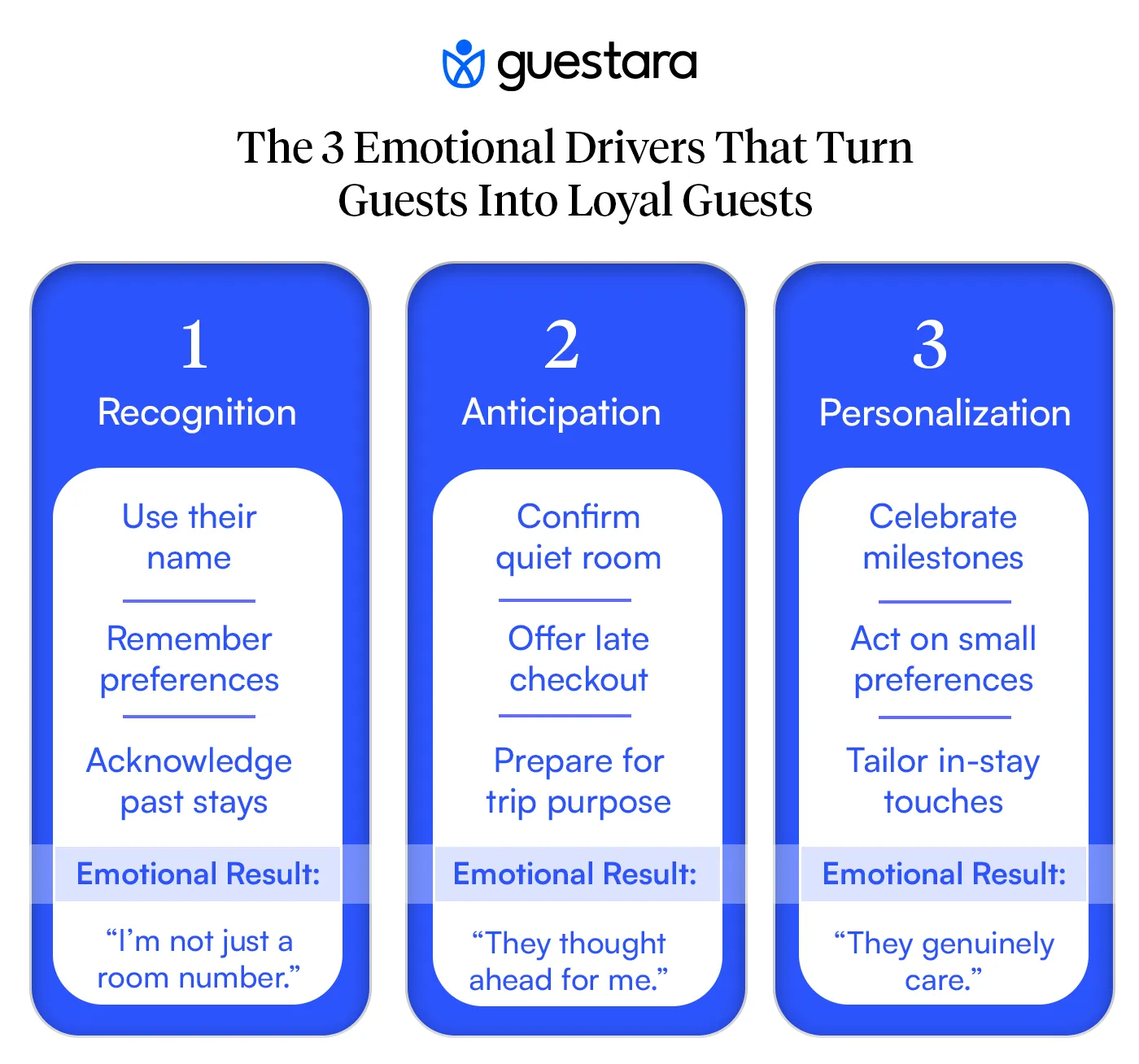
Research on customer loyalty reveals three consistent drivers across industries:
Guests want to be known. Not as "room 412." As themselves.
"Welcome back, James. We saw you stayed with us last month. We've put you in your preferred room type and pre-loaded your favorite coffee order in the room."
Recognition doesn't require luxury. It requires attention. A four-star hotel that remembers a guest's preference for extra pillows often gets more repeat bookings than a five-star hotel that treats every guest generically.
Guests want to feel that the hotel has thought about their needs before they arrive.
A guest arriving for a business trip receives: check-in reminder with parking info, late checkout confirmation, quiet workspace availability, meeting-ready room setup.
They didn't have to ask. The hotel anticipated their likely needs. This creates a feeling of care that's worth far more than thread count.
Guests want experiences designed for them, not standard packages offered to everyone.
A guest mentions they're celebrating an anniversary. They receive: welcome note in the room, complimentary champagne at dinner, special dessert at checkout.
This isn't expensive. A bottle of champagne costs $15. But it transforms the experience from "nice hotel stay" to "we noticed something that matters to you and honored it."
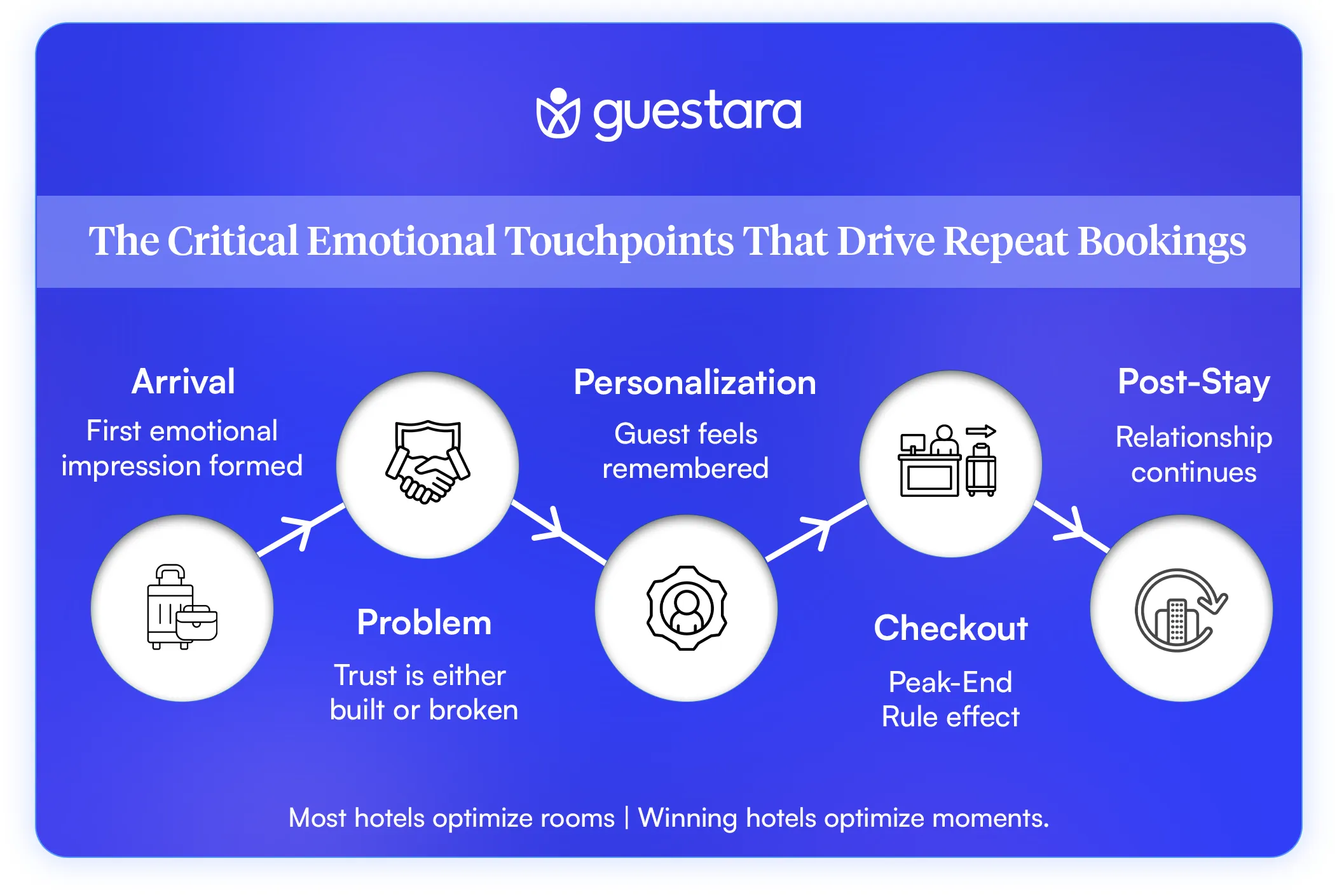
Not all moments in the guest journey are equally important. Some moments are emotionally neutral (parking, check-in process). Others are highly emotional (arrival, discovering a problem, checkout).
The hotels that drive loyalty are the ones that orchestrate the high-emotional moments intentionally.
High-Emotional Moments (where loyalty is won or lost):
Low-Emotional Moments (important, but not loyalty-critical):
The problem with most hotels: They over-invest in low-emotional moments (nice room, good WiFi, clean bathroom) and under-invest in high-emotional moments (recognition, anticipation, personalization).
It's backwards. A guest forgives a slightly older bathroom if they feel genuinely cared for. They'll never come back to a pristine hotel if they felt invisible.
A guest books your hotel. This is your first chance to create an emotional impression.
What most hotels do: Send confirmation email. Done.
What emotionally-intelligent hotels do: Send confirmation. Then, 5 days before arrival, send a personalized message asking about their trip purpose. Are they traveling for business or pleasure? Do they have any preferences or special needs?
This serves two purposes:
A guest traveling for a stressful business meeting receives: quiet room confirmation, workspace setup, express checkout option, late dinner availability.
A guest on honeymoon receives: champagne confirmation, romance package offer, privacy note.
Same hotel, completely different emotional experiences. Modern hotel guest messaging software makes this personalization possible at scale.
The pre-arrival period is when you set expectations. If you signal care early, guests arrive with goodwill. If you're silent until they arrive, they arrive neutral or skeptical.
This is where loyalty-critical emotions form.
A guest walks into your lobby with luggage. They're tired, potentially stressed, definitely transitioning from "outside" to "your space."
The Emotional Question: Do I belong here? Am I welcome?
What most hotels do: Standard check-in. "Room number [x], breakfast is [y], questions [z]?"
What emotionally-intelligent hotels do:
A staff member greets them by name. "Welcome back, Sarah, or Welcome Sarah—we're so glad you're here. We have you in a quiet room away from the elevator, just like you prefer. Your digital key is ready. [Hands key or sends to phone]."
Notice what happened:
The guest hasn't eaten, hasn't slept in the room, hasn't used the gym. But they've already decided: "I like this hotel."
Most guests come to hotels to do things (sleep, eat, work, relax). But emotionally, they're waiting for moments of care.
A guest's room temperature is wrong. Most hotels: Guest calls. Staff fixes it after 30 minutes.
Emotionally-intelligent hotels: Guest mentions it to staff in the hallway. Staff doesn't just fix it—they proactively call 10 minutes later. "We adjusted it to 72. Is that perfect or do you need it adjusted further?" They also mention: "And I've added an extra blanket to your room. My apologies for the inconvenience."
Cost difference: $2 in staff time and one blanket.
Emotional difference: Guest feels heard, valued, and cared for. They're now more likely to return.
A guest mentions (in a message or conversation) that they love coffee. The hotel doesn't just note it—they act on it.
Morning after: A premium coffee appears in the room with a note. "We know you love coffee. This is our barista's favorite pour-over method. Enjoy."
Using messaging channels like WhatsApp makes it easy to communicate these personal touches to guests in real-time during their stay.
Emotional impact: The guest realizes someone remembered something they said and acted on it. This creates a disproportionately strong sense of being cared for.
A guest celebrates an anniversary or birthday during their stay. Most hotels: Nothing happens.
Emotionally-intelligent hotels: The concierge notices it (from reservation notes or conversation). They arrange: a small cake or dessert at dinner, a note in the room, maybe a small upgrade offer for next time.
This guest doesn't just have a nice hotel stay. They have a memory. They tell others about it. They return.
Most guests check out neutrally. They didn't have a bad experience, but nothing memorable happened either.
The Standard Checkout: Guest checks out. Receives bill. Leaves.
The Emotionally-Intelligent Checkout:
Guest approaches checkout. Staff already has their bill ready (anticipation). They say: "We hope you had a wonderful stay. We'd love your feedback. [Hands card with link]."
Then, the personal touch: "We've noted that you prefer room [x], you love [coffee], and you arrived with stress about your meeting. We hope it went well. We'd love to see you back soon."
This guest leaves thinking: "They really did pay attention."
The Post-Checkout Moment
Most hotels: Guest leaves. Goodbye.
Emotionally-intelligent hotels:
24 hours later, guest receives a message: "We hope your trip was wonderful. We noticed you were in town for a business meeting—we'd love to know how it went. And we'd be thrilled to welcome you back."
This is a $0 gesture that reinforces: The relationship doesn't end at checkout.
Why do these emotional moments matter so much? Because of how human brains work.
Humans don't remember every moment of an experience. They remember:
Most hotel stays are emotionally flat. Guest arrives (neutral), stays (neutral), leaves (neutral).
But if you orchestrate one or two emotional peaks—a moment of genuine care, recognition, or surprise—the brain codes the entire experience differently.
Suddenly, the entire hotel stay becomes a "positive experience" because there were emotional highlights.
When someone shows you care, you feel obligated to reciprocate. If a hotel shows genuine care, guests reciprocate with loyalty.
A guest feels noticed and valued. Unconsciously, they think: "This hotel cares about me. I should return the favor by booking here again."
This reciprocity is more powerful than discounts. A guest who feels genuinely cared for will return even if a competitor offers lower rates. But a guest who feels transactional will jump to any competitor with a better deal.
People's memory of an experience is disproportionately influenced by:
If a guest's stay is fine but their checkout is handled with extra care and warmth, their memory of the entire stay becomes positive.
This is why checkout matters. The last thing they experience is the last thing they remember.
Not every moment matters equally. Map your guest journey and identify:
For most hotels, the top 5 are:
You can't personalize without information. How do you gather it ethically and efficiently?
At Booking: Ask: "This is your first time with us, correct? Any preferences we should know about?"
At Pre-Arrival: Message: "We want to make your stay perfect. Do you have any preferences or special needs?"
During Stay: Staff note-taking: When a guest mentions something, it's logged. "Guest mentioned they love coffee." "Guest is celebrating anniversary."
Smart Systems: PMS systems with guest preference flags. If a guest has stayed before, the system reminds staff: "This is Sarah's fifth stay. She prefers quiet rooms, loves coffee, and is a business traveler."
A unified inbox consolidates this information so every team member—front desk, housekeeping, F&B—has access to the same guest context consistently.
This matters more than any system. A staff member who genuinely cares about guest experience will create emotional moments. One who's just following procedures won't.
Training should include:
A staff member who genuinely notices a guest is upset about a problem, takes ownership, and fixes it with care creates loyalty. The same action delivered robotically doesn't.
Technology's role is to support emotional connection, not replace it.
Good use of technology:
A guest engagement platform enables this by coordinating messaging across channels while preserving the personal touch.
Bad use of technology:
Why should you invest in emotional design? Because it directly impacts revenue.
Hotels that excel at emotional design see repeat booking rates 15-25% higher than competitors.
For a 100-room hotel at 70% occupancy:
The difference is 15 additional repeat bookings per month. At $150 average rate, that's $27,000 in annual recurring revenue.
The investment in emotional design? Staff training ($2,000) + systems setup ($1,000). Payback: 1 month.
Emotionally-designed hotels score 8-12 points higher on guest satisfaction surveys.
Why? Because guests aren't comparing your bathroom to competitors' bathrooms. They're comparing how they felt. And if you made them feel cared for, they rate you highly.
Emotionally-intelligent hotels get more reviews and higher ratings.
Why? Because guests remember emotional moments. They tell others about them. They write reviews about them.
A guest who stayed in an identical room at two hotels might give one 4 stars and the other 5 stars based purely on emotional experience.
Guests who feel cared for spend more. They:
A guest who feels like a transaction will negotiate your rates. A guest who feels cared for will pay extra for the privilege of returning.
A hotel installs heated marble floors and premium bedding. Meanwhile, guests still feel like room numbers.
Emotional intelligence doesn't require luxury. It requires attention.
A hotel remembers too much too quickly. "Welcome back, Sarah. We see you ordered chamomile tea on your last visit. We've ordered chamomile tea for your room."
This feels less like care and more like surveillance. The line between thoughtful and creepy is: Does it feel anticipated or tracked?
Solution: Share what you know with transparency. "We see you stayed with us before and prefer quiet rooms. We've arranged that for you."
One staff member remembers guest preferences. Another doesn't. One visit is warm. The next is transactional.
Emotional loyalty requires consistency. If a guest feels cared for sometimes but not always, they never fully trust the hotel.
Solution: Systems-enforced care. Everyone checks the same notes. Everyone follows the same process.
A hotel creates loyalty programs and special treatment for frequent guests. Meanwhile, first-time guests feel standard.
This is backwards. First-time guests are the most emotionally sensitive. They're deciding whether to return. A first-time guest who feels cared for becomes a repeat guest. A VIP guest is already loyal—they need less emotional work.
Solution: Apply emotional design to all guests, amplified for repeat guests and special situations.
You buy the best systems and procedures, but staff treat it as a checklist. "Okay, I'm supposed to remember this guest's preference. Got it." But they say it without genuine care.
Emotional intelligence can't be automated. It requires humans who genuinely care.
How do you know if your emotional design is working?
This is the clearest metric. If repeat bookings increase 10-15% after implementing emotional design, you're succeeding.
NPS (Net Promoter Score) improvements of 8-12 points indicate emotional design is resonating.
Are reviews mentioning personal touches? "They remembered I was celebrating an anniversary." "The staff was so warm and welcoming."
Emotional experiences get mentioned in reviews. Generic nice hotels don't.
Guests who feel genuinely cared for tell others. You'll see more bookings mentioning "my friend recommended this hotel."
Staff who work in emotionally-positive environments stay longer. If your turnover decreases after implementing emotional design, staff are happier too.
The hospitality industry is increasingly competitive on price. Discount hotels, Airbnb, flexible booking—guests have options.
In this environment, emotional loyalty is the only sustainable differentiation.
Hotels that compete on room quality alone will struggle. Hotels that create genuine emotional connection will thrive.
The future belongs to hotels that understand: Guests don't come for the room. They come for how the room—and the experience around it—makes them feel.


Learn how to design the emotional hotel guest journey. Discover the moments that drive guest loyalty, satisfaction, and repeat bookings.
A guest arrives at your hotel tired from travel. They've had a long day. They just want to relax in their room.
Here's what happens in most hotels: They walk to the front desk. They wait in line. They check in. They go to their room. No one has acknowledged them personally. No one knows it's their fifth stay. No one knows they had a problem last time. No one knows they're traveling for a stressful business meeting.
They feel like another room number.
Now imagine a different experience: They arrive. A message from the hotel is waiting on their phone: "Welcome back, Sarah. We remember you prefer a quiet room away from the elevator. We've arranged that for you. Your digital key is ready. Just scan to enter."
They feel known. They feel valued. They feel special.
The difference between these two experiences isn't cost. It's attention to emotional moments.
The hotels that drive loyalty aren't the ones with the nicest rooms. They're the ones that notice, remember, and respond to the emotional needs of their guests. They understand that loyalty isn't built on luxury. It's built on feeling cared for.
This guide explores the emotional architecture of the guest journey. We'll examine the moments that matter most, the psychology behind loyalty, and how to design intentional experiences that turn one-time visitors into returning guests. By the end, you'll understand why some hotels are full while others struggle—even when their rooms are equally nice.
For a comprehensive look at how to implement these emotional moments through technology and systems, see our complete guide to hotel guest messaging and journey automation.
The most dangerous hotel belief is this: "If we give them a nice room, they'll come back."
Data shows this isn't true. Hotels with identical room quality have drastically different repeat booking rates. Why?
Because loyalty isn't about rooms. It's about the guest. It's about being known, being anticipated, being remembered.
A guest might have an objectively nice room but feel invisible. They might receive good service but feel transactional. They might sleep well but not feel welcome.
These gaps—between room quality and human experience—are where guests are lost. To understand how guest messaging and communication bridges some of these gaps, it's important to first understand the emotional foundation.
Research on customer loyalty reveals three consistent drivers across industries:
Guests want to be known. Not as "room 412." As themselves.
"Welcome back, James. We saw you stayed with us last month. We've put you in your preferred room type and pre-loaded your favorite coffee order in the room."
Recognition doesn't require luxury. It requires attention. A four-star hotel that remembers a guest's preference for extra pillows often gets more repeat bookings than a five-star hotel that treats every guest generically.
Guests want to feel that the hotel has thought about their needs before they arrive.
A guest arriving for a business trip receives: check-in reminder with parking info, late checkout confirmation, quiet workspace availability, meeting-ready room setup.
They didn't have to ask. The hotel anticipated their likely needs. This creates a feeling of care that's worth far more than thread count.
Guests want experiences designed for them, not standard packages offered to everyone.
A guest mentions they're celebrating an anniversary. They receive: welcome note in the room, complimentary champagne at dinner, special dessert at checkout.
This isn't expensive. A bottle of champagne costs $15. But it transforms the experience from "nice hotel stay" to "we noticed something that matters to you and honored it."
Not all moments in the guest journey are equally important. Some moments are emotionally neutral (parking, check-in process). Others are highly emotional (arrival, discovering a problem, checkout).
The hotels that drive loyalty are the ones that orchestrate the high-emotional moments intentionally.
High-Emotional Moments (where loyalty is won or lost):
Low-Emotional Moments (important, but not loyalty-critical):
The problem with most hotels: They over-invest in low-emotional moments (nice room, good WiFi, clean bathroom) and under-invest in high-emotional moments (recognition, anticipation, personalization).
It's backwards. A guest forgives a slightly older bathroom if they feel genuinely cared for. They'll never come back to a pristine hotel if they felt invisible.
A guest books your hotel. This is your first chance to create an emotional impression.
What most hotels do: Send confirmation email. Done.
What emotionally-intelligent hotels do: Send confirmation. Then, 5 days before arrival, send a personalized message asking about their trip purpose. Are they traveling for business or pleasure? Do they have any preferences or special needs?
This serves two purposes:
A guest traveling for a stressful business meeting receives: quiet room confirmation, workspace setup, express checkout option, late dinner availability.
A guest on honeymoon receives: champagne confirmation, romance package offer, privacy note.
Same hotel, completely different emotional experiences. Modern hotel guest messaging software makes this personalization possible at scale.
The pre-arrival period is when you set expectations. If you signal care early, guests arrive with goodwill. If you're silent until they arrive, they arrive neutral or skeptical.
This is where loyalty-critical emotions form.
A guest walks into your lobby with luggage. They're tired, potentially stressed, definitely transitioning from "outside" to "your space."
The Emotional Question: Do I belong here? Am I welcome?
What most hotels do: Standard check-in. "Room number [x], breakfast is [y], questions [z]?"
What emotionally-intelligent hotels do:
A staff member greets them by name. "Welcome back, Sarah, or Welcome Sarah—we're so glad you're here. We have you in a quiet room away from the elevator, just like you prefer. Your digital key is ready. [Hands key or sends to phone]."
Notice what happened:
The guest hasn't eaten, hasn't slept in the room, hasn't used the gym. But they've already decided: "I like this hotel."
Most guests come to hotels to do things (sleep, eat, work, relax). But emotionally, they're waiting for moments of care.
A guest's room temperature is wrong. Most hotels: Guest calls. Staff fixes it after 30 minutes.
Emotionally-intelligent hotels: Guest mentions it to staff in the hallway. Staff doesn't just fix it—they proactively call 10 minutes later. "We adjusted it to 72. Is that perfect or do you need it adjusted further?" They also mention: "And I've added an extra blanket to your room. My apologies for the inconvenience."
Cost difference: $2 in staff time and one blanket.
Emotional difference: Guest feels heard, valued, and cared for. They're now more likely to return.
A guest mentions (in a message or conversation) that they love coffee. The hotel doesn't just note it—they act on it.
Morning after: A premium coffee appears in the room with a note. "We know you love coffee. This is our barista's favorite pour-over method. Enjoy."
Using messaging channels like WhatsApp makes it easy to communicate these personal touches to guests in real-time during their stay.
Emotional impact: The guest realizes someone remembered something they said and acted on it. This creates a disproportionately strong sense of being cared for.
A guest celebrates an anniversary or birthday during their stay. Most hotels: Nothing happens.
Emotionally-intelligent hotels: The concierge notices it (from reservation notes or conversation). They arrange: a small cake or dessert at dinner, a note in the room, maybe a small upgrade offer for next time.
This guest doesn't just have a nice hotel stay. They have a memory. They tell others about it. They return.
Most guests check out neutrally. They didn't have a bad experience, but nothing memorable happened either.
The Standard Checkout: Guest checks out. Receives bill. Leaves.
The Emotionally-Intelligent Checkout:
Guest approaches checkout. Staff already has their bill ready (anticipation). They say: "We hope you had a wonderful stay. We'd love your feedback. [Hands card with link]."
Then, the personal touch: "We've noted that you prefer room [x], you love [coffee], and you arrived with stress about your meeting. We hope it went well. We'd love to see you back soon."
This guest leaves thinking: "They really did pay attention."
The Post-Checkout Moment
Most hotels: Guest leaves. Goodbye.
Emotionally-intelligent hotels:
24 hours later, guest receives a message: "We hope your trip was wonderful. We noticed you were in town for a business meeting—we'd love to know how it went. And we'd be thrilled to welcome you back."
This is a $0 gesture that reinforces: The relationship doesn't end at checkout.
Why do these emotional moments matter so much? Because of how human brains work.
Humans don't remember every moment of an experience. They remember:
Most hotel stays are emotionally flat. Guest arrives (neutral), stays (neutral), leaves (neutral).
But if you orchestrate one or two emotional peaks—a moment of genuine care, recognition, or surprise—the brain codes the entire experience differently.
Suddenly, the entire hotel stay becomes a "positive experience" because there were emotional highlights.
When someone shows you care, you feel obligated to reciprocate. If a hotel shows genuine care, guests reciprocate with loyalty.
A guest feels noticed and valued. Unconsciously, they think: "This hotel cares about me. I should return the favor by booking here again."
This reciprocity is more powerful than discounts. A guest who feels genuinely cared for will return even if a competitor offers lower rates. But a guest who feels transactional will jump to any competitor with a better deal.
People's memory of an experience is disproportionately influenced by:
If a guest's stay is fine but their checkout is handled with extra care and warmth, their memory of the entire stay becomes positive.
This is why checkout matters. The last thing they experience is the last thing they remember.
Not every moment matters equally. Map your guest journey and identify:
For most hotels, the top 5 are:
You can't personalize without information. How do you gather it ethically and efficiently?
At Booking: Ask: "This is your first time with us, correct? Any preferences we should know about?"
At Pre-Arrival: Message: "We want to make your stay perfect. Do you have any preferences or special needs?"
During Stay: Staff note-taking: When a guest mentions something, it's logged. "Guest mentioned they love coffee." "Guest is celebrating anniversary."
Smart Systems: PMS systems with guest preference flags. If a guest has stayed before, the system reminds staff: "This is Sarah's fifth stay. She prefers quiet rooms, loves coffee, and is a business traveler."
A unified inbox consolidates this information so every team member—front desk, housekeeping, F&B—has access to the same guest context consistently.
This matters more than any system. A staff member who genuinely cares about guest experience will create emotional moments. One who's just following procedures won't.
Training should include:
A staff member who genuinely notices a guest is upset about a problem, takes ownership, and fixes it with care creates loyalty. The same action delivered robotically doesn't.
Technology's role is to support emotional connection, not replace it.
Good use of technology:
A guest engagement platform enables this by coordinating messaging across channels while preserving the personal touch.
Bad use of technology:
Why should you invest in emotional design? Because it directly impacts revenue.
Hotels that excel at emotional design see repeat booking rates 15-25% higher than competitors.
For a 100-room hotel at 70% occupancy:
The difference is 15 additional repeat bookings per month. At $150 average rate, that's $27,000 in annual recurring revenue.
The investment in emotional design? Staff training ($2,000) + systems setup ($1,000). Payback: 1 month.
Emotionally-designed hotels score 8-12 points higher on guest satisfaction surveys.
Why? Because guests aren't comparing your bathroom to competitors' bathrooms. They're comparing how they felt. And if you made them feel cared for, they rate you highly.
Emotionally-intelligent hotels get more reviews and higher ratings.
Why? Because guests remember emotional moments. They tell others about them. They write reviews about them.
A guest who stayed in an identical room at two hotels might give one 4 stars and the other 5 stars based purely on emotional experience.
Guests who feel cared for spend more. They:
A guest who feels like a transaction will negotiate your rates. A guest who feels cared for will pay extra for the privilege of returning.
A hotel installs heated marble floors and premium bedding. Meanwhile, guests still feel like room numbers.
Emotional intelligence doesn't require luxury. It requires attention.
A hotel remembers too much too quickly. "Welcome back, Sarah. We see you ordered chamomile tea on your last visit. We've ordered chamomile tea for your room."
This feels less like care and more like surveillance. The line between thoughtful and creepy is: Does it feel anticipated or tracked?
Solution: Share what you know with transparency. "We see you stayed with us before and prefer quiet rooms. We've arranged that for you."
One staff member remembers guest preferences. Another doesn't. One visit is warm. The next is transactional.
Emotional loyalty requires consistency. If a guest feels cared for sometimes but not always, they never fully trust the hotel.
Solution: Systems-enforced care. Everyone checks the same notes. Everyone follows the same process.
A hotel creates loyalty programs and special treatment for frequent guests. Meanwhile, first-time guests feel standard.
This is backwards. First-time guests are the most emotionally sensitive. They're deciding whether to return. A first-time guest who feels cared for becomes a repeat guest. A VIP guest is already loyal—they need less emotional work.
Solution: Apply emotional design to all guests, amplified for repeat guests and special situations.
You buy the best systems and procedures, but staff treat it as a checklist. "Okay, I'm supposed to remember this guest's preference. Got it." But they say it without genuine care.
Emotional intelligence can't be automated. It requires humans who genuinely care.
How do you know if your emotional design is working?
This is the clearest metric. If repeat bookings increase 10-15% after implementing emotional design, you're succeeding.
NPS (Net Promoter Score) improvements of 8-12 points indicate emotional design is resonating.
Are reviews mentioning personal touches? "They remembered I was celebrating an anniversary." "The staff was so warm and welcoming."
Emotional experiences get mentioned in reviews. Generic nice hotels don't.
Guests who feel genuinely cared for tell others. You'll see more bookings mentioning "my friend recommended this hotel."
Staff who work in emotionally-positive environments stay longer. If your turnover decreases after implementing emotional design, staff are happier too.
The hospitality industry is increasingly competitive on price. Discount hotels, Airbnb, flexible booking—guests have options.
In this environment, emotional loyalty is the only sustainable differentiation.
Hotels that compete on room quality alone will struggle. Hotels that create genuine emotional connection will thrive.
The future belongs to hotels that understand: Guests don't come for the room. They come for how the room—and the experience around it—makes them feel.
The emotional hotel guest journey is how guests feel at every stage of their stay — from booking to post-checkout. It focuses on recognition, personalization, and problem resolution rather than just operations. Hotels that design emotional moments intentionally see higher loyalty because guests return to places where they feel known and valued.
Because “good” is not memorable. A clean room and smooth check-in create satisfaction, but not attachment. Guests return when they feel recognized, anticipated, and personally valued — not when everything was simply fine. Without emotional connection, guests choose based on price next time.
The loyalty-defining moments are: Arrival and first impression, How problems are handled, Personal recognition, Checkout experience, Post-stay follow-up. Guests remember emotional peaks and endings more than routine interactions. These moments determine whether they return.
Personalization works when it is transparent and relevant. Referencing past preferences (“We’ve arranged your usual quiet room”) feels thoughtful. Overusing hidden data feels invasive. The rule: use only helpful information and be clear about how you know it.
Emotional design creates attachment, not just satisfaction. When guests feel cared for, they are less price-sensitive, more likely to book direct, and more likely to return. Hotels that focus on emotional moments often see repeat booking rates increase by 10–25%. Loyalty reduces dependency on discounts.
We work closely with the industry leaders to offer seamless solutions




We’re here to help your whole team stay ahead of the curve as you grow.

Get up and running quickly with a personalized onboarding plan

Connect with real people who really get it, 24/7

Checkout our vast library of free resources, templates and more
There's only so much we can say — so let us show you! Schedule a demo today and reach your business goals.


.png)