A practical guide to agentic AI for hospitality. Real examples, workflows, and how AI agents are replacing chatbots in 2026 hotel operations.





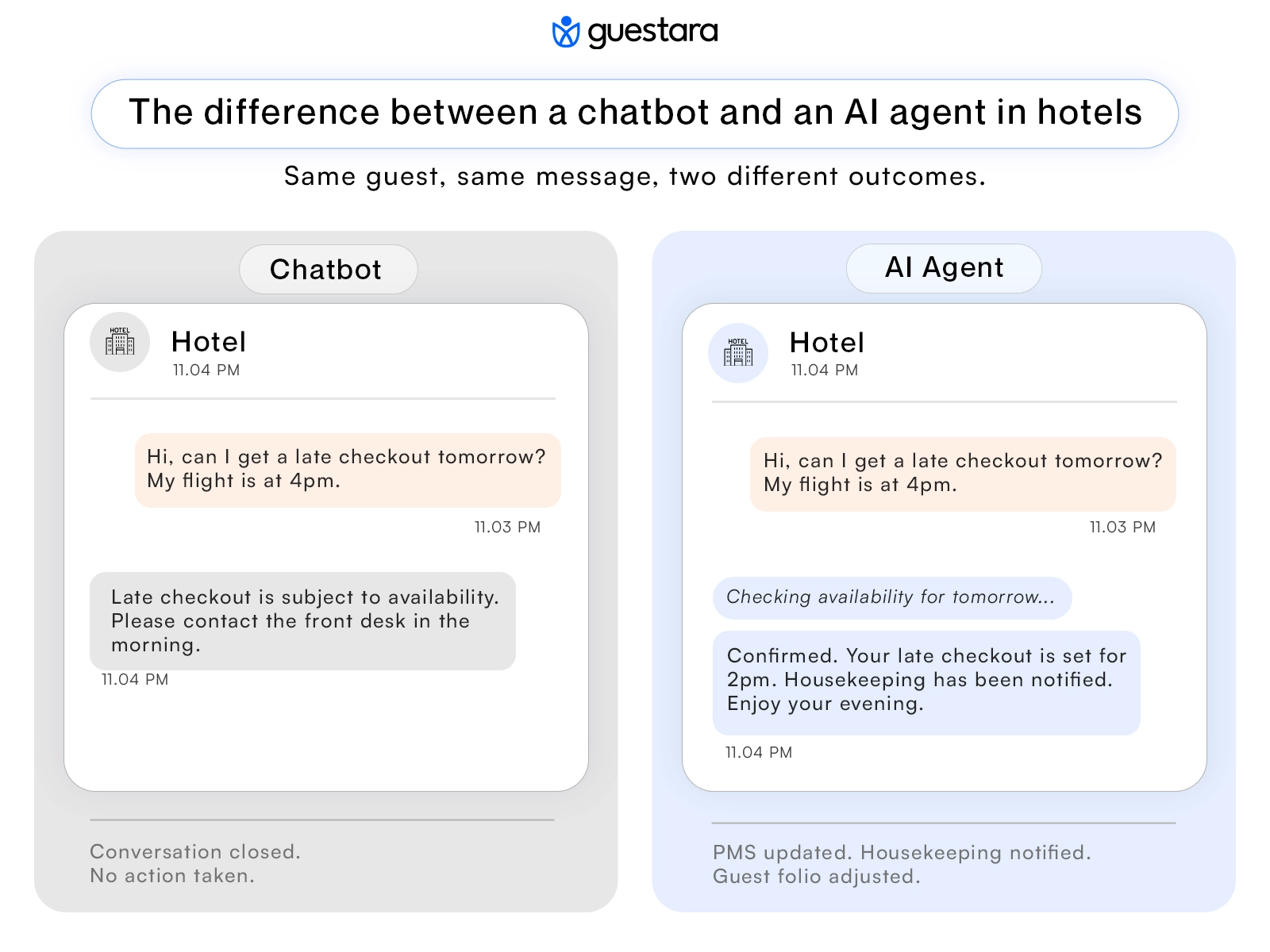
A guest sends a WhatsApp message at 11pm asking for a late checkout.
A chatbot reads the message. It looks at its trained answers. It replies, "Late checkout is subject to availability. Please contact the front desk in the morning."
The guest is annoyed. The front desk is closed. Nothing happened.
Now imagine the same message sent to an AI agent.
It reads the message. It checks the PMS for tomorrow's arrival schedule. It sees the room is not needed until 3pm. It validates the guest's loyalty tier. It approves the late checkout for 2pm. It updates housekeeping. It replies to the guest with a confirmation.
The guest never knew a human was not involved. The work got done.
This is the difference between a chatbot and an AI agent. And this is why the entire hotel industry is suddenly using the same word for the same shift in hotel AI: agentic AI.
Agentic AI for hospitality is the use of AI systems that can read live data, hold context across multiple steps, and take action across hotel systems without waiting for a human to tell them what to do.
A chatbot responds. An agent acts.
The shift sounds small. The operational impact is not.
A chatbot is built to answer questions. It has a script of responses, a knowledge base, and a single conversation thread. When the question goes outside its script, it escalates to a human or stalls.
An AI agent is built to complete tasks. It has access to your PMS, your CRM, your channel manager, your task board, and your communication tools. When a guest asks for something, it does not just answer. It evaluates, decides, executes, and reports back.
The reason every major hospitality vendor is suddenly using this language — Mews, IDC, BCG, Skift, Cloudbeds, SiteMinder is because the underlying hotel AI technology has finally caught up to the operational need. Hotels have been running 10% below pre-pandemic staffing for three years. Wages keep climbing. Guest expectations keep rising. The math no longer works without something filling the gap, and chatbots cannot fill it because they cannot do anything beyond reply.
If you have been deploying hotel technology for the last few years, you have probably already adopted some form of hotel AI. Most hotels have at least one of the following:
These are useful tools. None of them are agents.
The simplest test is this: can the system take action across more than one of your hotel platforms in a single workflow without human intervention?
A chatbot answering "what time is breakfast" is not agentic. The answer was prewritten and stored. The system did not look up anything live. It did not change anything in any other system.
An agent that reads "I need a late checkout, my flight is at 4pm" and then checks PMS availability, validates the guest's loyalty tier, approves the request, updates housekeeping, sends a confirmation, and logs the change in the guest profile — that is agentic.
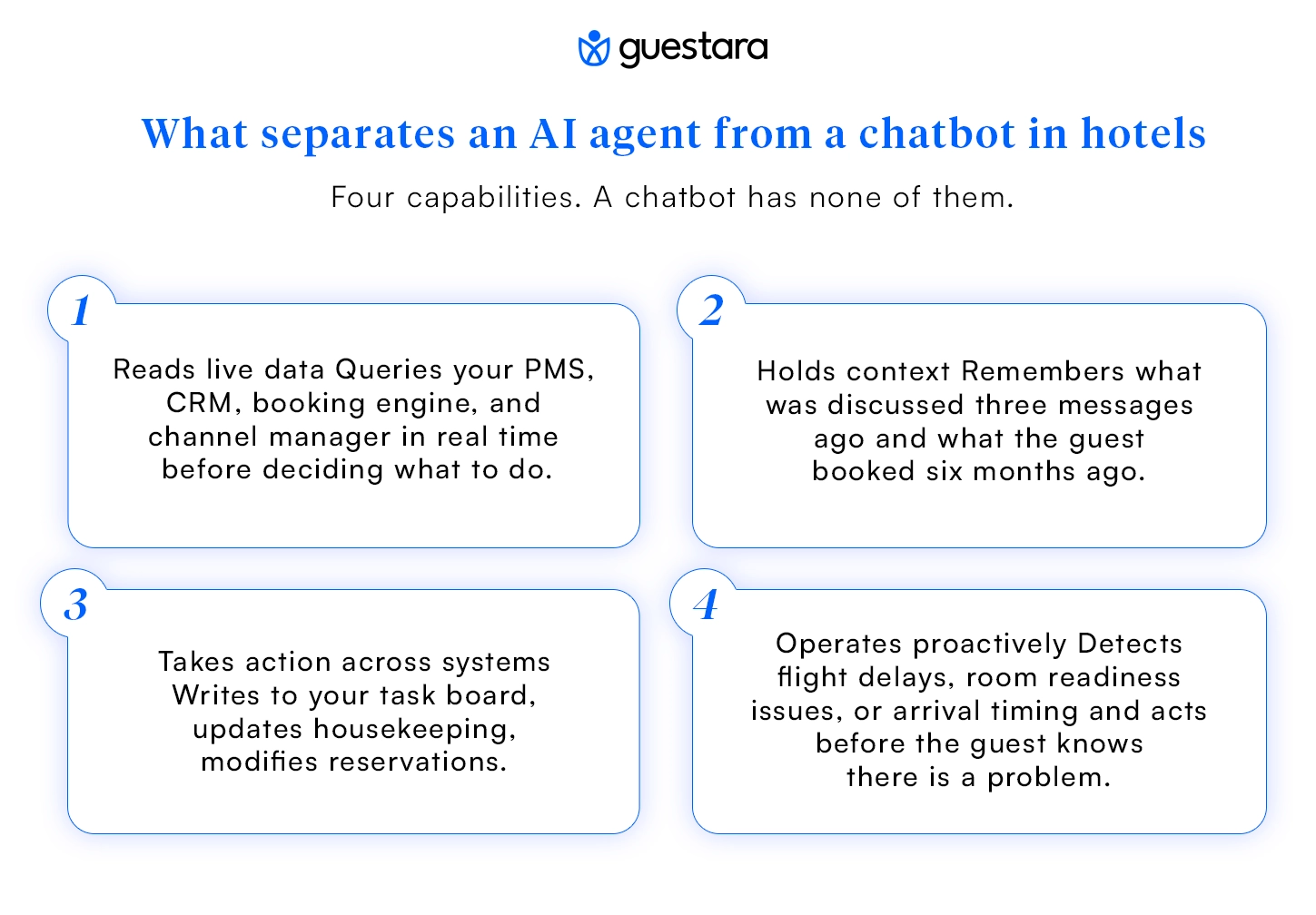
The difference comes down to four capabilities a chatbot does not have:
Most "AI" in hotels today fails three of these four tests.
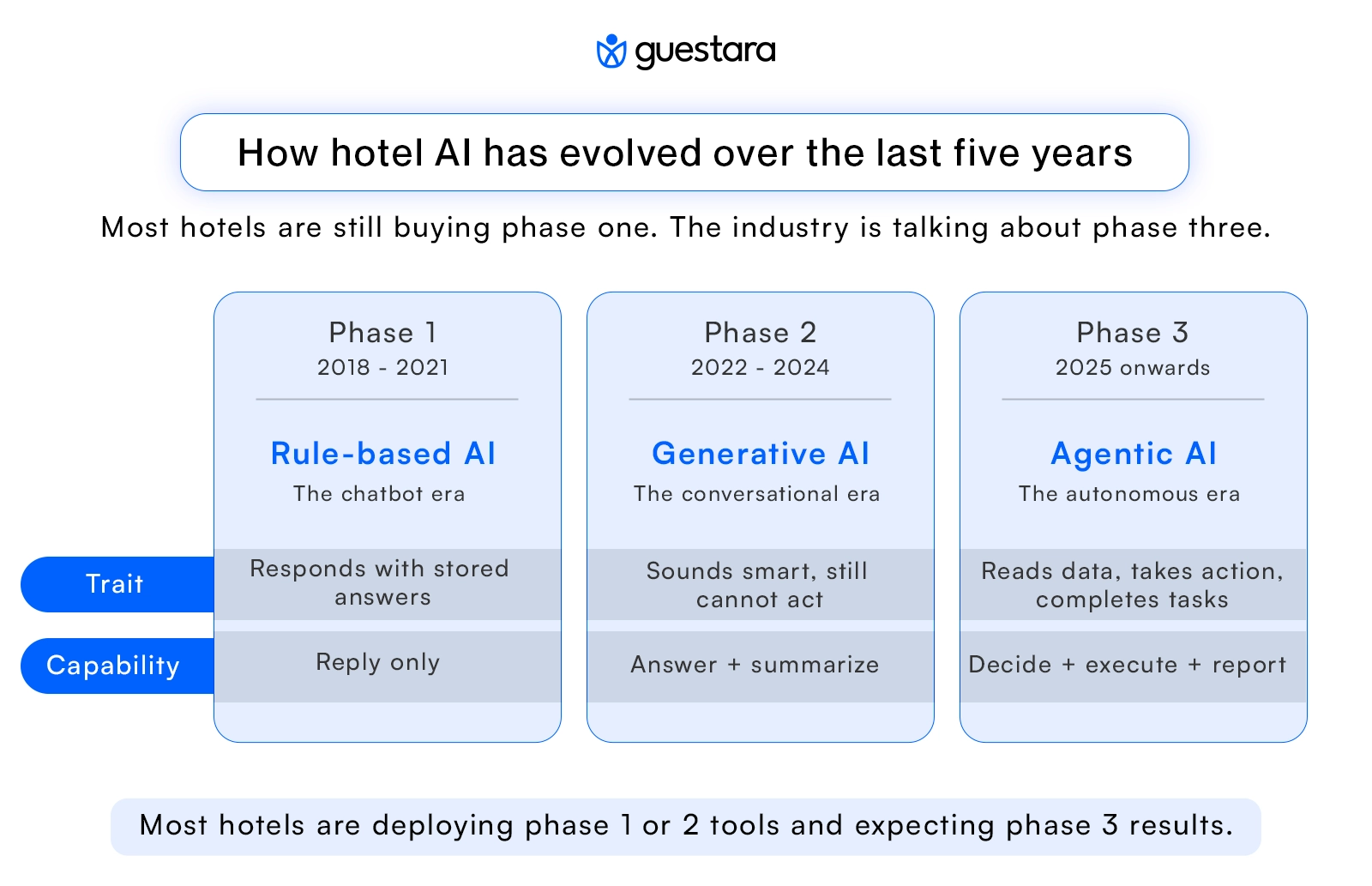
To understand why agentic AI matters, it helps to look at how hotel AI has actually progressed. The technology has gone through three distinct phases, and most properties are still stuck somewhere between phase one and phase two.
This was the era of the basic chatbot. If a guest asked a specific question, the system pulled a stored answer. There was no real intelligence — just a decision tree dressed up in a conversational interface. Most hotel AI deployments today still operate at this level, even when they are marketed as something more advanced.
The arrival of large language models changed what was possible. Chatbots became conversational, could handle questions outside their training, and could be trained on a hotel's specific property data. This is where most modern hotel AI tools sit today. They sound smart, but they still cannot do anything beyond reply.
This is the shift happening now. Hotel AI is moving from "answer the question" to "complete the task." The technology has the conversational fluency of phase two, but it can also read live data, take action across multiple hotel systems, and operate without human supervision for routine workflows.
The reason this matters is that most hotels are buying phase one or phase two tools and expecting phase three results. The vendor demo looks impressive. The actual implementation underwhelms. The gap between what hotel AI can do today and what most hotels have deployed is wider than any other technology gap in hospitality.
The hotels closing that gap fastest are not the ones with the biggest budgets. They are the ones who understand which phase of hotel AI they are actually buying.
A few data points explain why agentic AI moved from theory to deployment in the last 12 months.
The travel and hospitality sector saw agentic AI use grow at an average rate of 133% per month in the first half of 2025, according to data published by SiteMinder. That is not a curve. That is a step change.
IDC predicts that by 2030, 30% of travel bookings will be executed by AI agents. Mews's 2026 Hospitality Industry Outlook describes the next 12 months as the "make-or-break setup year" for hotels to get systems, data, and teams AI-ready. McKinsey's research on agentic AI in travel tracks the adoption shift directly: only 4% of the largest publicly traded travel companies mentioned AI in their 2022 annual reports. By 2024, that figure was 35%.
But the technology itself is not the only reason this is happening now. Three operational pressures are forcing the move.
US hotel employment is still 10% below pre-pandemic levels. The American Hotel and Lodging Association reports 65% of hotels are running with active staffing shortages. This is the structural pressure that makes agentic AI a near-necessity rather than a nice-to-have.
Research from Alice (covered by Hospitality Technology) found guests expect a response to text-based requests in under 12 minutes. Skift's reporting on hotel guest behavior confirms guests are no longer willing to wait for hotel responses to mobile messages. eHotelier's industry research and BCV's analysis of response time impact both reinforce the same finding: response speed has become a primary driver of guest satisfaction and review scores. Travelers using ChatGPT, Perplexity, and Gemini for trip planning have made this expectation worse, not better. A "please contact the front desk" reply at midnight feels broken in a way it did not three years ago. Agentic AI is the only realistic path to meeting these response times without doubling staff.
The data infrastructure has matured. PMS-CRM-channel manager integrations that were a custom IT project five years ago are now native features in modern hospitality platforms. Without that integration, agents cannot act. With it, they can.
This is the section most articles on this topic skip. They explain the theory and stop. Here are five workflows that are running in actual hotels today.
The guest sends a WhatsApp message asking for a late checkout. The agent checks tomorrow's arrival schedule for that room in the PMS. It confirms the room is not needed until 3pm. It validates the guest's loyalty tier or rate plan. It approves the late checkout, updates housekeeping with the new turn time, and replies to the guest with a confirmation.
What used to be a front desk task that required a phone call, a shift handover note, and a housekeeping update now happens in 30 seconds. Without anyone touching it. This is the kind of workflow mobile check-in and checkout systems make possible at scale.
A guest is 24 hours from check-in. The agent reads the booking history. It sees the guest stayed at the property a year ago and ordered room service three times. It checks the current restaurant menu for items similar to what they ordered last time. It sends a pre-arrival message in the guest's preferred language with a curated list of recommendations and a one-tap upsell offer for an early check-in.
The hotel did not have to brief the front desk on returning guests. The system handled it.
A flight tracker shows the guest's arrival flight is delayed by three hours. The agent detects the delay. It cross-references the guest's check-in time. It sends a proactive message offering a complimentary welcome drink at the bar and confirming the room will still be ready. It updates the front desk task board with a flag noting the late arrival. It adjusts housekeeping priority so a different room can be turned first.
The guest is greeted at the bar at 11pm by a staff member who already knows what happened. The hotel never had to react to a complaint, because there was nothing to complain about.
The agent monitors guest behavior during the stay. It notices the guest has not yet ordered anything from the restaurant or used the spa. It checks the booking duration and identifies the guest is on a leisure trip with a partner. It sends a contextual upsell offer for a couples' spa package at 4pm on day two of the stay. The booking is taken in-platform, the payment is processed, the spa is notified, and the guest sees the package added to their folio.
The upsell is not pushed at every guest. It is offered only when the data suggests it will land. Hotel upsell software built for agentic delivery is what makes this kind of contextual targeting possible.
The agent waits for the moment immediately after checkout. It sends a one-tap review request via WhatsApp. If the guest responds positively, it routes them to a public review platform. If the guest responds with a complaint, the message is intercepted before going public. The agent flags the issue on the task board, notifies the GM, and triggers a recovery workflow that the team can act on while the guest is still in the area.
Negative reviews that used to land on TripAdvisor before anyone at the hotel saw them now get resolved before they are public. Modern hotel review management is built around this exact intercept-and-recover pattern.
Agentic AI is not a single tool. It is a stack of capabilities that have to work together. Most hotels that try to deploy hotel AI agents fail because they buy a chatbot and expect it to behave like an agent.
There are four layers an actual agentic system needs.
The agent has to be able to query your PMS, your CRM, your channel manager, and your booking engine in real time. If your data lives in spreadsheets, paper logs, or systems that do not talk to each other, the agent cannot act. This is the layer most hotels skip and then wonder why their AI does not work.
This is the layer most hotels confuse for the entire system. Chatbots, AI receptionists, and unified guest messaging tools all sit here. They are necessary but not sufficient. Without the data layer below and the action layers above, a conversational interface is just a chatbot.
The agent needs somewhere to actually do the work. A task board, a workflow engine, or a routing system that can take the agent's decision and turn it into a real action — a room status update, a housekeeping ticket, a folio modification. Without this, the agent can only talk.
This is the brain. It decides which agent to invoke, what data to read, what action to take, and how to handle handoffs to humans. It is also the layer that learns and improves over time.
Most hospitality platforms today offer one or two of these layers. The platforms winning the agentic AI shift are the ones offering all four in a single integrated stack.
Not every guest interaction is a candidate for an AI agent. The hotels deploying this technology well are clear about where to draw the line.
A grieving family checking in for a funeral. A guest dealing with a medical emergency. A complaint that has already escalated. These are moments where the human touch is the entire point, and an agent that "handles" them efficiently is doing the wrong job well.
A handwritten welcome card. A personal recommendation from the GM. A surprise upgrade for an anniversary. These are the moments that earn five-star reviews. They should not be automated, even if they could be.
Should the hotel comp the meal? Should the upgrade be honored? Should the noise complaint be escalated? These are judgment calls. Agents can flag them and surface context, but the decision should sit with a human.
A guest who wants to understand the cancellation policy is fine talking to an agent. A guest who wants to argue about it should be talking to a human. Agents handle execution. Humans handle persuasion and trust.
The right model is not full automation. It is augmentation. The Anthropic Economic Index tracks this directly: 57% of AI-assisted tasks involve a human in the loop, and that share has been rising, not falling. The hotels getting agentic AI right are the ones that automate the work that does not need a human and protect the work that does.
If you are reading this and wondering where to start with hotel AI agents, the answer is not "deploy them everywhere." That is how implementations fail.
The pattern that works is narrow, measured, and progressive.
Pick a single guest interaction that happens often, has a clear outcome, and does not require human judgment. Late checkout requests. WiFi password questions. Restaurant booking confirmations. These are the entry points where an agent can deliver visible value in 30 days.
Time saved per request. Guest satisfaction scores. Front desk message volume. Without measurement, you cannot tell if the agent is helping or just adding a layer.
A common failure pattern is adding a second agent before the first one has been refined. Each new workflow adds complexity. Earn the right to expand.
Most platforms let you set agent decisions to "draft and require approval" before going fully autonomous. Use this. It builds trust, surfaces edge cases, and lets your team understand what the agent is doing before it does it without supervision.
Look at what it did, what it got right, and what it got wrong. This is the same review you would do with a new team member. Agents are no different.
The hotels deploying agentic AI well are not the ones with the most ambitious plans. They are the ones with the most disciplined first 90 days.
Most of the agentic AI conversation in 2026 is theoretical. The vendors writing about it are either consulting firms describing what is possible, or platforms with a single piece of the stack trying to position as the whole.
Guestara is built around the multi-layer architecture this post described. The AI Chatbot module sits in the conversational interface layer, trained on the hotel's actual property data and capable of escalating to humans when needed. The Unified Inbox aggregates messages from WhatsApp, OTAs, email, Instagram, and Facebook into a single thread the agent can read and act on. The Task Board sits in the execution layer with Access Control Logic that routes the agent's decisions to the right department automatically — a room upgrade goes to front desk, a food order goes to F&B, a maintenance issue goes to housekeeping.
The Engage module ties it together. Trigger-based message journeys read PMS booking data and fire automated workflows across WhatsApp, email, and SMS at the right moment in the guest journey. Late checkout requests, pre-arrival personalization, mid-stay upsell, and review collection — the five workflow examples earlier in this post — are not future scenarios. They are running on Guestara's infrastructure today.
The platforms that will define the next phase of hospitality technology are not the ones with the most "AI" in their marketing. They are the ones that quietly ship agents that do real work for real hotels. That is the work Guestara has been doing.
If you run a hotel and you are looking at all of this and feeling behind, do not panic. Most hotels are.
The honest read on where the hotel AI market is right now is that agentic AI is in its early-deployment phase. Maybe 5% of hotels have a real agent doing real work in production. Another 15% have something they call an agent that is closer to a chatbot with a wider knowledge base. The remaining 80% are still figuring out which vendor to talk to.
The window to be early is open for another 12 to 18 months. By 2027, having agents handling routine guest workflows will be table stakes. Hotels without them will feel as outdated as hotels without WiFi felt in 2015.
The path forward is not complicated. Pick one workflow. Deploy one agent. Measure the result. Expand carefully. Keep humans in the loop where the human matters.
The hotels that figure this out now will be the ones AI-driven travel agents recommend, the ones whose direct booking funnels actually work, and the ones whose staff stop doing the work that was never supposed to be done by humans in the first place.
If you want to see what an agentic AI deployment actually looks like inside a hotel, book a demo with Guestara. We will show you the workflows running in real properties, the data layer underneath them, and what the first 30 days of deployment looks like for a hotel starting from zero.


A practical guide to agentic AI for hospitality. Real examples, workflows, and how AI agents are replacing chatbots in 2026 hotel operations.
A guest sends a WhatsApp message at 11pm asking for a late checkout.
A chatbot reads the message. It looks at its trained answers. It replies, "Late checkout is subject to availability. Please contact the front desk in the morning."
The guest is annoyed. The front desk is closed. Nothing happened.
Now imagine the same message sent to an AI agent.
It reads the message. It checks the PMS for tomorrow's arrival schedule. It sees the room is not needed until 3pm. It validates the guest's loyalty tier. It approves the late checkout for 2pm. It updates housekeeping. It replies to the guest with a confirmation.
The guest never knew a human was not involved. The work got done.
This is the difference between a chatbot and an AI agent. And this is why the entire hotel industry is suddenly using the same word for the same shift in hotel AI: agentic AI.
Agentic AI for hospitality is the use of AI systems that can read live data, hold context across multiple steps, and take action across hotel systems without waiting for a human to tell them what to do.
A chatbot responds. An agent acts.
The shift sounds small. The operational impact is not.
A chatbot is built to answer questions. It has a script of responses, a knowledge base, and a single conversation thread. When the question goes outside its script, it escalates to a human or stalls.
An AI agent is built to complete tasks. It has access to your PMS, your CRM, your channel manager, your task board, and your communication tools. When a guest asks for something, it does not just answer. It evaluates, decides, executes, and reports back.
The reason every major hospitality vendor is suddenly using this language — Mews, IDC, BCG, Skift, Cloudbeds, SiteMinder is because the underlying hotel AI technology has finally caught up to the operational need. Hotels have been running 10% below pre-pandemic staffing for three years. Wages keep climbing. Guest expectations keep rising. The math no longer works without something filling the gap, and chatbots cannot fill it because they cannot do anything beyond reply.
If you have been deploying hotel technology for the last few years, you have probably already adopted some form of hotel AI. Most hotels have at least one of the following:
These are useful tools. None of them are agents.
The simplest test is this: can the system take action across more than one of your hotel platforms in a single workflow without human intervention?
A chatbot answering "what time is breakfast" is not agentic. The answer was prewritten and stored. The system did not look up anything live. It did not change anything in any other system.
An agent that reads "I need a late checkout, my flight is at 4pm" and then checks PMS availability, validates the guest's loyalty tier, approves the request, updates housekeeping, sends a confirmation, and logs the change in the guest profile — that is agentic.
The difference comes down to four capabilities a chatbot does not have:
Most "AI" in hotels today fails three of these four tests.
To understand why agentic AI matters, it helps to look at how hotel AI has actually progressed. The technology has gone through three distinct phases, and most properties are still stuck somewhere between phase one and phase two.
This was the era of the basic chatbot. If a guest asked a specific question, the system pulled a stored answer. There was no real intelligence — just a decision tree dressed up in a conversational interface. Most hotel AI deployments today still operate at this level, even when they are marketed as something more advanced.
The arrival of large language models changed what was possible. Chatbots became conversational, could handle questions outside their training, and could be trained on a hotel's specific property data. This is where most modern hotel AI tools sit today. They sound smart, but they still cannot do anything beyond reply.
This is the shift happening now. Hotel AI is moving from "answer the question" to "complete the task." The technology has the conversational fluency of phase two, but it can also read live data, take action across multiple hotel systems, and operate without human supervision for routine workflows.
The reason this matters is that most hotels are buying phase one or phase two tools and expecting phase three results. The vendor demo looks impressive. The actual implementation underwhelms. The gap between what hotel AI can do today and what most hotels have deployed is wider than any other technology gap in hospitality.
The hotels closing that gap fastest are not the ones with the biggest budgets. They are the ones who understand which phase of hotel AI they are actually buying.
A few data points explain why agentic AI moved from theory to deployment in the last 12 months.
The travel and hospitality sector saw agentic AI use grow at an average rate of 133% per month in the first half of 2025, according to data published by SiteMinder. That is not a curve. That is a step change.
IDC predicts that by 2030, 30% of travel bookings will be executed by AI agents. Mews's 2026 Hospitality Industry Outlook describes the next 12 months as the "make-or-break setup year" for hotels to get systems, data, and teams AI-ready. McKinsey's research on agentic AI in travel tracks the adoption shift directly: only 4% of the largest publicly traded travel companies mentioned AI in their 2022 annual reports. By 2024, that figure was 35%.
But the technology itself is not the only reason this is happening now. Three operational pressures are forcing the move.
US hotel employment is still 10% below pre-pandemic levels. The American Hotel and Lodging Association reports 65% of hotels are running with active staffing shortages. This is the structural pressure that makes agentic AI a near-necessity rather than a nice-to-have.
Research from Alice (covered by Hospitality Technology) found guests expect a response to text-based requests in under 12 minutes. Skift's reporting on hotel guest behavior confirms guests are no longer willing to wait for hotel responses to mobile messages. eHotelier's industry research and BCV's analysis of response time impact both reinforce the same finding: response speed has become a primary driver of guest satisfaction and review scores. Travelers using ChatGPT, Perplexity, and Gemini for trip planning have made this expectation worse, not better. A "please contact the front desk" reply at midnight feels broken in a way it did not three years ago. Agentic AI is the only realistic path to meeting these response times without doubling staff.
The data infrastructure has matured. PMS-CRM-channel manager integrations that were a custom IT project five years ago are now native features in modern hospitality platforms. Without that integration, agents cannot act. With it, they can.
This is the section most articles on this topic skip. They explain the theory and stop. Here are five workflows that are running in actual hotels today.
The guest sends a WhatsApp message asking for a late checkout. The agent checks tomorrow's arrival schedule for that room in the PMS. It confirms the room is not needed until 3pm. It validates the guest's loyalty tier or rate plan. It approves the late checkout, updates housekeeping with the new turn time, and replies to the guest with a confirmation.
What used to be a front desk task that required a phone call, a shift handover note, and a housekeeping update now happens in 30 seconds. Without anyone touching it. This is the kind of workflow mobile check-in and checkout systems make possible at scale.
A guest is 24 hours from check-in. The agent reads the booking history. It sees the guest stayed at the property a year ago and ordered room service three times. It checks the current restaurant menu for items similar to what they ordered last time. It sends a pre-arrival message in the guest's preferred language with a curated list of recommendations and a one-tap upsell offer for an early check-in.
The hotel did not have to brief the front desk on returning guests. The system handled it.
A flight tracker shows the guest's arrival flight is delayed by three hours. The agent detects the delay. It cross-references the guest's check-in time. It sends a proactive message offering a complimentary welcome drink at the bar and confirming the room will still be ready. It updates the front desk task board with a flag noting the late arrival. It adjusts housekeeping priority so a different room can be turned first.
The guest is greeted at the bar at 11pm by a staff member who already knows what happened. The hotel never had to react to a complaint, because there was nothing to complain about.
The agent monitors guest behavior during the stay. It notices the guest has not yet ordered anything from the restaurant or used the spa. It checks the booking duration and identifies the guest is on a leisure trip with a partner. It sends a contextual upsell offer for a couples' spa package at 4pm on day two of the stay. The booking is taken in-platform, the payment is processed, the spa is notified, and the guest sees the package added to their folio.
The upsell is not pushed at every guest. It is offered only when the data suggests it will land. Hotel upsell software built for agentic delivery is what makes this kind of contextual targeting possible.
The agent waits for the moment immediately after checkout. It sends a one-tap review request via WhatsApp. If the guest responds positively, it routes them to a public review platform. If the guest responds with a complaint, the message is intercepted before going public. The agent flags the issue on the task board, notifies the GM, and triggers a recovery workflow that the team can act on while the guest is still in the area.
Negative reviews that used to land on TripAdvisor before anyone at the hotel saw them now get resolved before they are public. Modern hotel review management is built around this exact intercept-and-recover pattern.
Agentic AI is not a single tool. It is a stack of capabilities that have to work together. Most hotels that try to deploy hotel AI agents fail because they buy a chatbot and expect it to behave like an agent.
There are four layers an actual agentic system needs.
The agent has to be able to query your PMS, your CRM, your channel manager, and your booking engine in real time. If your data lives in spreadsheets, paper logs, or systems that do not talk to each other, the agent cannot act. This is the layer most hotels skip and then wonder why their AI does not work.
This is the layer most hotels confuse for the entire system. Chatbots, AI receptionists, and unified guest messaging tools all sit here. They are necessary but not sufficient. Without the data layer below and the action layers above, a conversational interface is just a chatbot.
The agent needs somewhere to actually do the work. A task board, a workflow engine, or a routing system that can take the agent's decision and turn it into a real action — a room status update, a housekeeping ticket, a folio modification. Without this, the agent can only talk.
This is the brain. It decides which agent to invoke, what data to read, what action to take, and how to handle handoffs to humans. It is also the layer that learns and improves over time.
Most hospitality platforms today offer one or two of these layers. The platforms winning the agentic AI shift are the ones offering all four in a single integrated stack.
Not every guest interaction is a candidate for an AI agent. The hotels deploying this technology well are clear about where to draw the line.
A grieving family checking in for a funeral. A guest dealing with a medical emergency. A complaint that has already escalated. These are moments where the human touch is the entire point, and an agent that "handles" them efficiently is doing the wrong job well.
A handwritten welcome card. A personal recommendation from the GM. A surprise upgrade for an anniversary. These are the moments that earn five-star reviews. They should not be automated, even if they could be.
Should the hotel comp the meal? Should the upgrade be honored? Should the noise complaint be escalated? These are judgment calls. Agents can flag them and surface context, but the decision should sit with a human.
A guest who wants to understand the cancellation policy is fine talking to an agent. A guest who wants to argue about it should be talking to a human. Agents handle execution. Humans handle persuasion and trust.
The right model is not full automation. It is augmentation. The Anthropic Economic Index tracks this directly: 57% of AI-assisted tasks involve a human in the loop, and that share has been rising, not falling. The hotels getting agentic AI right are the ones that automate the work that does not need a human and protect the work that does.
If you are reading this and wondering where to start with hotel AI agents, the answer is not "deploy them everywhere." That is how implementations fail.
The pattern that works is narrow, measured, and progressive.
Pick a single guest interaction that happens often, has a clear outcome, and does not require human judgment. Late checkout requests. WiFi password questions. Restaurant booking confirmations. These are the entry points where an agent can deliver visible value in 30 days.
Time saved per request. Guest satisfaction scores. Front desk message volume. Without measurement, you cannot tell if the agent is helping or just adding a layer.
A common failure pattern is adding a second agent before the first one has been refined. Each new workflow adds complexity. Earn the right to expand.
Most platforms let you set agent decisions to "draft and require approval" before going fully autonomous. Use this. It builds trust, surfaces edge cases, and lets your team understand what the agent is doing before it does it without supervision.
Look at what it did, what it got right, and what it got wrong. This is the same review you would do with a new team member. Agents are no different.
The hotels deploying agentic AI well are not the ones with the most ambitious plans. They are the ones with the most disciplined first 90 days.
Most of the agentic AI conversation in 2026 is theoretical. The vendors writing about it are either consulting firms describing what is possible, or platforms with a single piece of the stack trying to position as the whole.
Guestara is built around the multi-layer architecture this post described. The AI Chatbot module sits in the conversational interface layer, trained on the hotel's actual property data and capable of escalating to humans when needed. The Unified Inbox aggregates messages from WhatsApp, OTAs, email, Instagram, and Facebook into a single thread the agent can read and act on. The Task Board sits in the execution layer with Access Control Logic that routes the agent's decisions to the right department automatically — a room upgrade goes to front desk, a food order goes to F&B, a maintenance issue goes to housekeeping.
The Engage module ties it together. Trigger-based message journeys read PMS booking data and fire automated workflows across WhatsApp, email, and SMS at the right moment in the guest journey. Late checkout requests, pre-arrival personalization, mid-stay upsell, and review collection — the five workflow examples earlier in this post — are not future scenarios. They are running on Guestara's infrastructure today.
The platforms that will define the next phase of hospitality technology are not the ones with the most "AI" in their marketing. They are the ones that quietly ship agents that do real work for real hotels. That is the work Guestara has been doing.
If you run a hotel and you are looking at all of this and feeling behind, do not panic. Most hotels are.
The honest read on where the hotel AI market is right now is that agentic AI is in its early-deployment phase. Maybe 5% of hotels have a real agent doing real work in production. Another 15% have something they call an agent that is closer to a chatbot with a wider knowledge base. The remaining 80% are still figuring out which vendor to talk to.
The window to be early is open for another 12 to 18 months. By 2027, having agents handling routine guest workflows will be table stakes. Hotels without them will feel as outdated as hotels without WiFi felt in 2015.
The path forward is not complicated. Pick one workflow. Deploy one agent. Measure the result. Expand carefully. Keep humans in the loop where the human matters.
The hotels that figure this out now will be the ones AI-driven travel agents recommend, the ones whose direct booking funnels actually work, and the ones whose staff stop doing the work that was never supposed to be done by humans in the first place.
If you want to see what an agentic AI deployment actually looks like inside a hotel, book a demo with Guestara. We will show you the workflows running in real properties, the data layer underneath them, and what the first 30 days of deployment looks like for a hotel starting from zero.
A chatbot answers questions using prewritten responses. An agentic AI system reads live data from your hotel platforms, makes decisions, and takes action across multiple systems without human input. A chatbot replies. An agent acts.
Yes, often more than chains do. Independent hotels with limited staff stand to gain the most because agents can take on tasks that would otherwise require additional hires. The technology is also becoming affordable enough that property size no longer determines access.
Real workflows running in hotels today include late checkout automation, pre-arrival personalization, flight delay response, mid-stay upsell, review collection, and recovery from negative feedback before it goes public. These are not theoretical. They are running on commercial platforms.
Most hotel AI today is single-purpose: a chatbot, a pricing tool, a revenue management engine. Agentic AI connects to multiple systems, holds context across interactions, and takes action across workflows. The test is whether the system can complete a task end-to-end without a human in the loop.
High-emotion guest situations, brand voice moments, ambiguous judgment calls, and conversations that require persuasion or empathy. Agents handle execution well. Humans handle trust, recovery, and meaningful guest moments better.
We work closely with the industry leaders to offer seamless solutions




We’re here to help your whole team stay ahead of the curve as you grow.

Get up and running quickly with a personalized onboarding plan

Connect with real people who really get it, 24/7

Checkout our vast library of free resources, templates and more
There's only so much we can say — so let us show you! Schedule a demo today and reach your business goals.


.webp)
.png)

